
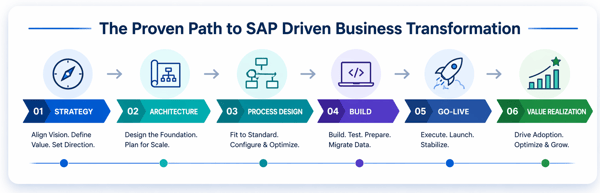
A Greenfield SAP Implementation gives your organization the opportunity to start fresh with a new SAP environment built around today’s business requirements—not yesterday’s limitations. Instead of carrying forward years of legacy customizations, outdated processes, and technical debt, a Greenfield approach allows you to redesign operations using current SAP best practices and a modern digital architecture.
For many organizations, this is more than a software project. It is a business transformation initiative. The decisions made during implementation can affect finance, supply chain, manufacturing, sales, reporting, compliance, and long-term scalability for years to come.
That is why success requires more than software licenses or technical resources. It requires experienced SAP project leadership, skilled architects, functional experts, a practical implementation roadmap, and disciplined execution from start to go-live and beyond.
We help clients plan and execute Greenfield SAP Implementations using proven project management methods, SAP Activate, and the right combination of business and technical expertise.
Complete the Form to Request a Consultation
Free Download: Top 10 SAP Project Management Tips when you complete the form.
Build Your New SAP Environment the Right Way
A new SAP system can create major competitive advantages—but only when it is designed and implemented correctly from the beginning. A Greenfield project gives your organization a rare chance to rethink processes, simplify operations, improve reporting, and align technology with business goals. It is often the cleanest path to long-term value.
It is also where expensive mistakes are made.
Poor scope definition, weak governance, inexperienced resources, rushed timelines, and unclear decision-making can create delays, budget overruns, user resistance, and years of avoidable rework. Many implementation problems are not caused by SAP itself. They are caused by planning and execution failures.
The right approach starts before configuration begins. It starts with a clear business case, measurable objectives, executive sponsorship, realistic planning, and the right delivery team. From there, proven methodology, strong project controls, and accountable leadership keep the program on track.
We help clients build new SAP environments with both strategy and execution in mind—so the system you launch is one the business can actually use, scale, and benefit from.
What Is a Greenfield SAP Implementation?
A Greenfield SAP Implementation is the deployment of a new SAP system in a newly designed environment rather than converting an existing one. In practical terms, it means building the future-state solution from the ground up based on current business needs, strategic goals, and modern SAP capabilities.
Instead of inheriting years of old custom code, outdated workflows, duplicate data structures, or process workarounds, the organization can evaluate what should be kept, what should be improved, and what should be eliminated. That freedom is one of the biggest advantages of a Greenfield approach.
This model is often the best fit for companies that are replacing legacy ERP systems, consolidating multiple systems after mergers or acquisitions (or doing a carve-out) , standardizing global operations, or using the move to SAP as part of a broader transformation program.
A successful Greenfield implementation does not mean starting with a blank sheet of paper and improvising. It means using proven SAP standards where they make sense, making smart design decisions where differentiation matters, and executing the program with discipline.
When done well, the result is a cleaner foundation, better processes, stronger data integrity, and a system built to support future growth.
Greenfield vs Brownfield vs Hybrid: Which SAP Path Fits Your Business?
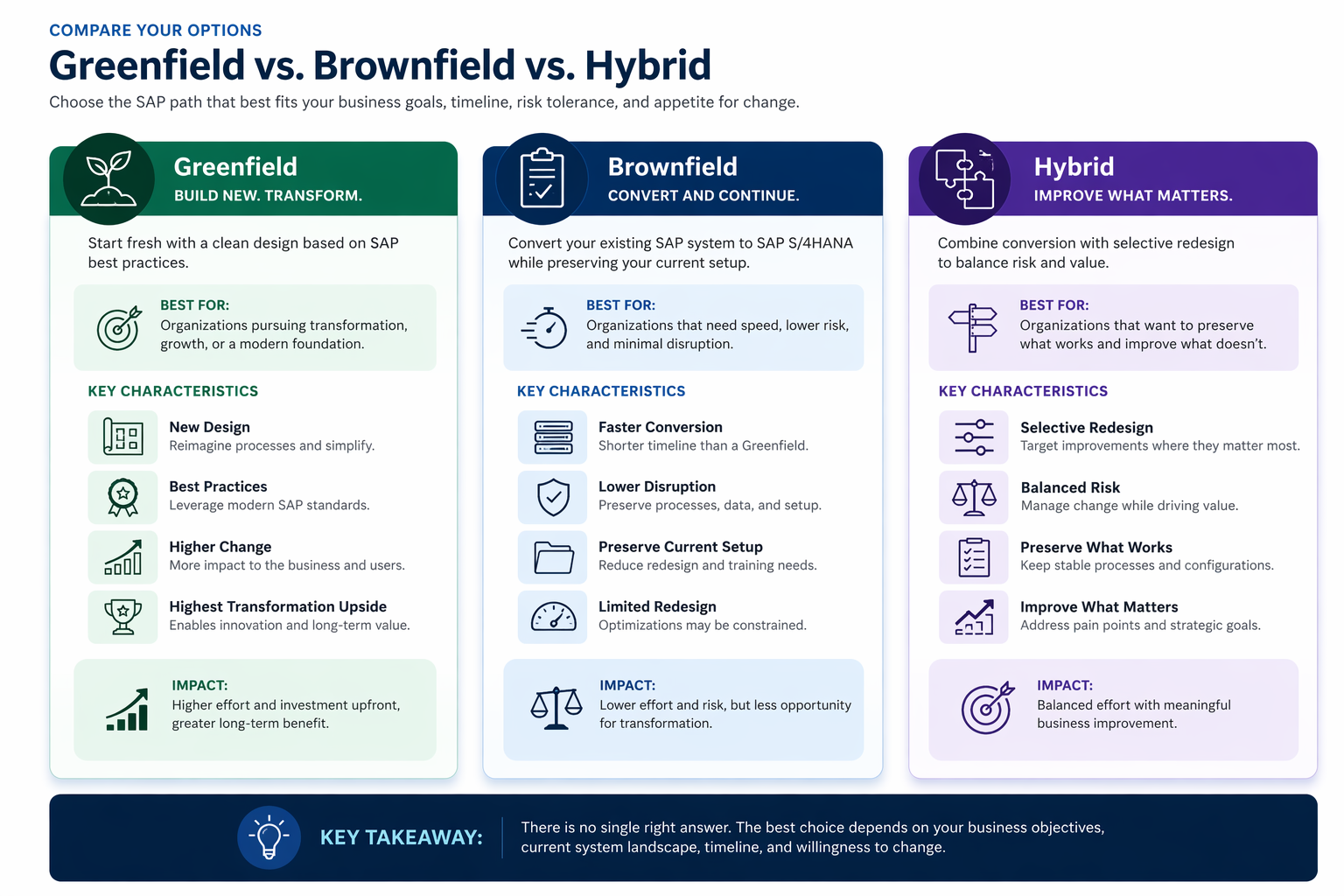
Not every SAP journey should follow the same path. One of the most important early decisions is choosing the right implementation model. The answer depends on your current systems, business goals, timeline, appetite for change, internal capabilities, and how much value you believe is trapped inside existing processes.
A Greenfield approach is ideal when the goal is transformation. A Brownfield approach is often chosen when speed and continuity matter most. A Hybrid approach can be the best option when some parts of the business need redesign while others should be preserved.
The right choice is not the one that sounds most fashionable. It is the one that best aligns with business reality and execution capacity. We help clients evaluate these options honestly before major investment decisions are made.
Greenfield Implementation
Build a new SAP environment using redesigned processes and current best practices. Best suited for organizations seeking major operational improvement, simplification, or strategic change.
Brownfield Implementation
Convert an existing SAP environment to a newer platform while preserving much of the current configuration and process design. Often selected when disruption must be minimized or timelines are compressed.
Hybrid Implementation
Combine selective migration with targeted redesign. Keep what still creates value, improve what does not, and prioritize change where business impact is highest.
Why SAP Projects Succeed or Fail
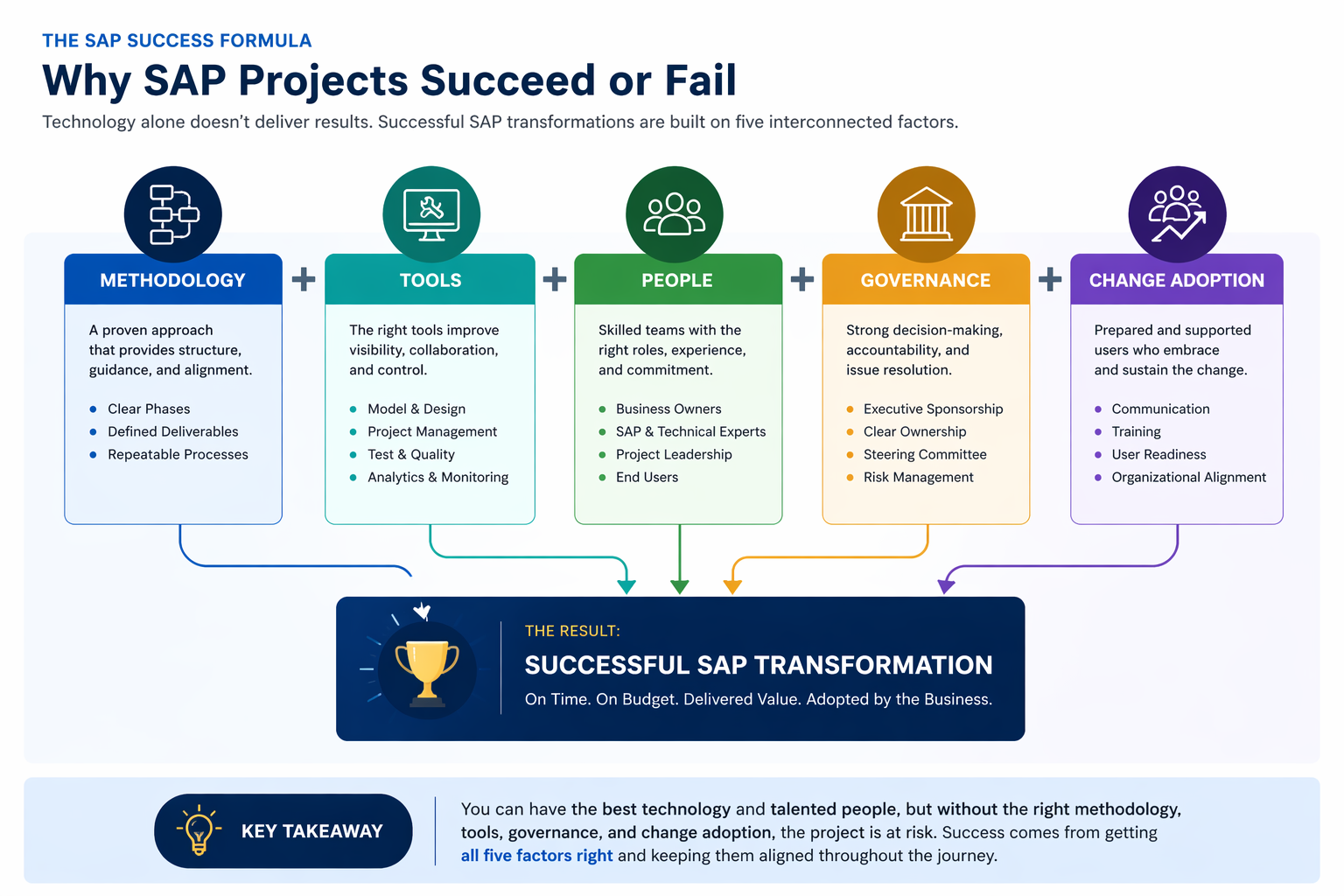
SAP projects rarely succeed or fail because of software alone. The platform is powerful, proven, and used by organizations around the world. Outcomes are usually determined by how the project is led, how decisions are made, how well the business is prepared, and whether the delivery team has the experience to execute under real-world conditions.
Many troubled projects follow the same pattern: unclear objectives, weak governance, slow decisions, underqualified resources, unrealistic schedules, poor testing discipline, and resistance to process change. These issues compound over time until timelines slip, budgets expand, and confidence drops.
Successful projects tend to look different. Leadership defines measurable goals. Governance is active. The right people are assigned. Risks are surfaced early. Trade-offs are made quickly. Users are engaged. Testing is taken seriously. Go-live is treated as a business event, not just a technical milestone.
Methodology matters. Tools matter. Talent matters. Client readiness matters. When those elements work together, SAP can become a major business advantage. When they do not, even a well-funded program can struggle.
That is why we focus not only on what will be implemented, but on how the implementation will actually be delivered.
Methodology: SAP Activate
Modern SAP implementations need a structured delivery model. SAP Activate is the current SAP implementation methodology designed to help organizations move from planning to go-live with greater speed, control, and clarity. It combines proven project governance, fit-to-standard design principles, guided configuration, and agile delivery practices.
One of the biggest shifts in SAP Activate is the focus on adopting standard SAP processes wherever practical rather than recreating every legacy process from the past. That approach can reduce complexity, lower long-term support costs, and speed implementation timelines.
SAP Activate is typically organized into phases such as Discover, Prepare, Explore, Realize, Deploy, and Run. Each phase has clear objectives, deliverables, and decision points. When properly managed, this creates better visibility for executives and stronger control for the project team.
Methodology alone does not guarantee success. It still requires experienced leadership, capable functional and technical resources, active business participation, and disciplined project management. But without a strong methodology, even talented teams can lose direction.
We help clients apply SAP Activate in a practical way—keeping the structure strong while adapting execution to the realities of the business.
Tools: LeanIX, Cloud ALM, Signavio, Microsoft Project or Jira
Modern SAP programs benefit from a connected toolset that improves visibility, coordination, and execution discipline. These platforms can accelerate planning, reduce blind spots, and help teams manage complexity across business and technical workstreams.
SAP LeanIX helps organizations understand their application landscape, technology dependencies, and enterprise architecture choices. This is especially valuable when deciding what to retire, what to integrate, and how the future-state environment should be structured.
SAP Signavio supports process discovery, process analysis, and process redesign. It helps leadership and project teams understand how work is done today, where friction exists, and where standardization or improvement should occur before the new system is built.
SAP Cloud ALM provides implementation governance, testing support, task management, issue tracking, and operational monitoring. It is an important platform for managing delivery and supporting the system after go-live.
Detailed execution still requires strong project scheduling and resource management. That is where tools such as Microsoft Project or Jira can play an important role. My preference remains Microsoft Project because a properly built schedule is still one of the strongest control mechanisms on a complex program.
Tools can improve outcomes, but tools do not replace experienced judgment. They are most effective when used by people who understand both the technology and the realities of SAP delivery.
People: Project Managers, Architects, Functional Experts, Client Leaders
Every successful SAP implementation is ultimately delivered by people. Methodology and tools are important, but they do not make decisions, solve conflicts, manage risk, or earn user trust. Experienced people do.
Strong project management provides direction, governance, scheduling discipline, escalation control, and accountability across the full program. On complex initiatives, this role often determines whether the project stays coordinated or begins to drift.
Enterprise architects help shape the future-state landscape, integration model, data strategy, security approach, and long-term scalability of the solution. Good architecture decisions made early can prevent expensive problems later.
Functional and technical consultants translate business requirements into workable SAP solutions across each track—finance, supply chain, procurement, manufacturing, sales, analytics, integrations, and more. Depth of experience matters because configuration choices made during design often have downstream consequences.
Client leadership is equally important. Executive sponsors, process owners, and business decision-makers must stay engaged, remove roadblocks, prioritize trade-offs, and lead organizational adoption. No consulting team can substitute for committed client ownership.
The strongest SAP programs are partnerships: experienced implementation specialists working alongside empowered client leaders with clear business goals.
Change Management and Business Adoption
Many SAP projects are technically successful and operationally disappointing. The system goes live, transactions process, reports run, and integrations work—yet the expected business value never fully appears. The missing link is often change management.
New systems change how people work. Roles shift. Approvals change. Data ownership becomes clearer. Old shortcuts disappear. New controls are introduced. Metrics become visible. Even positive change can create resistance if people do not understand why it is happening or how to succeed in the new environment.
Effective change management starts early, not near go-live. It includes stakeholder alignment, clear communication, leadership visibility, role readiness, training, super-user development, adoption planning, and reinforcement after launch.
Business adoption should be treated as a measurable workstream, not a side activity. If users avoid the new process, rely on spreadsheets, create workarounds, or delay key transactions, the organization pays for the system without receiving the full return.
We help clients approach implementation as both a technology program and a people transition—because real transformation happens when the business changes behavior, not just software.
Our SAP Activate Delivery Approach
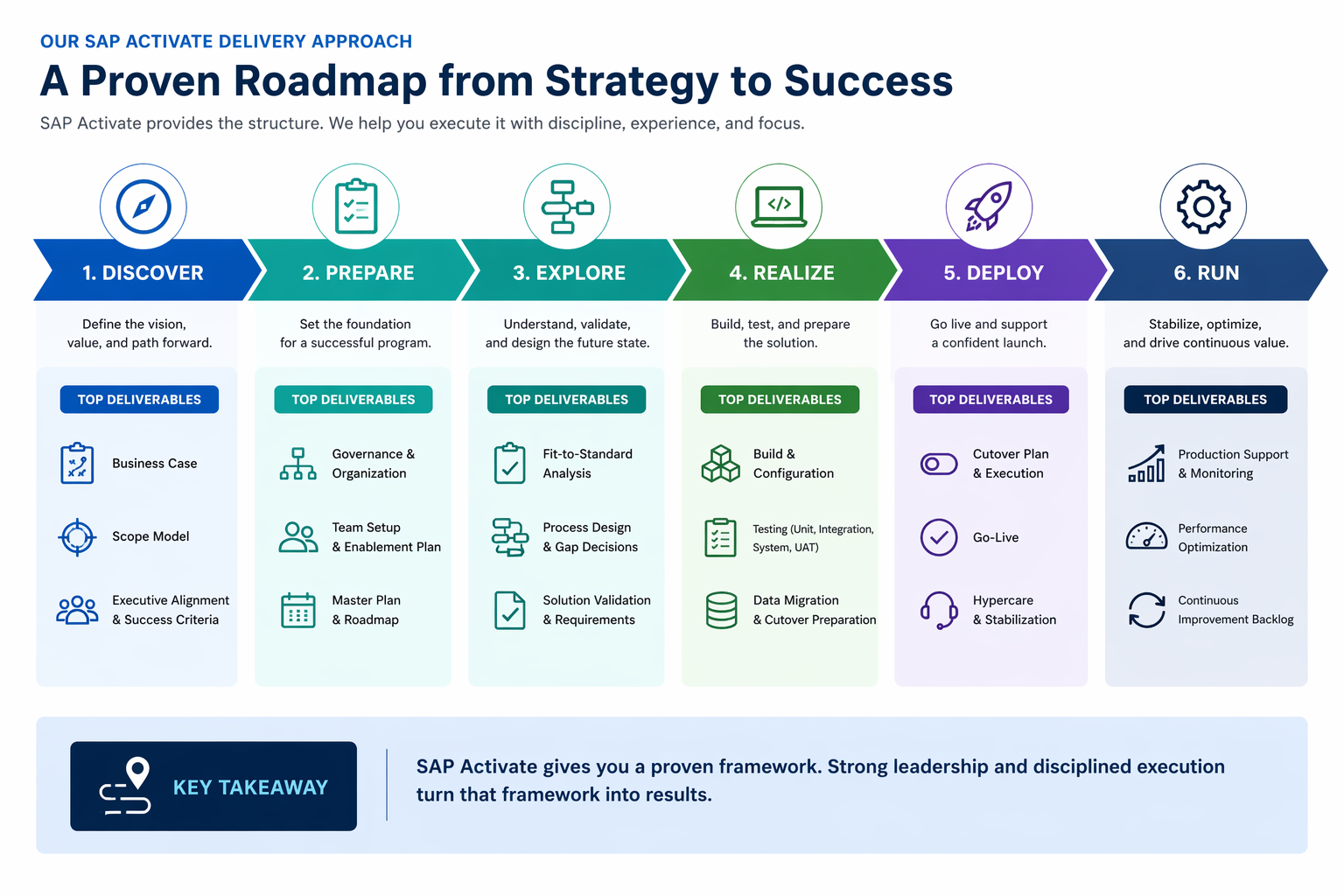
A successful SAP program needs more than effort and good intentions. It needs a clear roadmap, defined decision points, accountable ownership, and disciplined execution from start to finish. SAP Activate provides that structure, and we help clients apply it in a practical, results-focused way.
Each phase of the program should reduce uncertainty, improve readiness, and move the business closer to measurable value. The goal is not to create unnecessary bureaucracy. The goal is to make sure critical decisions are made at the right time, risks are managed early, and the organization is prepared for go-live.
Below is a high-level view of the SAP Activate journey and how we support clients through each stage.
Discover
The Discover phase is where the business case is established and the direction of the program begins to take shape. Before budgets are approved and teams are mobilized, leadership should be clear on why the project is being undertaken, what outcomes matter most, and how success will be measured.
This phase often includes executive alignment, current-state assessment, high-level scope definition, transformation priorities, deployment model discussions, and early evaluation of Greenfield, Brownfield, or Hybrid options. It is also the right time to consider RISE with SAP, operating model impacts, and major organizational dependencies.
Good work in Discover prevents costly confusion later. When objectives are vague at the start, every later decision becomes harder.
We help clients turn broad ambitions into a practical business case and a realistic path forward.
Prepare
The Prepare phase turns strategy into an executable program. Governance structures are established, the project team is assembled, roles are clarified, timelines are developed, environments are planned, and the operating cadence of the program begins.
This is where strong project controls become essential. A realistic integrated schedule, clear reporting structure, risk management process, issue escalation path, and decision framework should be in place before the project reaches full speed. When these foundations are weak, problems multiply quickly once design and build activities intensify.
Prepare is also the time to confirm resource commitments from both the client and consulting team. Many projects are delayed not because of technical difficulty, but because key people were never truly available.
We help clients build a delivery model that is organized, accountable, and ready for serious execution.
Explore
The Explore phase is where future-state business processes are designed and key solution decisions are made. Through fit-to-standard workshops, leadership and process owners evaluate how SAP works out of the box, where standard processes should be adopted, and where carefully justified gaps require additional design.
This phase is critical because many cost, timeline, and complexity outcomes are set here. Good decisions simplify the program. Poor decisions create custom development, testing burden, support challenges, and long-term technical debt.
Explore should include active participation from business owners, not just IT or consultants. The people responsible for running the business must help shape how the future process will operate.
Clear documentation, disciplined decision-making, and fast resolution of open items keep momentum strong during this stage.
We help clients lead productive workshops, make sound design choices, and balance business needs with implementation practicality.
Realize
The Realize phase is where approved designs are turned into a working solution. Configuration is completed, developments are built, integrations are connected, data migration objects are prepared, security roles are refined, and formal testing begins at increasing levels of depth.
This is often the busiest phase of the program because multiple workstreams are moving at the same time. Without disciplined coordination, one delay can quickly affect several others. Strong dependency management, clear ownership, and visible progress tracking are essential.
Quality matters here. Defects found early are cheaper to fix than defects discovered during cutover or after go-live. That is why unit testing, integration testing, user acceptance testing, and readiness checks should be planned seriously rather than treated as milestones to rush through.
Realize is also when leadership needs honest reporting. It is better to surface risks while there is still time to act than to protect status reporting and create surprises later.
We help clients keep execution organized, risks visible, and quality standards high as the solution moves toward launch.
Deploy
The Deploy phase is where planning meets reality. Final data migration is executed, cutover activities are completed, users transition to the new system, support teams are activated, and the organization moves from project mode into live operations.
A successful go-live is rarely the result of last-minute effort. It is usually the outcome of months of preparation, realistic readiness assessments, disciplined testing, contingency planning, and clear accountability across every workstream.
Cutover should be managed like a mission-critical event. Tasks need owners, timing needs control, dependencies must be understood, and escalation paths must be active. Small mistakes during this window can create outsized business impact.
Deploy also requires strong business coordination. Finance closes still need to happen. Orders still need to ship. Procurement still needs to buy. Customer commitments do not pause because a project reaches go-live weekend.
We help clients execute cutover with structure, manage go-live risk, and stabilize operations quickly after launch.
Run
Go-live is important, but it is not the finish line. The Run phase is where the organization begins capturing the long-term value of its SAP investment through stable operations, user adoption, continuous improvement, and disciplined governance after launch.
In the early period after go-live, attention is usually focused on stabilization. Issues are resolved, users gain confidence, support processes mature, and performance is closely monitored. Fast response during this stage can protect credibility and reduce disruption.
Once the environment is stable, leadership can shift attention to optimization. That may include process refinement, reporting enhancements, automation opportunities, additional functionality, training improvements, and stronger use of data for decision-making.
Organizations that treat go-live as the end of the journey often leave value on the table. The strongest performers continue improving the system as the business evolves.
We help clients move beyond implementation mode and build a practical roadmap for ongoing SAP success.
The Modern SAP Tool Chain for SAP Implementations
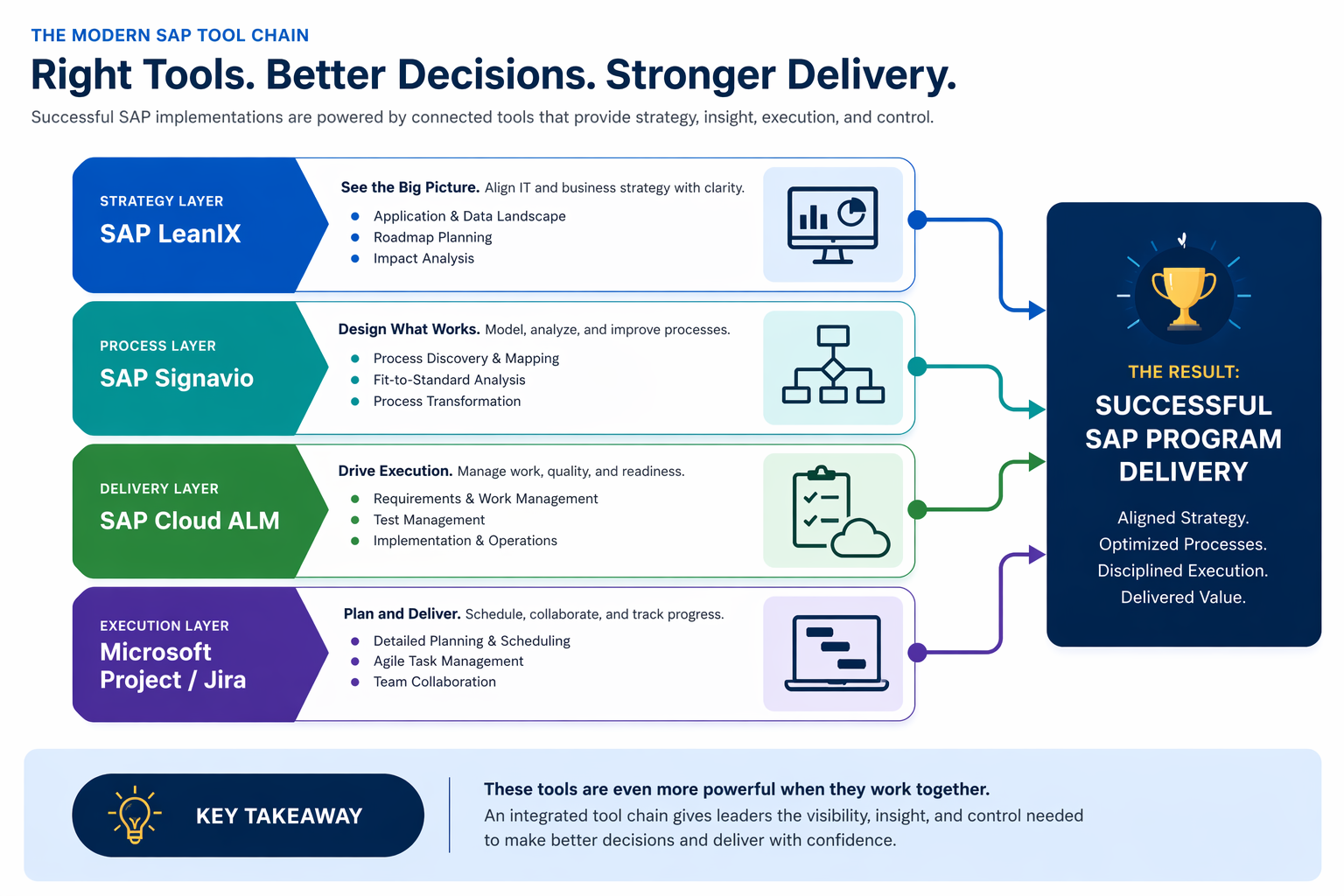
Large SAP programs generate thousands of tasks, decisions, dependencies, requirements, test cases, process changes, and architectural choices. Trying to manage all of that through email threads and disconnected spreadsheets creates unnecessary risk.
The modern SAP tool chain helps bring structure, visibility, and control to complex implementations. Used properly, these platforms improve planning quality, decision-making speed, stakeholder alignment, and execution discipline across the life of the program.
Different tools serve different purposes. Some focus on enterprise architecture. Some focus on process excellence. Some focus on implementation governance and operations. Others help manage schedules, resources, and day-to-day delivery execution.
Technology alone is not the answer. A poor plan inside a good tool is still a poor plan. But when the right tools are paired with experienced leadership, they can significantly improve project outcomes.
Below are several important platforms used on modern SAP initiatives.
SAP LeanIX
SAP LeanIX helps organizations understand their current application landscape and design a smarter future-state architecture. Many companies operate with overlapping systems, unclear ownership, redundant tools, and integration complexity that has grown over time. Those issues often become visible during an SAP transformation.
LeanIX provides a structured way to map applications, business capabilities, interfaces, technology dependencies, and lifecycle risk. This gives leadership better insight into what should be retained, consolidated, replaced, integrated, or retired as part of the program.
For Greenfield initiatives, that visibility is valuable because implementation decisions should support the long-term enterprise model, not just immediate project needs. Architecture choices made early can affect cost, agility, support effort, and scalability for years.
We help clients use architecture thinking practically—connecting system decisions to business priorities rather than creating documentation for its own sake.
SAP Signavio
SAP Signavio helps organizations understand how work is performed today and how it should be improved in the future. Many companies know they need a new system, but they do not always have a clear picture of where process delays, handoff problems, rework, or unnecessary complexity are actually occurring.
Signavio supports process discovery, process modeling, collaboration, and continuous improvement. It can help leadership compare current processes against desired outcomes and identify where standardization, simplification, automation, or stronger controls would create measurable value.
This is especially important in Greenfield programs because redesign decisions should be based on evidence, not assumptions. If poor processes are simply recreated inside a new system, the organization changes software without improving performance.
Used well, process tools help align business stakeholders, reduce debate, and focus implementation energy on the changes that matter most.
We help clients connect process improvement efforts to practical SAP execution so transformation goals become operational results.
SAP Cloud ALM
SAP Cloud ALM is SAP’s modern platform for implementation governance, application lifecycle management, and operational monitoring. It is designed to support organizations during deployment and after go-live through a more connected and transparent way of managing work.
During implementation, Cloud ALM can support task tracking, testing coordination, issue management, deployment readiness, and project visibility across teams. This helps leaders understand progress, identify blockers earlier, and maintain stronger control over execution.
After launch, the platform can also support monitoring, operations, alerting, and continuous improvement activities. That makes it useful beyond the project itself.
For many organizations, the real value of Cloud ALM is not the software feature list. It is the ability to replace fragmented status reporting and scattered control processes with a more disciplined operating model.
We help clients use Cloud ALM as a management tool—not just another system to maintain.
Microsoft Project or Jira
Even with modern SAP platforms in place, large implementations still require detailed day-to-day execution management. Dependencies must be sequenced, resources must be allocated, milestones must be tracked, and leadership needs a realistic view of what is ahead—not just what already happened.
That is where project management tools such as Microsoft Project or Jira remain important. Each can be effective when used correctly. The best choice often depends on delivery style, organizational culture, reporting needs, and the level of schedule discipline required.
My preference remains Microsoft Project. On complex programs, a properly built integrated schedule can become one of the strongest control mechanisms available. It helps expose dependencies, forecast timing impacts, support scenario planning, and create accountability across workstreams.
Jira can also be valuable, particularly where agile delivery methods, backlog management, and fast-moving development teams are central to the program.
The tool matters less than the quality of the planning. But strong planning supported by the right tool can materially improve execution confidence.
Why Experienced SAP Project Leadership Matters
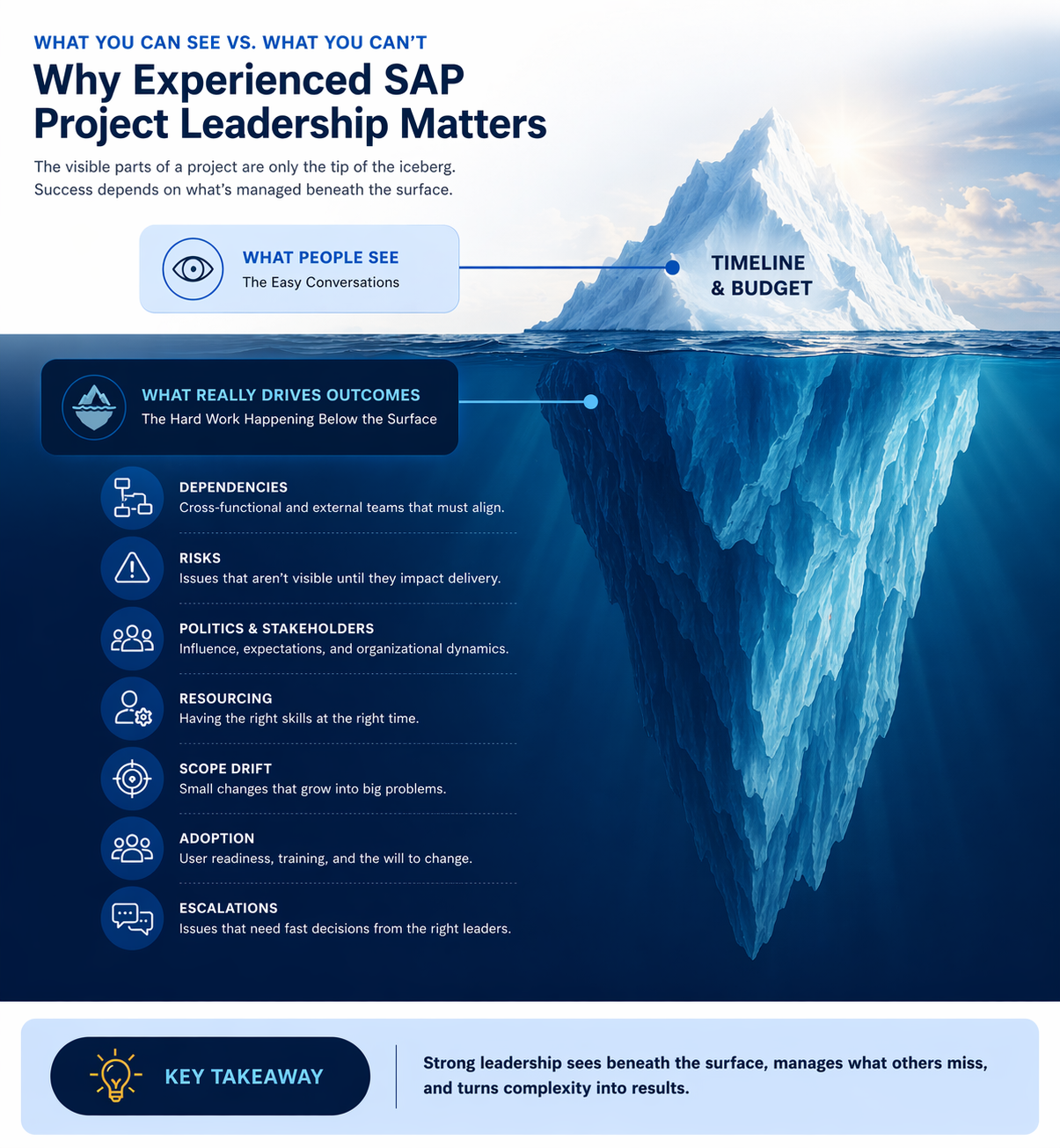
An SAP implementation can involve millions in investment, cross-functional disruption, executive visibility, operational risk, and decisions that shape the business for years. In that environment, project leadership is not an administrative role. It is a value-protection role.
Experienced leadership brings pattern recognition. Risks are seen earlier. Weak assumptions are challenged sooner. Unrealistic timelines are corrected before they become public commitments. Resource gaps are identified before they damage delivery. Escalations are handled before they become crises.
It also brings decision discipline. Large programs generate constant trade-offs involving scope, timing, cost, quality, customization, staffing, and business readiness. Inexperienced teams often delay these decisions or solve them politically. Experienced leaders solve them in a way that protects the outcome.
Strong SAP project leadership also creates alignment. Executives need clear reporting. Workstream leads need coordination. Consultants need direction. Business users need confidence. Vendors need accountability. Without leadership, each group moves in its own direction.
I have led and supported dozens of complex initiatives across industries. One lesson repeats itself: troubled projects usually do not fail all at once. They fail gradually through unmanaged details, delayed decisions, unclear ownership, and avoidable surprises.
The right leader changes that trajectory.
If your SAP program matters financially, operationally, or strategically, experienced project leadership is not overhead. It is one of the smartest investments on the project.
What Clients Need to Bring to the Table
A successful SAP implementation is not something done to a client. It is something achieved with a client. Even the strongest consulting team cannot compensate for missing executive engagement, slow decisions, unclear ownership, or a business that is unwilling to adapt.
One of the most important responsibilities of project leadership is educating client executives on how the implementation methodology actually works and why it matters. Senior leaders do not need to become SAP specialists, but they do need to understand the phases of the program, major decision gates, resource demands, testing expectations, change management requirements, and the consequences of delayed decisions.
When executives understand the implementation model, they make better decisions, remove blockers faster, fund the right priorities, and set realistic expectations across the organization. When they do not, they may unintentionally create risk by forcing shortcuts, underestimating effort, or expecting results out of sequence.
Clients also need committed process owners, available subject matter experts, timely participation in workshops, ownership of data decisions, and visible sponsorship of organizational change. These are not side tasks. They are core delivery requirements.
The best SAP programs operate as a partnership: experienced implementation leaders guiding the journey, and informed client leadership actively helping drive it forward.
Project Steering Committee
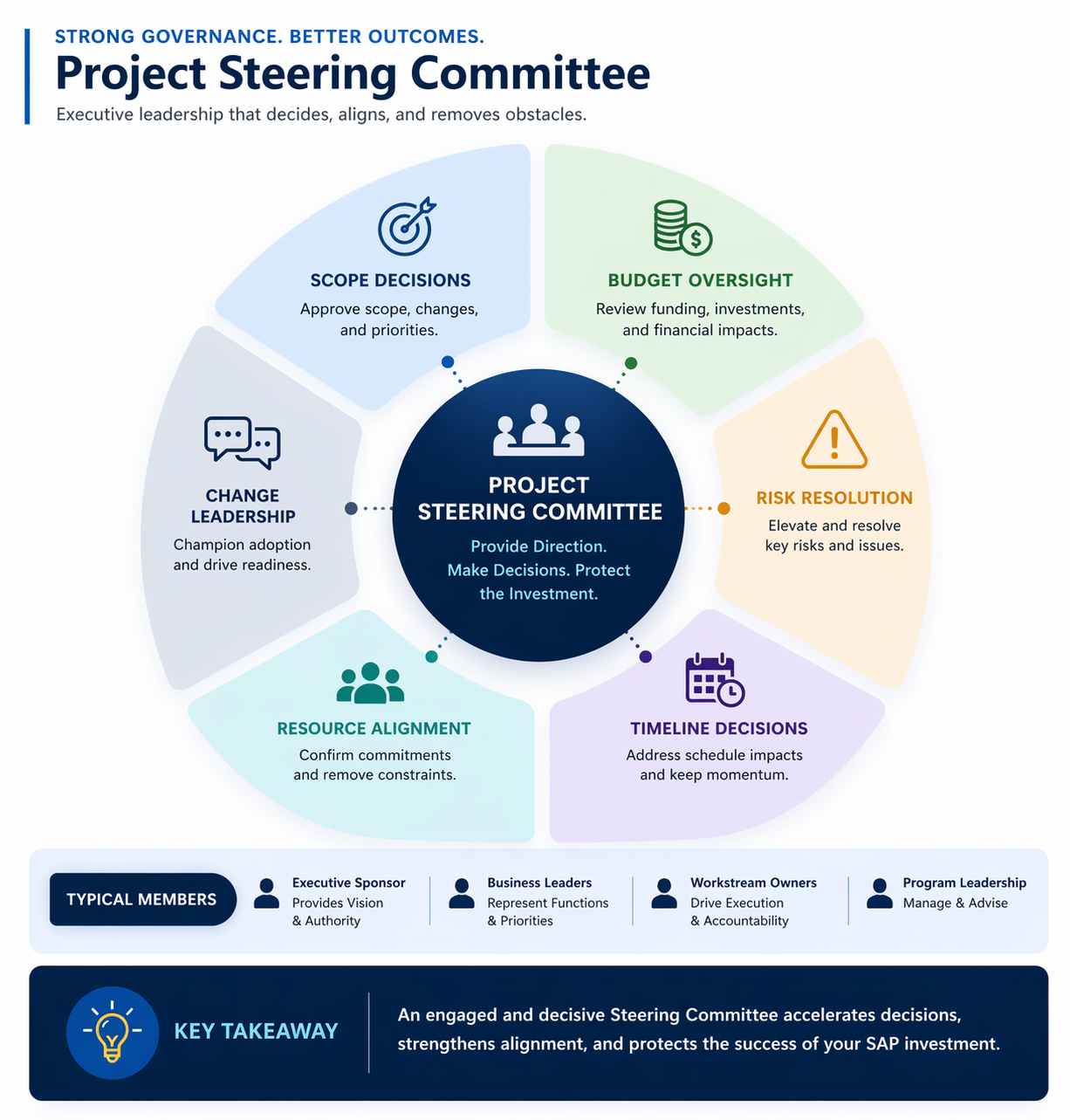
One of the most important structures on a successful SAP program is the Project Steering Committee. It is often discussed early, formally created, and then underused when the real pressure begins. That is a mistake.
A properly functioning Steering Committee gives the project executive direction, fast escalation paths, cross-functional decision authority, and visible accountability at the leadership level. It helps resolve issues that the working team cannot solve on its own and keeps the program aligned with business priorities.
This group should typically include senior client sponsors, key business leaders, major workstream owners, and program leadership, including, most importantly, the SAP Project Manager. Meetings should focus on decisions, risks, funding, scope changes, timeline impacts, resource constraints, and organizational readiness—not detailed task updates that belong elsewhere.
When the Steering Committee is engaged and decisive, projects move faster and with greater confidence. When it is passive or absent, unresolved issues tend to grow until they become expensive problems.
For many SAP programs, the Steering Committee is not a governance formality. It is one of the mechanisms that protects the investment.
Common Greenfield SAP Risks We Help You Avoid
Most SAP implementation problems are predictable. They may appear in different forms, but the root causes are often familiar. The advantage of experience is recognizing those patterns early enough to prevent them.
One common risk is starting with unclear objectives. If leadership cannot define what success looks like, scope expands, priorities shift, and decision-making becomes inconsistent.
Another is weak governance. When decisions are delayed or ownership is unclear, the project slows down and unresolved issues begin to stack up across workstreams.
Many programs also underestimate resource demands. Key business people are assigned in theory but unavailable in practice. The result is missed workshops, slow approvals, and poor design decisions made without the right input.
Over-customization is another frequent problem. Rebuilding every legacy process inside SAP increases cost, extends timelines, complicates testing, and creates long-term support burden.
Data migration is often underestimated. Poor master data quality, unclear ownership, and late cleansing efforts can jeopardize go-live readiness.
Testing shortcuts create expensive consequences. Defects ignored early tend to reappear at the worst possible time.
Finally, many projects underinvest in change management. If users do not adopt the new way of working, the business pays for transformation without receiving it.
We help clients identify these risks early, address them decisively, and keep momentum focused on successful delivery.
Free Download: Top 10 SAP Project Management Tips
Good SAP projects do not succeed by accident. They succeed because important fundamentals are handled well from the start and managed consistently throughout execution.
That is exactly why I created my Top 10 SAP Project Management Tips guide. It is a practical resource built from real project experience and focused on the habits, controls, and leadership behaviors that improve delivery outcomes.
Inside the guide, you will find proven ideas on topics such as planning discipline, task structure, resource accountability, schedule quality, project controls, and avoiding common execution mistakes. These principles remain relevant whether the project uses SAP Activate, agile methods, hybrid delivery, or traditional planning models.
If you are evaluating an SAP initiative—or already in the middle of one—this guide will help you think more clearly about what drives success and where projects often go off course.
Complete the Form Download the Free Guide
Request a Greenfield SAP Implementation Consultation
If you are considering a Greenfield SAP Implementation, the decisions made early will have lasting impact on cost, timeline, adoption, and long-term business value. Choosing the right path, assembling the right team, and establishing strong project controls from the start can materially improve the outcome.
Whether you are evaluating Greenfield versus Brownfield, planning an SAP S/4HANA program, preparing an executive business case, or trying to recover a struggling initiative, experienced guidance can save significant time and expense.
We provide practical support across strategy, planning, project leadership, governance, methodology execution, and delivery oversight.
If your SAP program matters, let’s discuss how to give it the strongest possible start.
Complete the Form or Use My Calendar to Request a Consultation