In This CEO SAP Series
- What Is SAP? The CEO’s Guide to Streamlining Business Operations
- SAP Executive Sponsorship: The CEO’s Role in Project Success
- Key Strategies for SAP Implementation Success
- Boost Your ROI with SAP Business Performance Improvement
- Boost Your Bottom Line with SAP Profitability Optimization
- Business Benchmarking with SAP: The Key to Smarter Portfolio Decisions
- How SAP Empowers Venture Capital Success and Portfolio Growth
Introduction
The most common question I still get from executives is a simple one. Even from CEOs whose companies are already running on it. They pull me aside and ask, "Lonnie, what is SAP, really?"
It is a great question because while many large companies use it, few leaders truly grasp what it is. In short, SAP provides comprehensive enterprise resource planning to manage nearly every part of a business. We are talking about finance, manufacturing, supply chain management, and even human resources, all in one place.
More specifically, SAP stands for Systems, Applications, and Products in Data Processing. In business terms, SAP is enterprise software that helps companies manage finance, operations, supply chain, sales, procurement, and human resources in one integrated system.
In simple terms, SAP helps a business run its core operations on one system. It gives leaders a single source of truth for financial reporting, inventory, purchasing, manufacturing, and other key processes, which makes decision-making faster and more reliable.
SAP is the backbone of profitable enterprise transformation.
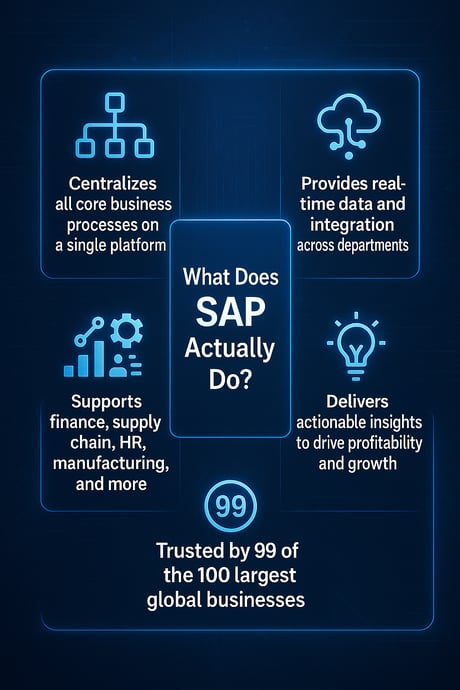
You might be wondering how its integration can be so powerful yet feel so complicated. This breakdown will explain it in plain language, detailing what makes this business software a global standard. SAP stands for Systems, Applications, and Products in Data Processing. If you are asking what SAP is in business, the short answer is this: SAP is enterprise software used to run finance, operations, supply chain, procurement, sales, and reporting in one integrated system.
Pro-Tip: SAP turns complexity into real-time, connected insight for growth-focused CEOs.
Need strategic-level advice on getting maximum value from your SAP system? Get our CEO's Guide to SAP
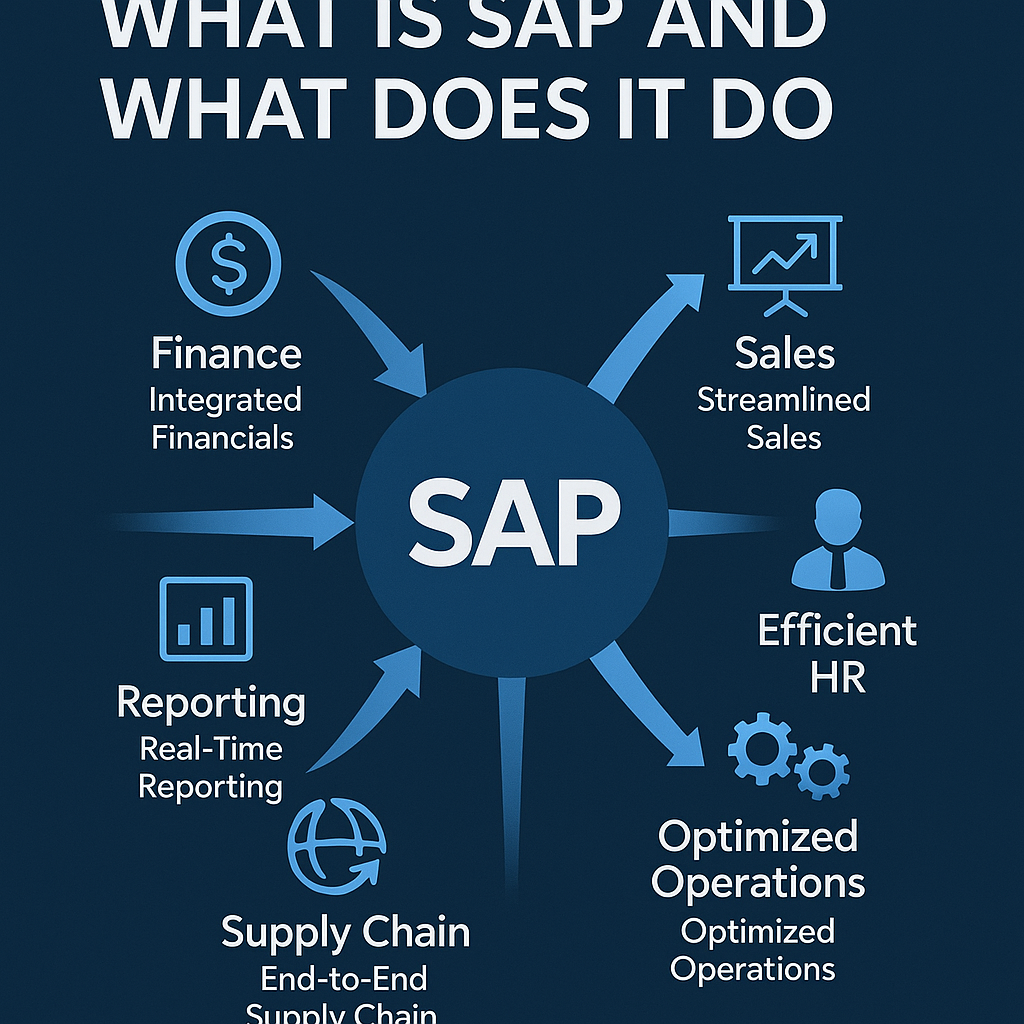
What Is SAP? Top 10 Things Every CEO Should Know
Many executives also ask what SAP does for a business. The answer is straightforward: SAP helps companies connect their major processes, reduce manual work, improve reporting, and make better operating decisions from shared data.
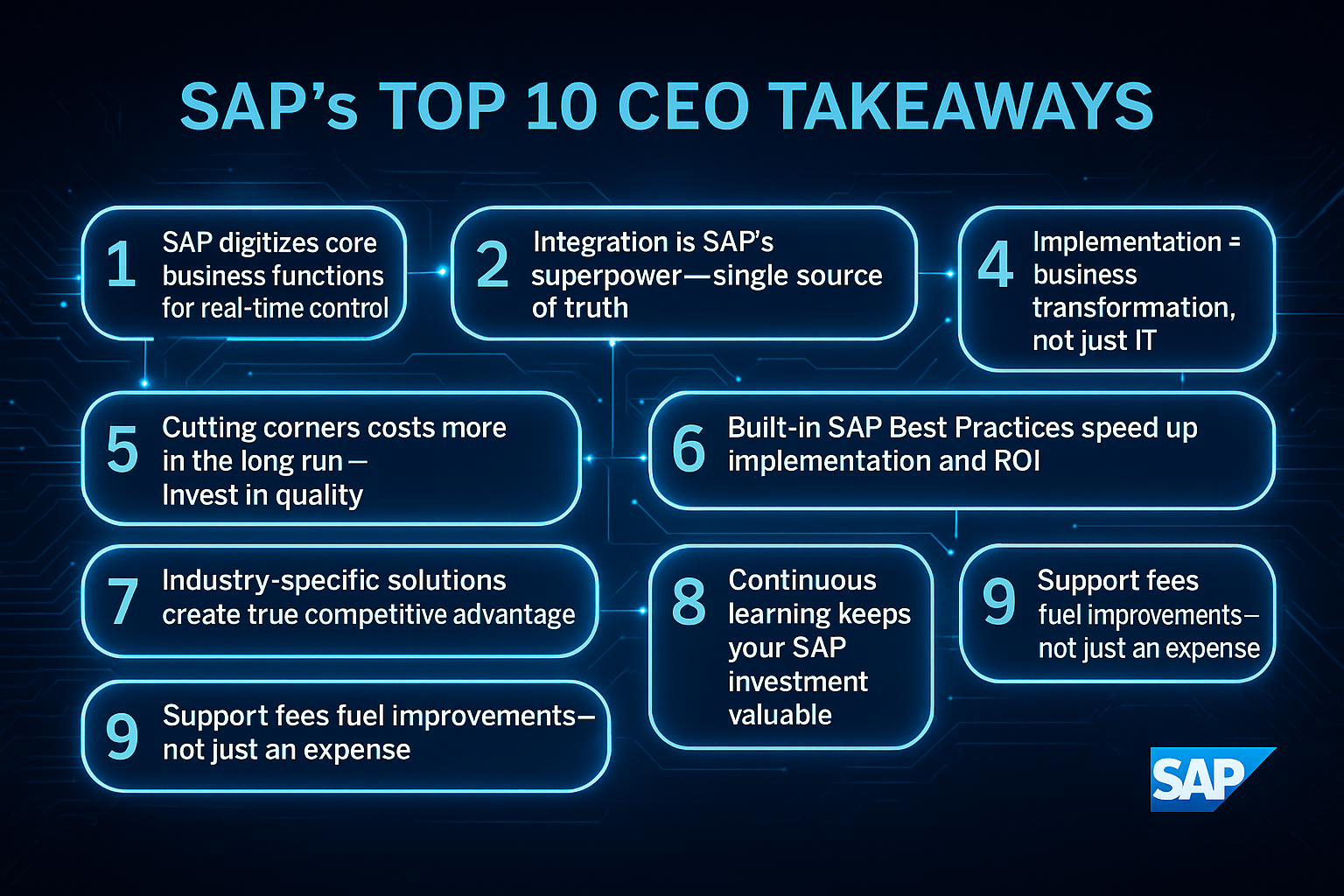
You may think of SAP as just another piece of software. But it is more like the central nervous system for a company. It connects different departments so they can communicate and work from the same data seamlessly.
1. SAP Is Not New — It's How Businesses Have Always Operated (Only Better)
SAP ERP software simply digitizes the core business functions companies have always performed. Five former IBM engineers—Dietmar Hopp, Klaus Tschira, Hasso Plattner, Hans-Werner Hector, and Claus Wellenreuther—founded the company in 1972. They wanted to create a standard commercial product that processed data in real time.
Before systems like SAP R/3, companies tracked orders and managed inventory with paper and ledgers. The game changer with an SAP system is real-time integration. When your sales team makes a sale, the financial accounting department sees it instantly.
The warehouse knows to ship a product, and production planning knows it may need to build more. It is like going from handwritten notes to a unified control tower for your entire business. This gives leaders a clear view of everything happening, as information is no longer siloed.
2. Integration Is SAP's Superpower
The real magic of SAP software is how everything connects. Building custom connections between different software systems is expensive and fragile. Some industry experts from companies like CIO estimate that each custom interface can cost a fortune over its lifetime to build and maintain.
SAP builds these integrations for you through its comprehensive ERP solutions. Your finance module "talks" to your sales and distribution module, while your materials management data flows directly into reporting tools. This built-in connection is a cornerstone of the SAP ERP, centralizing data management effectively. This is what allows SAP's new artificial intelligence system to quickly learn how your company is running and make optimization recommendations.
For a CEO, this means you can trust the numbers because everyone is making decisions based on a single version of the truth. You avoid the costly mistakes that happen when departments work with outdated information. This level of integration is key to achieving true operational efficiency.
For many CEOs, that visibility is the starting point for broader SAP business performance improvement across the company.
Pro-Tip: Standardize on SAP’s integrated modules to dramatically reduce manual reconciliations and audit-cycle headaches.
3. SAP Is a System of Systems — and a Marketplace of Solutions
SAP is much more than a single program; its software includes a vast portfolio. The core is the Enterprise Resource Planning (ERP) system, which handles fundamentals. Beyond that lies a massive ecosystem of solutions built on the SAP Business Technology Platform (SAP BTP).
You have specialized modules for almost any function, from customer relationship management to advanced data management. The business technology platform allows for incredible flexibility and scalability. This is what makes the SAP business ecosystem such a powerful force.
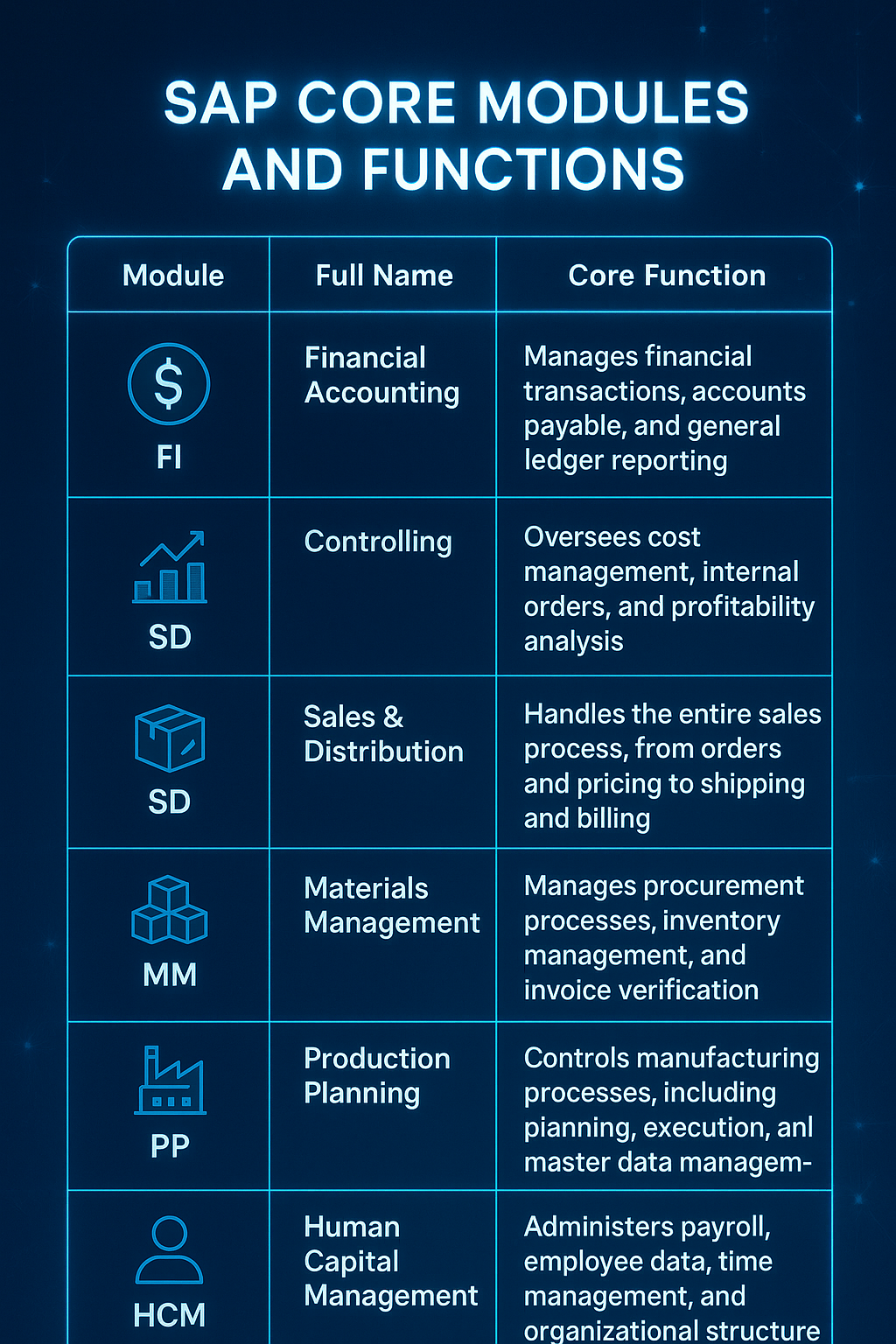
SAP solutions cover nearly every business need across more than 25 industries, helping companies manage everything from finance human resources to complex supply chains. Below is a simple breakdown of some core components of this management software.
| Module | Full Name | Core Function |
|---|---|---|
| FI | Financial Accounting | Manages financial transactions, accounts payable, and general ledger reporting. |
| CO | Controlling | Oversees cost management, internal orders, and profitability analysis. |
| SD | Sales & Distribution | Handles the entire sales process, from orders and pricing to shipping and billing. |
| MM | Materials Management | Manages procurement processes, inventory management, and invoice verification. |
| PP | Production Planning | Controls manufacturing processes, including planning, execution, and master data management. |
| HCM | Human Capital Management | Administers payroll, employee data, time management, and organizational structure. |
4. Implementing SAP Is a World Changing Event
Make no mistake, bringing SAP into your company is a significant event. It will touch every single job, process, and report. This is not just an IT project; it is a fundamental business transformation.
I saw this firsthand when I managed a massive change in an aircraft maintenance environment. Changing the daily work environment on such a large scale has dramatic effects on people's lives at work. People are creatures of habit, and this kind of project changes everything, from data processing to daily communication.
Success needs strong leadership and a solid change management plan. You have to listen to employee concerns and guide them through the transition. It demands patience and a thick skin, but the result is a more efficient organization that can manage complex business processes better. That is exactly why SAP executive sponsorship matters so much in large-scale transformations.
Pro-Tip: Assign a dedicated change management lead to champion user adoption and keep transformation on track.
5. Going Cheap Gets Cheap Results
I have seen too many SAP projects fail, and the cause is almost always the same. Leaders try to cut costs by hiring underqualified resources or sending critical work offshore. This approach frequently undermines the project's foundation.
I was recently on a project where the offshore team was nine time zones away, expecting our employees to join meetings at 11 PM. Do you think that is an effective way to operate? More importantly, do you think your best people will tolerate that for long?
There is another major problem with this approach, especially for training. End-user training done remotely just does not stick, as people need face-to-face interaction to learn complex ERP systems. When you offshore all your knowledge, you eventually lose control of your own data management sap and business operations.
6. SAP Best Practices Exist for a Reason
SAP did not just build software; it built thousands of pre-configured business processes. These are based on decades of experience working with the world's most successful companies. This library of business processes is a core part of the value offered by SAP.
Using these built-in Best Practices reduces project risk and shortens the time it takes to get value from your investment. You are not reinventing the wheel for things like invoice processing or spend management. You are adopting processes that are proven to accelerate workflows and work effectively.
Modern tools like SAP Solution Manager and SAP Activate are there to help you implement these processes correctly. Following these roadmaps is the smartest way to deliver your project on time and on budget. They provide a clear path for any company's digital transformation journey.
If you want a broader view of what separates strong projects from failed ones, review these key strategies for SAP implementation success.
Pro-Tip: Leverage SAP’s Activate and Solution Manager tools to access step-by-step blueprints and avoid costly reinvention.
7. What is SAP in Different Industries?
SAP goes deep with its industry solutions. For example, it offers powerful functions specifically for Aerospace and Defense, Utilities, or Retail. These are not generic tools; they are built for the specific challenges of each sector.
That same standardization is one reason SAP has become so important in venture capital and portfolio growth strategies.
The true competitive advantage often comes from cross-industry integration. Imagine a retail company using SAP's logistics and warehousing functions, enhanced with machine learning for demand forecasting. This creates a supply chain management system that competitors using separate systems simply cannot match.
But choosing the right combination of SAP solutions needs senior-level expertise. You need a partner who understands both the technology platform and your specific business goals. This collaboration is crucial to creating the perfect fit and achieving a high return on investment.
8. Continuous Learning Is Key for Everyone
SAP is constantly evolving, so your team's knowledge must evolve with it. SAP supports this through programs like the SAP University Alliances, which helps train the next generation of consultants. You should invest in your own people just as much.
As your internal team members gain valuable skills, they become more attractive in the job market. I have seen it time and again; as soon as a team gets skilled up, some of them leave for better-paying jobs. This talent drain can put your operations at risk.
As a CEO, you need a plan for this. You have to find ways to align their pay with their new skills and market demand. Investing in your people through continuous training and fair compensation is the only way to retain your critical SAP talent and ensure easy access to system capabilities.
9. SAP Support Is an Investment in Continuous Improvement
The annual support fee for SAP can seem steep to some executives. But it is not just a fee; it is an investment in the health of your system and access to continuous innovation. This fee funds ongoing improvements, security patches, and critical updates from one of the world's largest business technology companies.
A recent report by Salesforce discusses how technical debt can cripple a business. That is exactly what happens when you neglect system updates from SAP. Regular patching prevents small problems from turning into costly disasters down the road.
Staying current with updates is part of the total cost of ownership (TCO). Seeing it as an expense to be cut is shortsighted. It is a critical investment that protects your primary one in the SAP business technology platform. You should really be asking how much more can I invest it to get even more value from the SAP ERP System.
10. SAP Requires (and Rewards) Executive Commitment
The single biggest predictor of SAP success is executive involvement. Projects where the CEO leads from the front get the best results. When implementation is delegated down to IT, projects often struggle or fail because they lack strategic business alignment.
SAP is not a "set it and forget it" system; it is a dynamic ever changing platform that should grow and adapt with your business. The technology platform needs constant attention and strategic guidance from the top. Your leadership sets the tone for how the entire organization views and uses this powerful tool.
After 27 years in this business, I can tell you this with certainty. When an SAP system is led correctly, it becomes the unbreakable backbone of growth and profitability. Your leadership determines the final return on this important investment and its ability to enhance customer relations and experience.
When that foundation is in place, the next step is using SAP for profitability optimization across the enterprise.
For CEOs, the real value of SAP is not just software functionality. It is the ability to run the business with better visibility, better controls, and faster decisions across the entire enterprise.
Conclusion
Understanding what is SAP is about more than just technology. It is about understanding how to build a more integrated, efficient, and intelligent business. It combines people, processes, and a business technology platform into a single, powerful engine for growth.
Once your data and processes are standardized, SAP also gives leaders a stronger foundation for business benchmarking across divisions, business units, or portfolio companies.
A successful implementation costs money, demands leadership, and requires a commitment to your people. But when done right, SAP is not an expense. It is the operating system that will run your global business and improve your customer experience for decades to come.
With decades of successful experience, my team and I can help you with your SAP FICO Consulting needs. We help you develop a roadmap that supports your objectives as a CEO. Let us start the conversation about what SAP can do for you.
Get a SAP Value Realization Roadmap.
One of the most valuable things you can do as a CEO is insist on a SAP roadmap. Every year, you need to have a plan for additional SAP functionality you're going to roll out.
For instance, perhaps you're using a 3rd party warranty management system, which requires constant, costly modifications. You may want to consider one or more of the modules from the SAP ACS Warranty Management solution, which is a robust, proven, warranty management system. It is just one of dozens of solutions that most clients are either unaware of or do not have deep enough knowledge of to decide whether it should be on the SAP Value Realization Roadmap. If you want help making that happen, just book a meeting with us and we'll explain how to make it happen.

We are a SAP implementation and support partner. We can implement SAP in your business from 'greenfield' all the way to performing global roll-outs. With our deep Industry Expertise, we can help you uncover hidden value within your SAP system and drive your business to levels of profitability. Please our book a meeting service to get started.
Next in the CEO's Guide to SAP Series - SAP Leadership, Governance, and Execution