The executive case for reliable CRM data
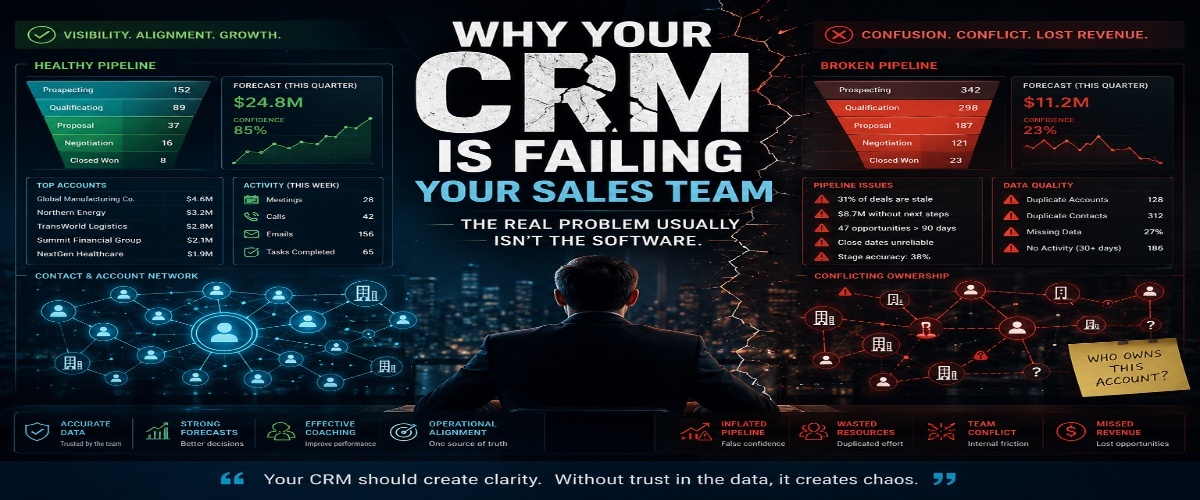
- CRM failures often begin with process design, account governance, and management behavior. When sales teams cannot rely on the system to reflect how deals actually progress, executives lose confidence in the forecast and the business loses a shared view of revenue.
- Sales teams often resist CRM systems because older platforms created administrative work instead of supporting how field sales organizations actually operate.
- In complex enterprise sales environments, simplistic CRM pipelines rarely reflect reality accurately.
- CRM discipline directly impacts forecasting, attribution, resource allocation, pipeline visibility, AI optimization, and executive decision-making.
- Modern platforms like HubSpot reduce friction by making CRM activity part of the natural workflow instead of a separate administrative burden.
- Once sales teams lose trust in CRM data, pipeline visibility and forecasting accuracy begin deteriorating rapidly.
- CRM systems are not merely contact databases. They are operational intelligence systems for managing revenue.
Most companies blame the CRM.
Sales says the system is cumbersome.
Leadership says the data is inaccurate.
Marketing says attribution is broken.
Finance says forecasts are unreliable.
Operations says nobody can see future demand correctly.
Eventually, everyone concludes: “The CRM is failing.”
In many cases, that diagnosis is wrong.
The CRM is often exposing deeper operational problems that already existed inside the business:
-
Poor pipeline discipline.
-
Weak forecasting processes.
-
Conflicting definitions.
-
Bad account ownership structures.
-
Lack of sales process alignment.
-
Management behavior that unintentionally destroys trust in the system.
Over time, the CRM simply becomes the visible symptom of organizational dysfunction.
Why Sales Teams Often Hate CRM Systems
To understand why CRM adoption struggles, especially in enterprise sales environments, you first have to acknowledge something important:
Sales teams are not wrong.
Older CRM systems often created enormous administrative friction.
Years ago, while working in enterprise software sales, I heard HubSpot cofounder Brian Halligan describe a problem I had already experienced while using SAP CRM with field sales teams.
CRM After the Fact
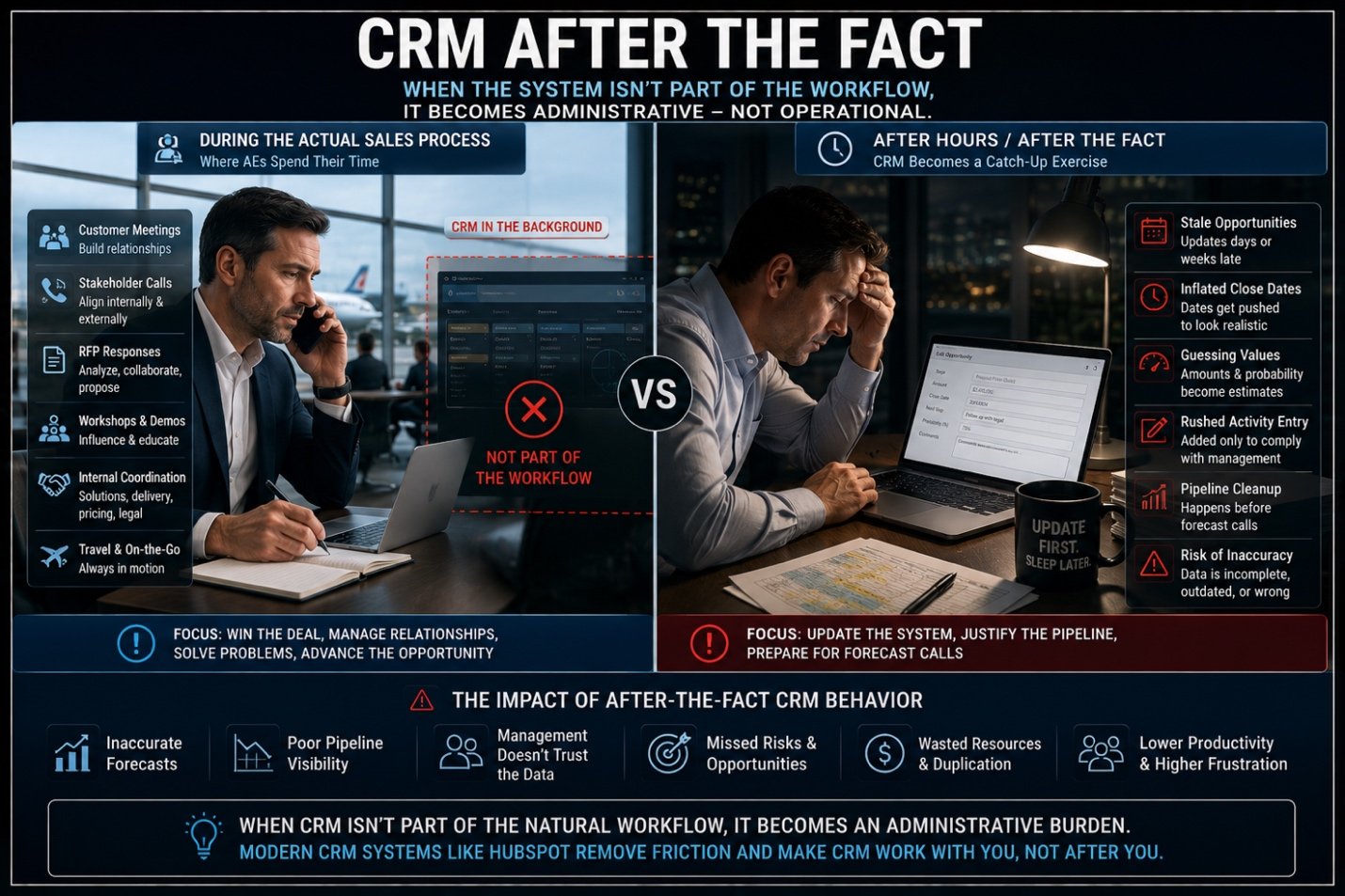
Most Account Executives used the CRM after the fact.
Not during the actual sales process.
That distinction matters enormously.
The CRM was not naturally integrated into how field sales professionals actually worked.
It became:
- something updated before forecast calls
- something cleaned up at quarter-end
- something management demanded
- something required for pipeline reviews
But not the operational center of the sales process itself.
That was especially true in enterprise field sales.
A field AE’s day is rarely linear.
They are:
- coordinating internal resources
- handling executive relationships
- navigating procurement
- managing political dynamics
- responding to complex RFPs
- organizing demonstrations
- scheduling workshops
- working partner ecosystems
- negotiating internally and externally
The CRM often felt disconnected from reality.
Inside Sales environments adapted more easily because the workflow itself was already digital and centralized.
Enterprise field sales was different.
That is one reason modern CRM systems evolved so aggressively around:
- email integration
- automatic activity logging
- meeting synchronization
- centralized contact records
- communication capture
- workflow continuity
Platforms such as HubSpot can reduce the friction between selling and documenting the sale through integrated communication and activity capture.
The CRM stopped being a separate administrative task and became part of the natural workflow.
That was a major shift.
The Problem with Simplistic Sales Funnels
The Enterprise Sales Reality
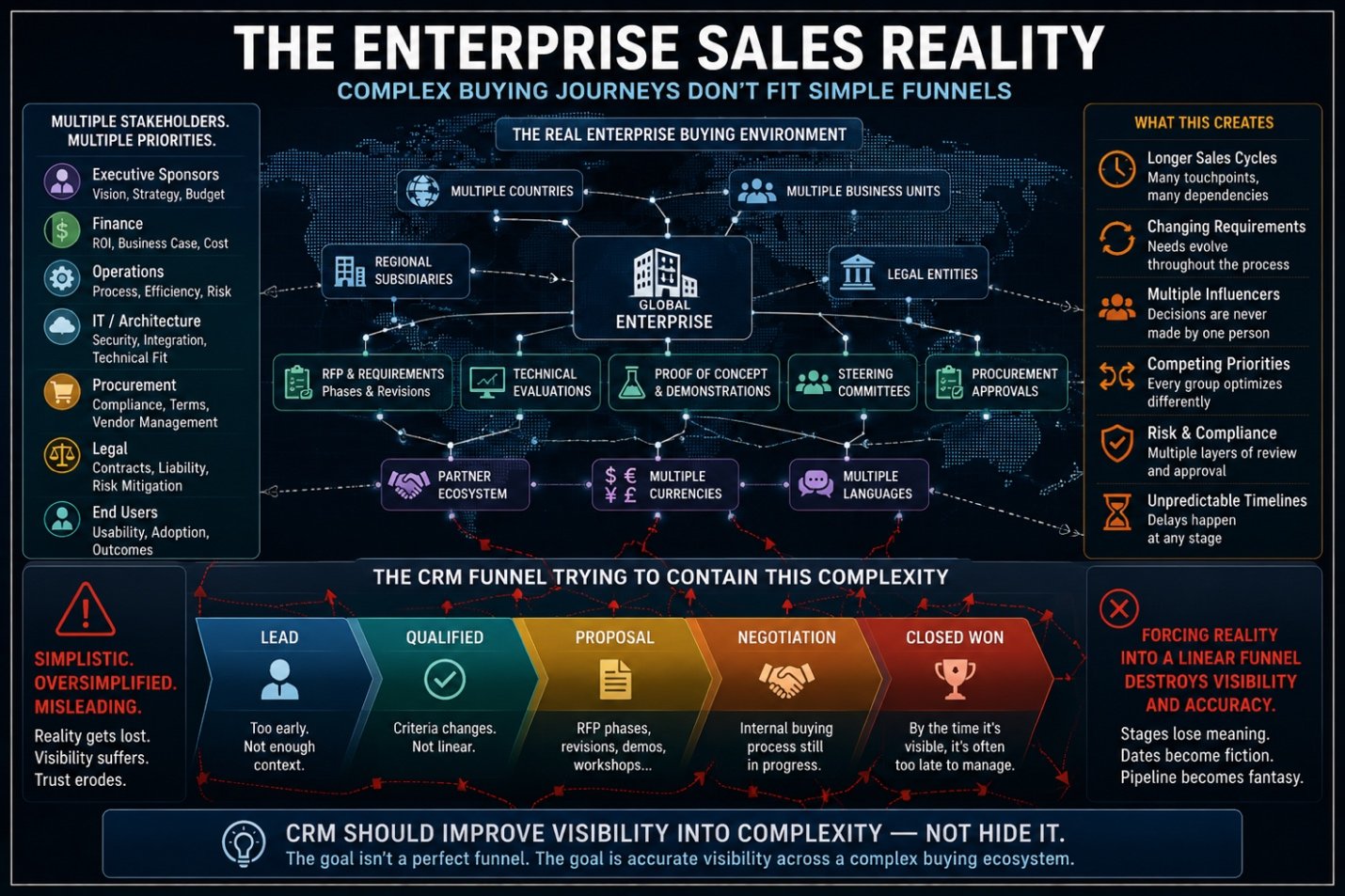
One of the biggest disconnects in CRM design is the assumption that all sales processes behave like simple linear funnels.
Many do not.
Enterprise sales often does not.
Complex sales pursuits often involve:
- multiple countries
- multiple business units
- legal reviews
- procurement teams
- steering committees
- partner organizations
- revised RFPs
- proof-of-concepts
- workshops
- executive sponsors
- competing political agendas
I spent years responding to large enterprise RFPs in the SAP ecosystem.
Those pursuits rarely moved neatly from lead to opportunity to proposal to closed deal.
Reality was much messier.
One RFP might involve:
- several subsidiaries
- multiple currencies
- several languages
- different regional stakeholders
- overlapping buying groups
- separate technical evaluations
- phased commercial negotiations
And despite all that complexity, leadership still needed visibility.
That is where many CRM implementations begin failing.
The organization attempts to force complex buying behavior into oversimplified pipeline structures.
Eventually:
- stages lose meaning
- close dates become fantasy
- opportunity values become inflated
- forecasting deteriorates
- trust erodes
A CRM should not oversimplify reality merely to make reporting easier.
It should improve visibility into reality, even when the sales process itself is complex.
The Trust Collapse Problem
The Trust Collapse
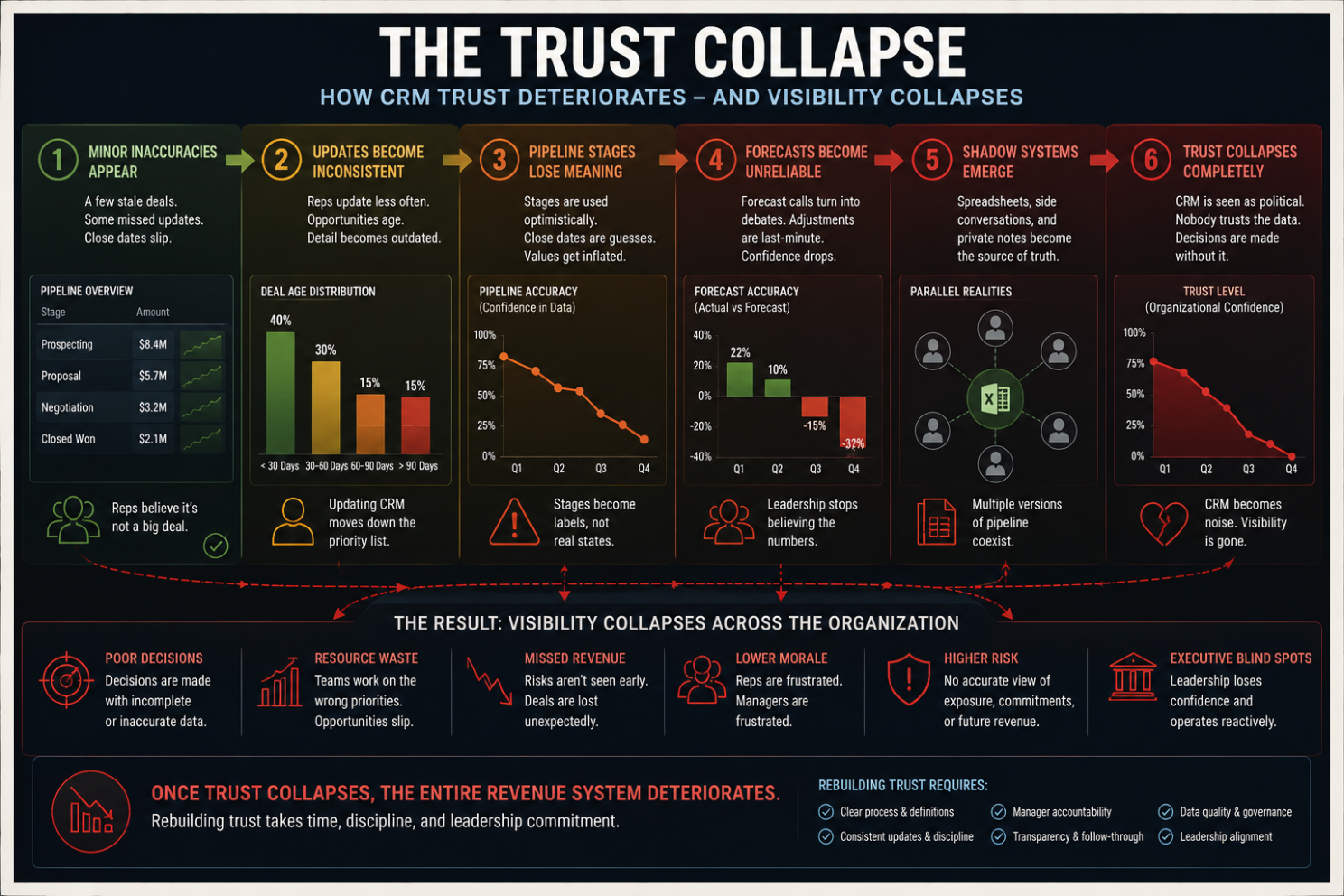
Once trust in the CRM begins deteriorating, the entire revenue system starts weakening.
This usually happens gradually.
-
First: sales reps stop updating opportunities consistently.
-
Then: close dates stop meaning anything.
-
Then: pipeline stages become optimistic placeholders.
-
Then: leadership stops trusting the forecasts.
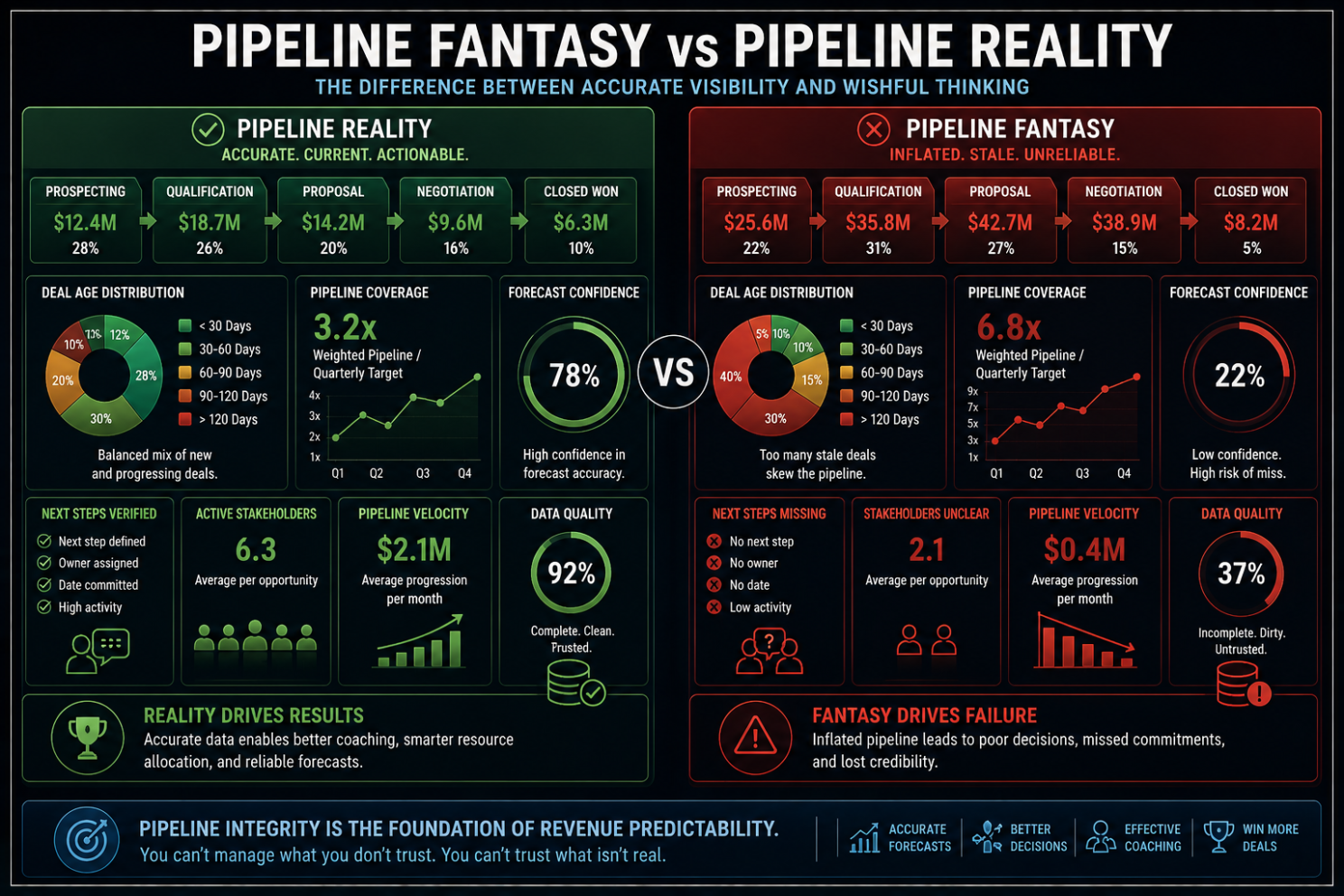
Pipeline Fantasy vs Pipeline Reality
At that point, everyone begins maintaining their own unofficial versions of reality:
- spreadsheets
- side conversations
- shadow forecasts
- private account notes
That fragmentation is why executive teams eventually need what I describe as a Single Version of Revenue Reality. Different functions can legitimately interpret business conditions differently, but coordinated decisions become extremely difficult when Sales, Marketing, Finance and Operations no longer share a trusted underlying representation of what is actually happening.
Now the organization has multiple competing truths.
That is dangerous.
Because forecasting quality depends heavily on organizational trust in the underlying data.
That relationship is what I examine more deeply in Why CRM Forecasts Often Fail Executive Teams. A CRM can provide extensive opportunity visibility while still failing to produce a forecast executives can safely use when qualification standards, opportunity stages, close dates and underlying assumptions are not sufficiently trustworthy.
If leadership does not trust the CRM:
- hiring decisions become reactive
- staffing plans become inaccurate
- delivery planning weakens
- marketing investments become harder to optimize
- resource allocation deteriorates
The damage spreads far beyond sales.
The Hidden Complexity of Enterprise Account Structures
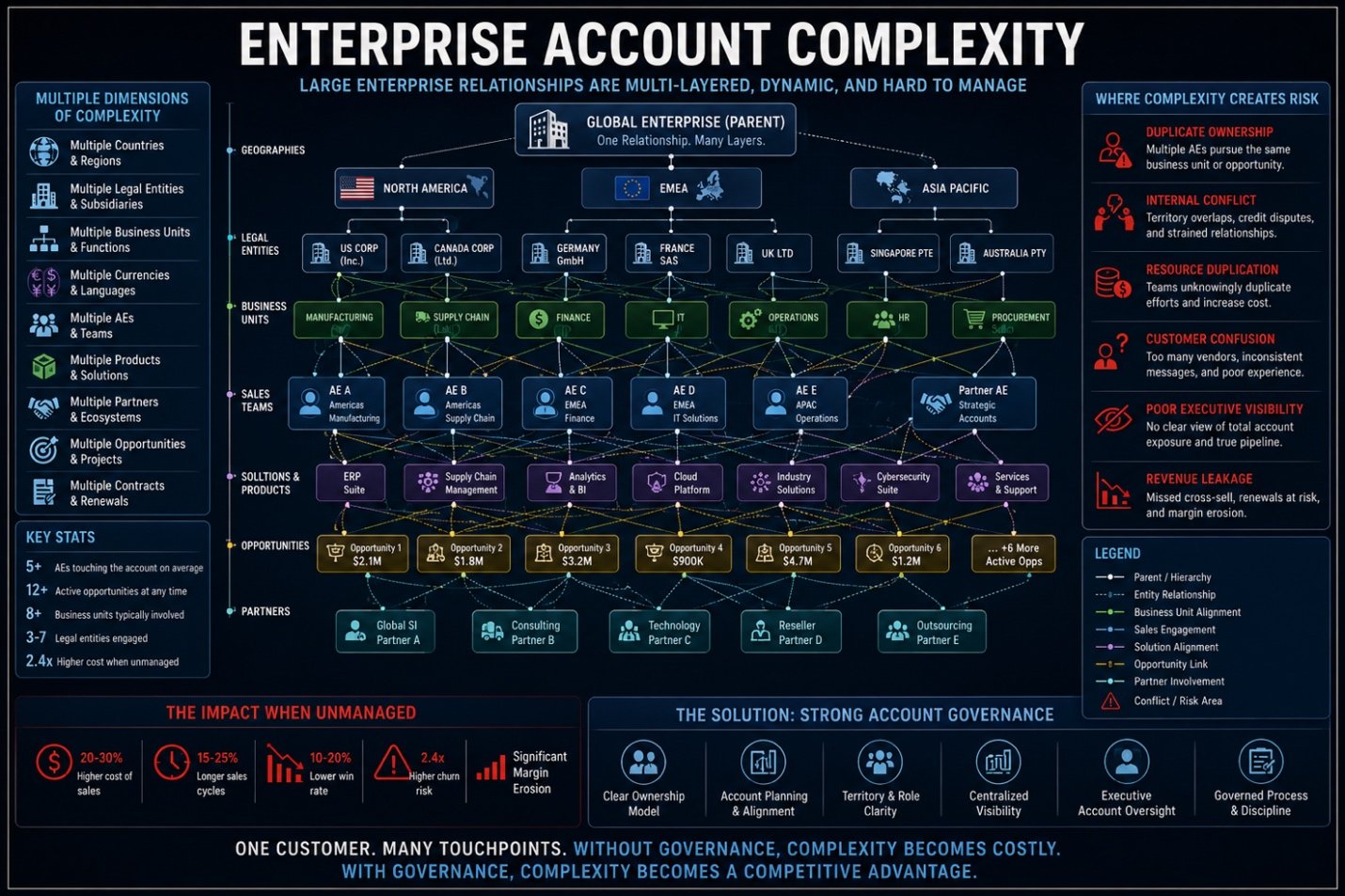
Enterprise Account Complexity
One of the most difficult operational problems I have personally dealt with is modeling large enterprise relationships inside CRM systems.
This is far more complicated than many people realize.
Large companies often operate:
- across multiple countries
- across multiple legal entities
- in multiple currencies
- in multiple languages
- across multiple business units
Over time, different Account Executives begin working different opportunities within the same broader customer relationship.
One AE may manage:
- manufacturing
Another:
- transportation
Another:
- finance
Another:
- regional operations
Meanwhile: partners may also be involved.
Now add:
- overlapping territories
- different compensation plans
- multiple product lines
- strategic account overlays
Complexity explodes quickly. Without strong account governance, the CRM can become chaotic. That creates several major problems simultaneously.
First: the customer becomes confused.
Multiple vendor representatives start contacting the same organization without coordinated visibility.
Second: internal sales conflict increases.
AEs begin disputing:
- ownership
- influence
- territory rights
- commissions
- deal attribution
Third: resource allocation becomes inefficient.
Organizations often spend far more on the sales effort than they realize because teams unknowingly duplicate activities across the same account structure.
And finally: executive visibility deteriorates.
Leadership loses the ability to clearly understand:
- total account exposure
- relationship ownership
- opportunity concentration
- revenue risk
- pipeline health
Again, the CRM itself is usually not the core problem.
The organization failed to operationalize the relationship model correctly.
CRM Discipline Is Not Administrative
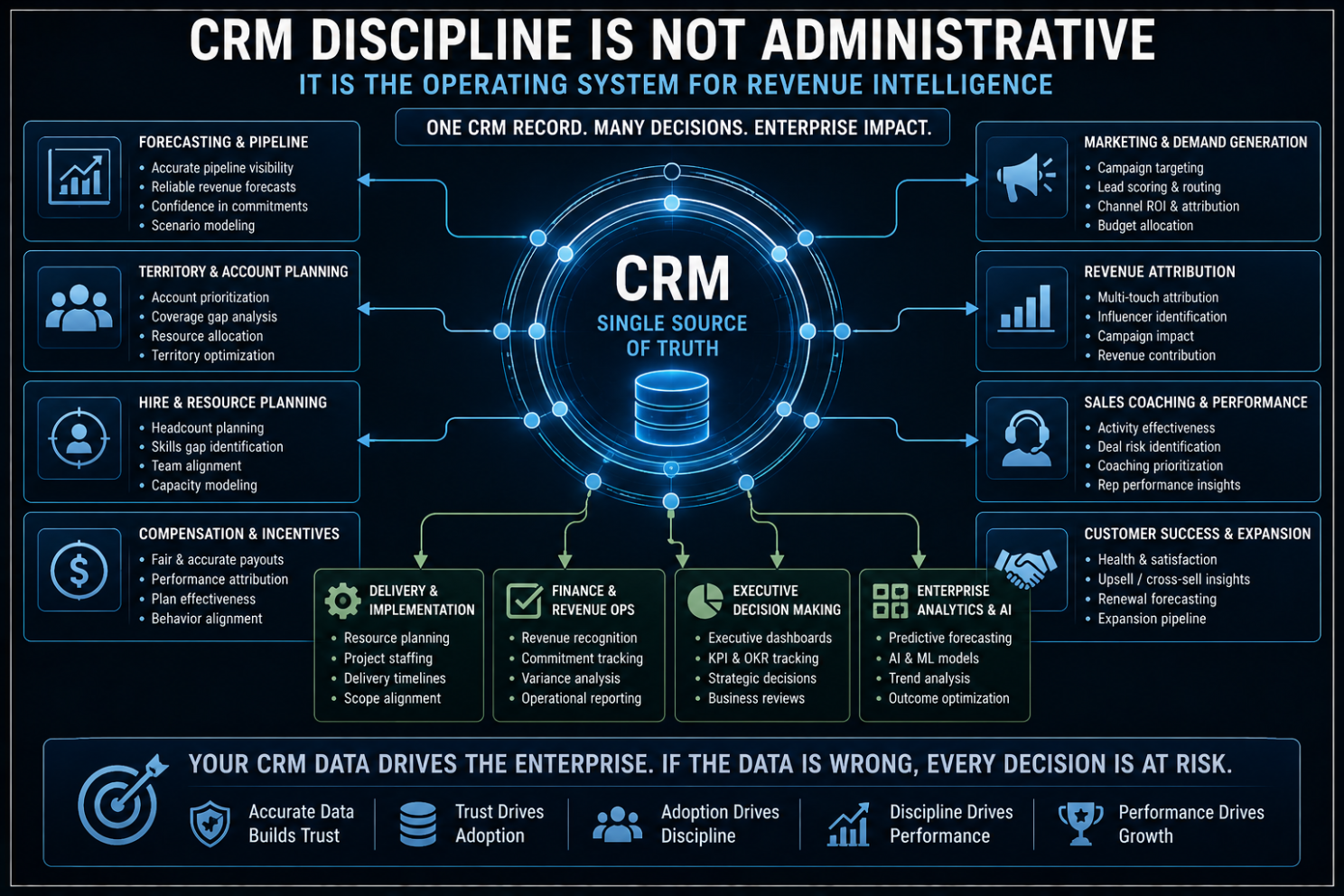
CRM discipline supports revenue decisions
This may be the single most misunderstood aspect of CRM systems.
CRM discipline is not administrative overhead.
It directly affects:
- forecasting
- pipeline visibility
- attribution accuracy
- AI optimization
- territory planning
- commission management
- executive decision-making
- delivery planning
- hiring decisions
In many organizations, deals only appear in the CRM once they are already highly mature or effectively closed.
That destroys forecasting accuracy.
It also prevents proactive coaching.
Strong sales organizations use CRM visibility to identify:
- stalled opportunities
- aging pipeline
- stage conversion weaknesses
- velocity issues
- relationship gaps
- competitive threats
Weak organizations only care about CRM updates at quarter-end.
That behavior trains sales teams to view the CRM as punishment instead of enablement.
And culture matters enormously here.
Because once reps believe:
- leadership ignores the data anyway
- forecasts are political
- stages are meaningless
- pipeline inflation is tolerated
…the system starts collapsing culturally.
That cultural breakdown can eventually change the nature of forecasting itself. In Why Revenue Forecasts Become Negotiations Instead of Predictions, I examine what happens when organizational expectations, incentives and management pressure begin influencing the forecast more strongly than the underlying commercial evidence.
The Customer Definition Problem
One of the most damaging issues inside CRM systems is surprisingly simple.
Many organizations cannot consistently define what a customer actually is.
Marketing may define a customer one way.
Finance another.
Sales another.
Operations another.
Customer Success another.
That inconsistency corrupts:
- reporting
- forecasting
- attribution
- lifecycle management
- AI optimization
This is ultimately a Revenue Signal Integrity problem. In Revenue Signal Integrity: Why Executive Decisions Depend on Trusted Data, I examine why data can be technically correct inside individual systems while still producing misleading management signals when different functions attach different definitions and business meaning to it.
Now dashboards conflict with each other.
Leadership loses confidence in the numbers.
And teams begin arguing over definitions instead of solving operational problems.
This issue becomes especially dangerous in large enterprise environments where:
- subsidiaries
- divisions
- parent-child account structures
- channel relationships
- regional ownership
Without clear governance: visibility deteriorates quickly.
The AI Problem Is Making This More Important
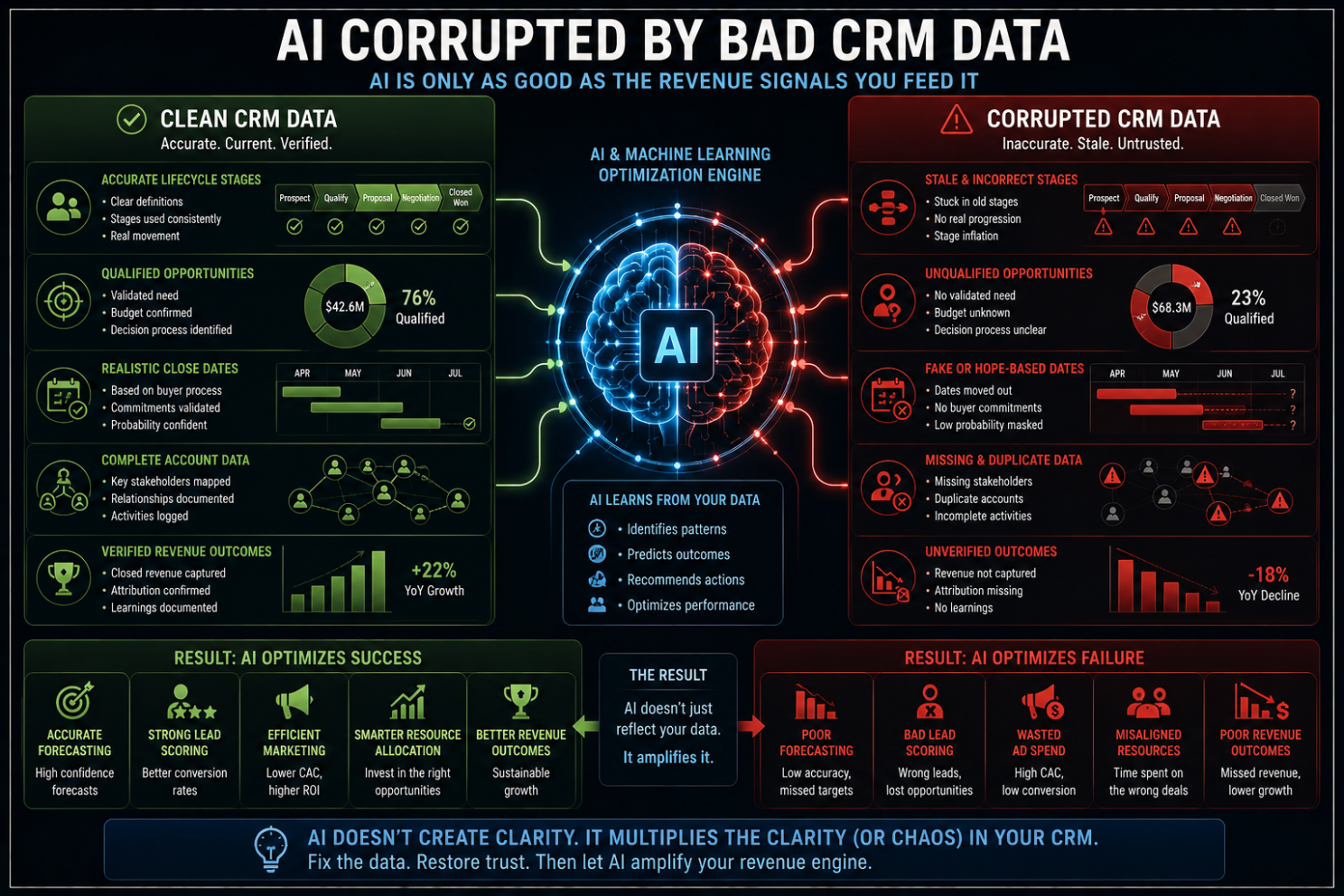
AI Corrupted by Bad CRM Data
Bad CRM data used to create reporting problems.
Now it creates AI problems too.
Modern systems increasingly depend on CRM data for:
- lead scoring
- forecasting models
- attribution systems
- advertising optimization
- pipeline prioritization
If the underlying CRM data is weak, AI systems can learn misleading patterns.
That relationship became the central argument of Why AI Is Only as Good as Your Revenue Signals. AI can become extraordinarily effective at detecting patterns, prioritizing opportunities and supporting forecasts, but its conclusions are only as meaningful as the revenue signals the organization teaches it to interpret.
That means:
- poor lead prioritization
- weak ad optimization
- distorted forecasting
- inefficient resource allocation
The quality of executive decision-making increasingly depends on CRM data integrity.
That trend will only accelerate.
How High-Performing Sales Organizations Use CRM Systems
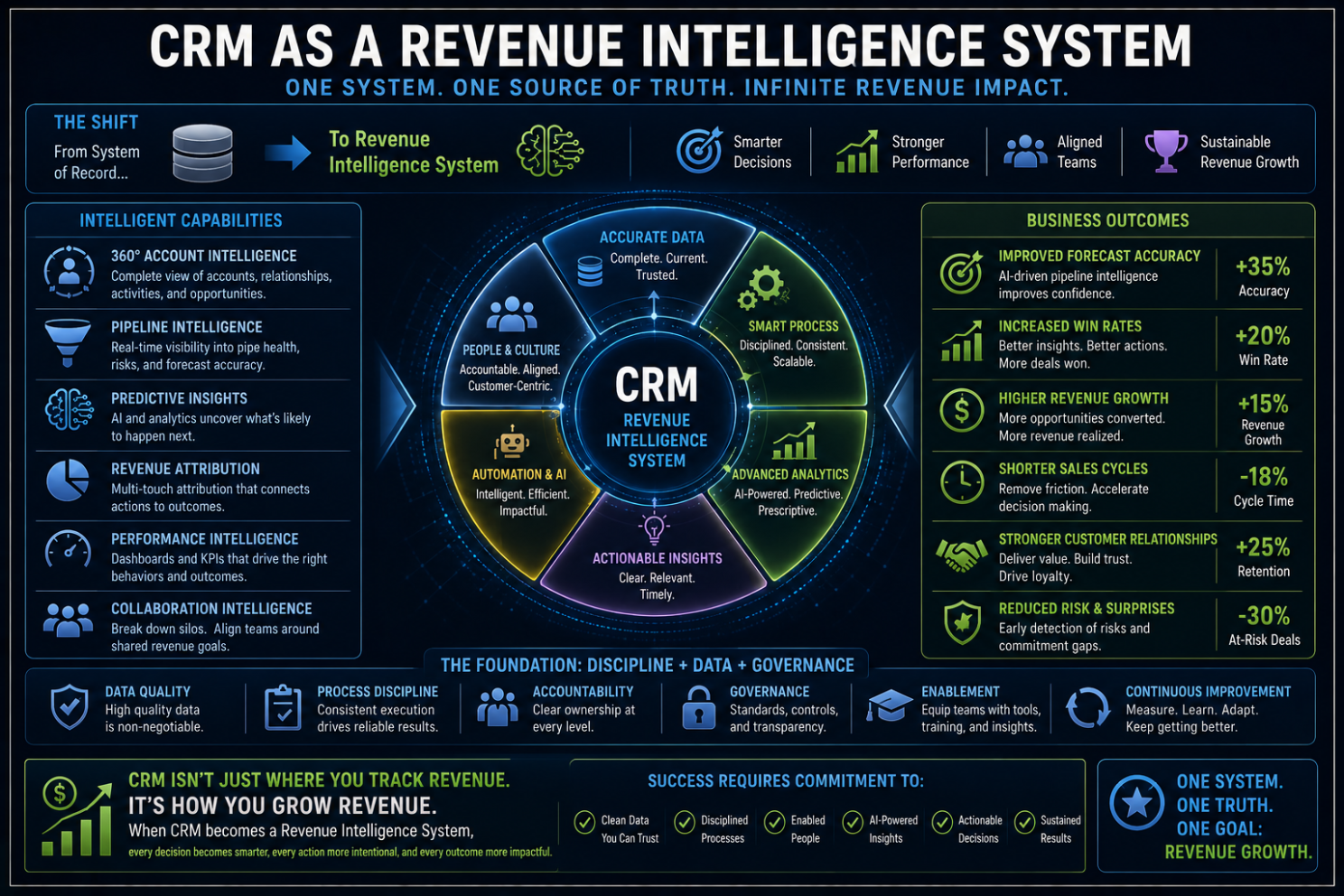
CRM as a Revenue Intelligence System
The best organizations do not use CRM systems primarily for reporting.
They use them for visibility.
But visibility only becomes valuable when it reveals what management actually needs to understand. In Why Operational Visibility Matters More Than Activity Metrics, I examine why organizations need visibility into flow, constraints, risk and meaningful changes in business conditions rather than simply more measures of activity.
That is a major difference.
Great sales organizations use CRM systems to:
- coordinate resources
- identify bottlenecks
- improve coaching
- prioritize accounts
- manage pipeline risk
- forecast accurately
- improve operational alignment
The CRM becomes an operational intelligence system, rather than just a database.
Not merely a database.
That distinction changes everything.
Because once leadership views the CRM correctly, the goal shifts.
The objective is no longer simply to make reps update the system.
The objective becomes better organizational visibility and better decisions.
That progression ultimately leads From Dashboards to Decision Intelligence. Visibility is the foundation, but the larger management objective is improving how the organization interprets changing conditions, evaluates alternatives, makes decisions and converts those decisions into coordinated action.
Final Thought
Most CRM systems are not failing because the technology is broken.
They fail because organizations underestimate the operational discipline required to make visibility systems work correctly.
A CRM reflects:
- process quality
- management behavior
- account governance
- forecasting discipline
- organizational alignment
If those systems are weak, the CRM eventually exposes the weakness.
And once trust in the data deteriorates, the entire revenue system begins operating reactively instead of intelligently.
The CRM is not merely software.
It is the visibility layer of the revenue system.
Companies that govern this visibility well can make more reliable decisions.
If your organization struggles with:
- unreliable forecasting
- inflated pipelines
- weak CRM adoption
- account ownership conflicts
- attribution problems
- inconsistent visibility
- poor operational alignment
then the issue may not be the CRM itself.
It may be the absence of a properly designed revenue operating system.
I help organizations identify revenue system constraints, improve operational visibility, and build more effective closed-loop revenue systems that support predictable growth and better executive decision-making.
The Process Starts with a Revenue Systems Assessment