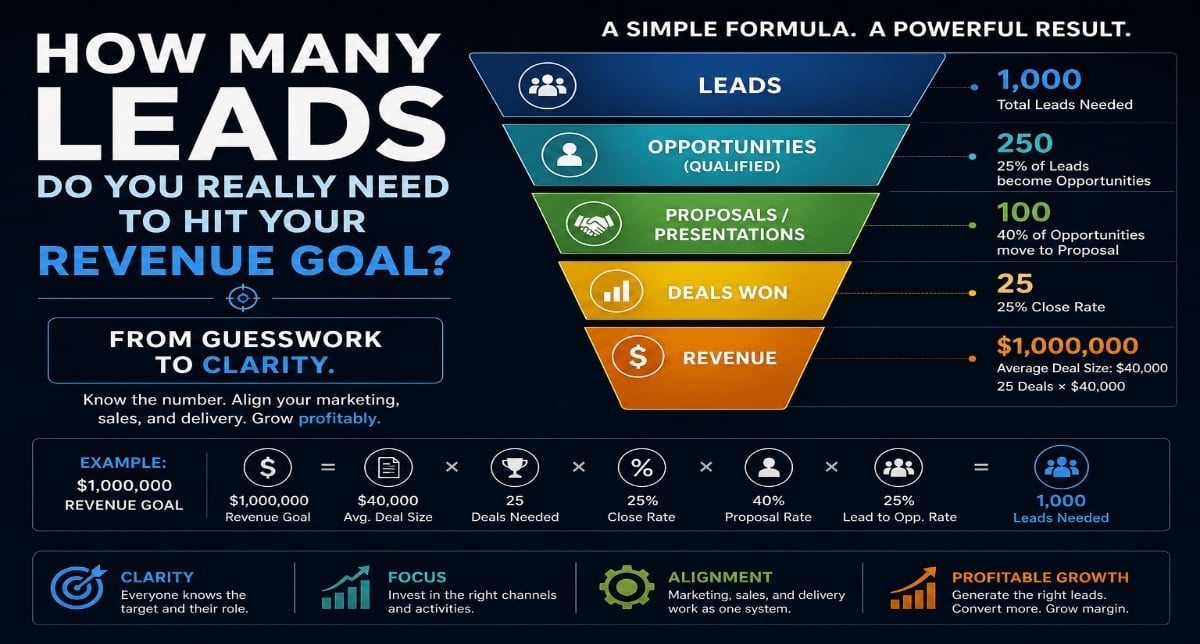
How Many Leads Do You Really Need to Hit Your Revenue Goal?
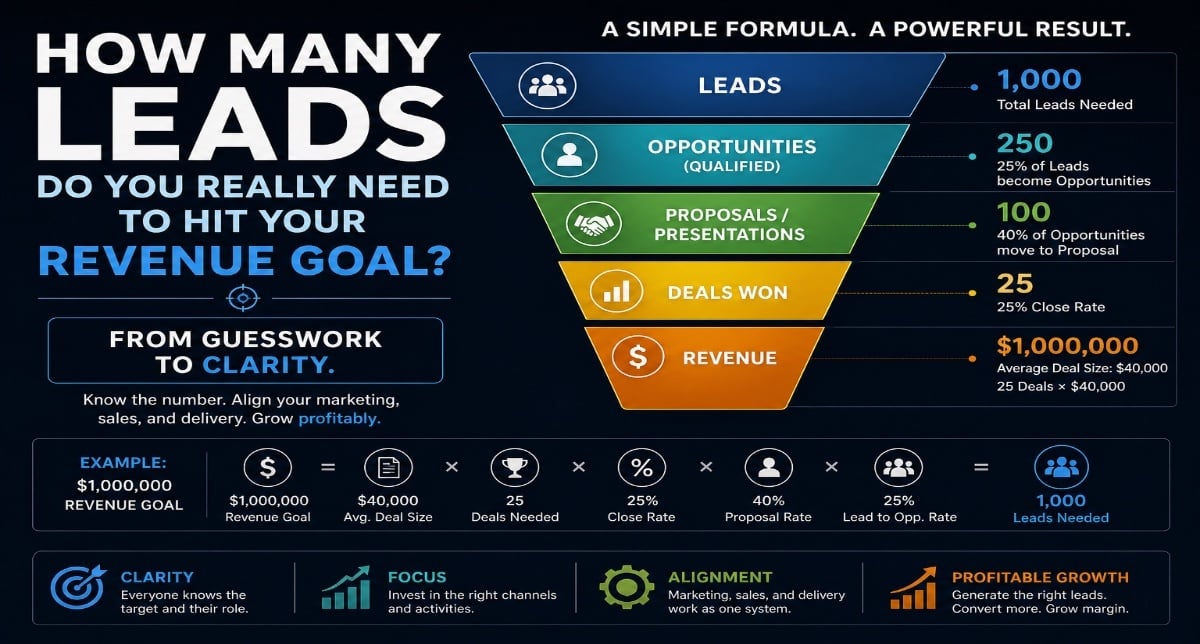
Most companies ask:
“How do we get more leads?”
Few ask:
“How many leads do we actually need?”
Without that number, everything becomes subjective.
Marketing is judged by activity.
Sales is judged by effort.
Results feel inconsistent.
And nothing ever feels like enough.
Executive Summary
One of the most common questions business leaders ask is:
"How do we generate more leads?"
A better question is:
"How many leads do we actually need?"
Without that answer, marketing budgets, sales targets, staffing plans, and growth forecasts are often built on assumptions rather than data. Teams focus on increasing activity, yet struggle to determine whether they are making meaningful progress toward revenue objectives.
Fortunately, revenue planning is not guesswork.
By understanding the relationship between revenue goals, average deal size, close rates, and conversion rates, organizations can calculate the lead volume required to achieve specific business outcomes. More importantly, they can identify where improvements in the system will produce the greatest return.
This article explains the simple math behind revenue planning, why lead generation should be viewed as a system rather than a marketing activity, and how factors such as offer design, sales effectiveness, and delivery capacity ultimately determine how many leads a business truly needs.
Key Takeaways
- More leads are not automatically the answer to revenue challenges.
- Revenue goals can be translated into specific lead requirements.
- Average deal size, close rate, and conversion rates drive lead volume requirements.
- Improving conversion often creates greater impact than increasing traffic.
- Offer quality influences every stage of the funnel.
- Delivery capacity can become a hidden constraint on growth.
- The goal is not generating the maximum number of leads—it is generating the right number of profitable leads.
Organizations that understand their revenue math make better decisions, set more realistic expectations, and create stronger alignment between marketing, sales, and operations.
Why “More Leads” Is the Wrong Question
More leads is not a strategy.
It’s a reaction.
Without a defined target:
- marketing operates without a finish line
- sales works whatever shows up
- leadership evaluates performance based on feel, not fact
And when results fall short, the default answer is:
“We need more leads.”
But more of the wrong thing rarely fixes the system.
If you don’t know the number, you can’t manage the system.
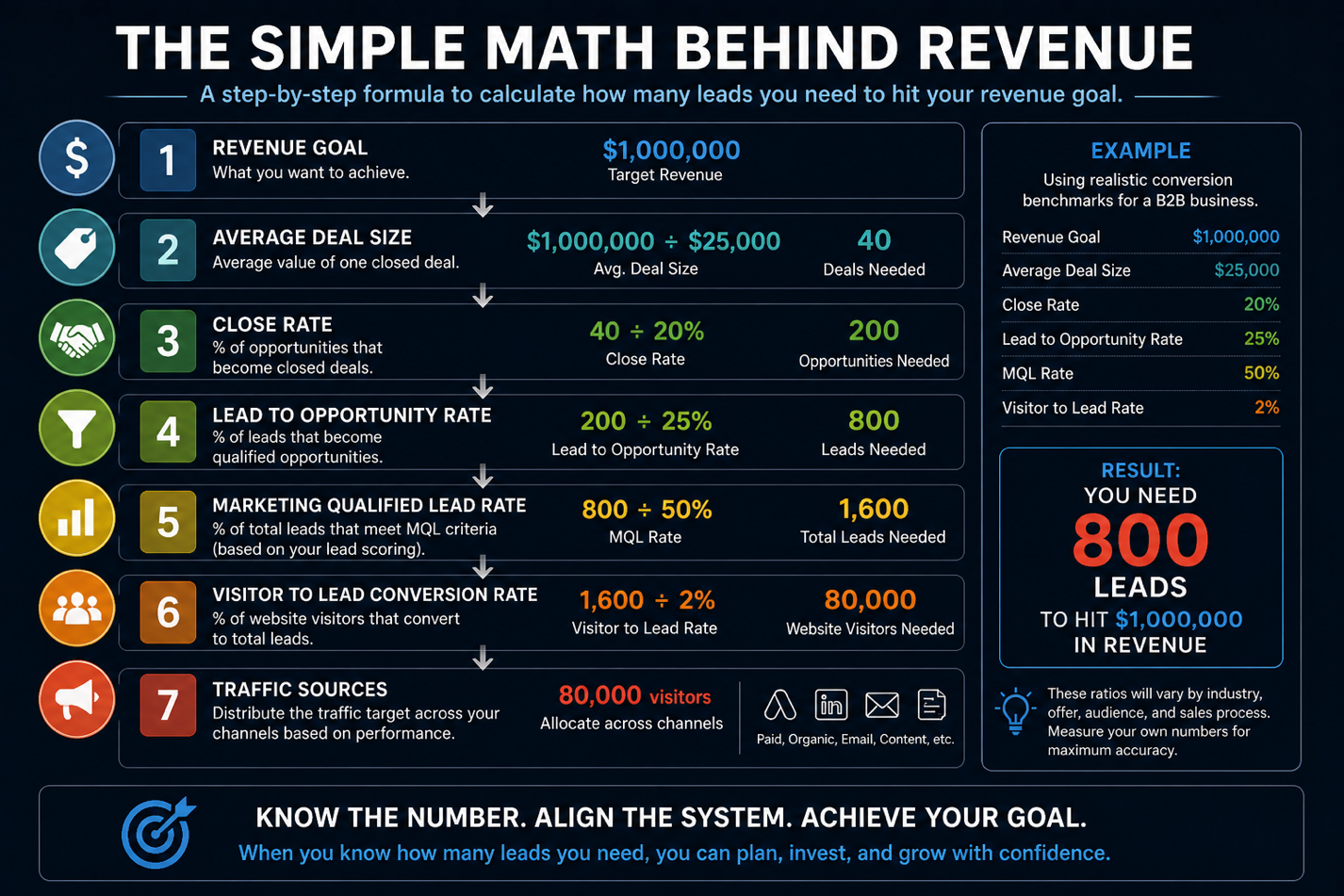
The Simple Math Behind Revenue
The Lead Generation Formula Every CEO Should Know
-
Revenue Goal ÷ Average Deal Size = Deals Required
-
Deals Required ÷ Close Rate = Opportunities Required
-
Opportunities Required ÷ Lead-to-Opportunity Rate = Leads Required
At its core, revenue is not mysterious.
It follows a sequence:
Revenue Goal
→ Average Deal Size
→ Deals Required
→ Close Rate
→ Opportunities Required
→ Lead-to-Opportunity Conversion
→ Leads Required
A simple Example:
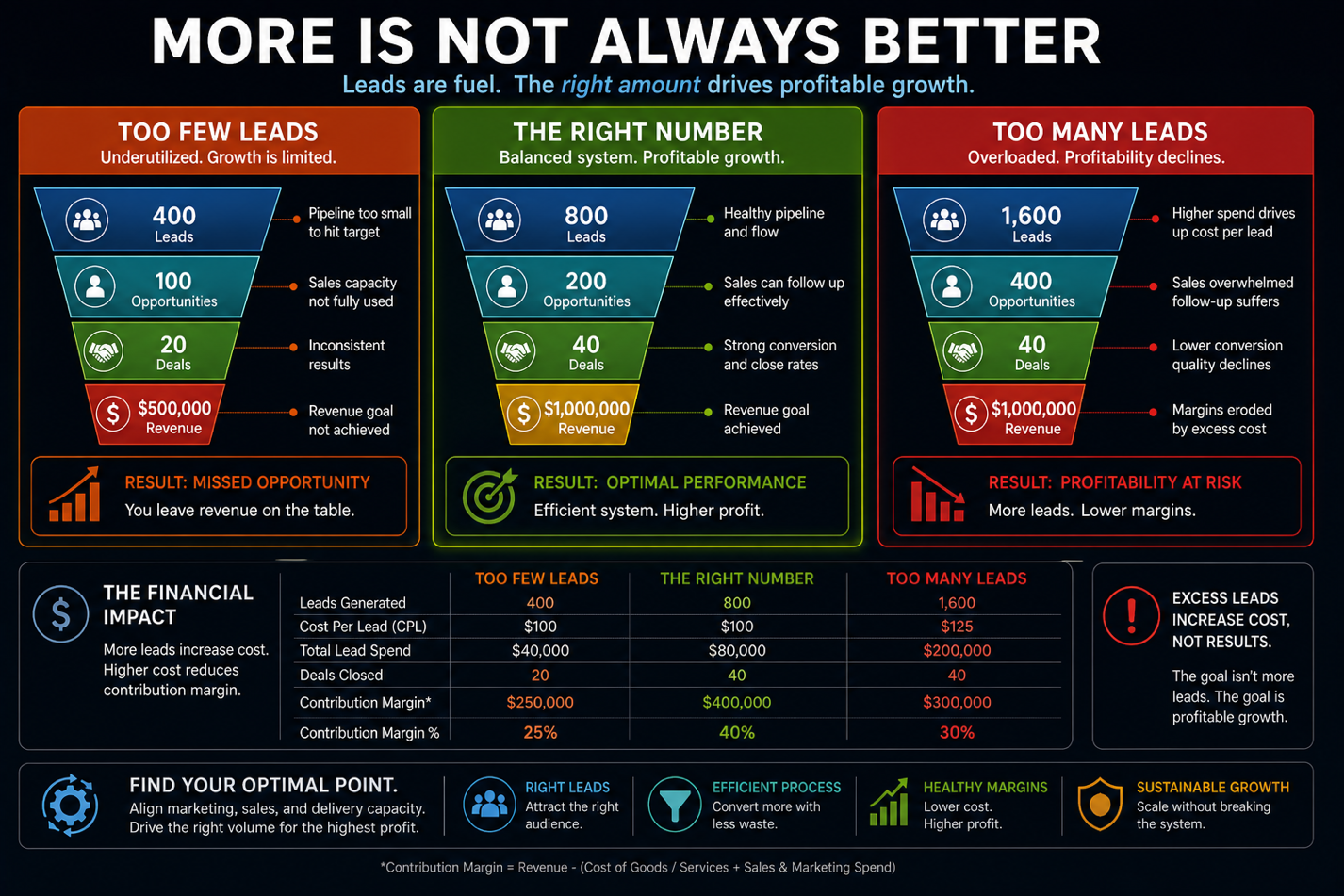
If your goal is $1,000,000 in revenue and your average deal is $25,000 you need 40 closed deals.
If your close rate is 20% you need 200 qualified opportunities.
If 25% of leads become opportunities you need 800 leads
Now you have a number.
Not a guess.
A target.
Where Most Businesses Go Wrong
The math is simple.
The inputs are not.
Most businesses:
- guess conversion rates
- overestimate sales performance
- underestimate the impact of lead quality
- ignore funnel drop-off points
- assume consistency where none exists
So the plan looks solid.
Execution tells a different story.
This Is Not Just a Marketing Problem
Lead requirements are not determined by marketing alone.
They depend on:
- what you sell
- who you sell to
- how you sell
- how well you deliver
This is where most agencies stop.
They focus on traffic and leads.
But if the system behind those leads is misaligned, more volume only amplifies the problem.
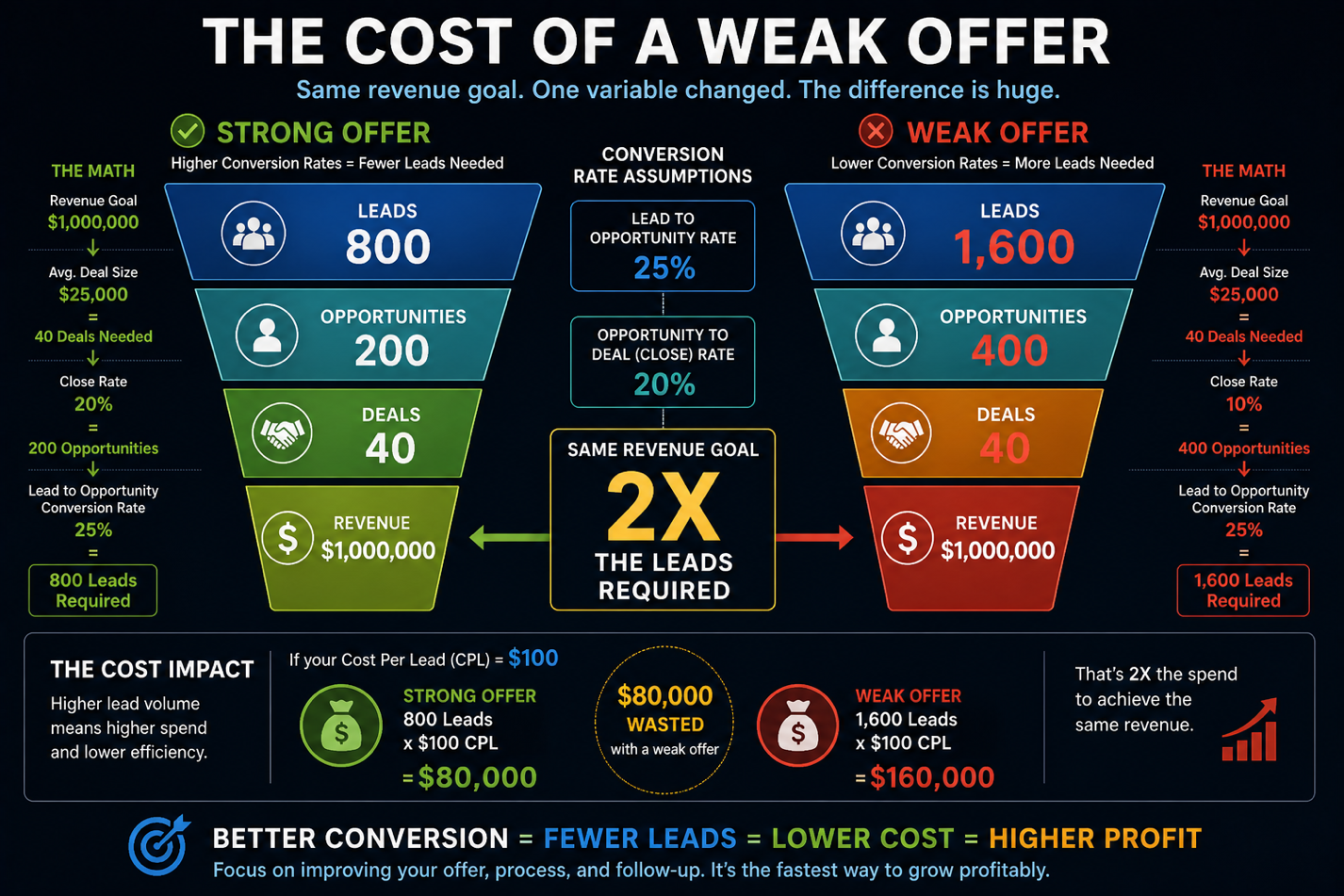
The Role of the Offer
There is one factor that quietly influences every part of the funnel.
The offer.
A strong offer:
- attracts the right buyers
- increases conversion rates
- supports higher pricing
- reduces sales friction
- aligns expectations for delivery
A weak offer does the opposite.
More leads.
Lower quality.
More effort per deal.
More pressure on delivery.
I wrote about this in Knowing What You Sell: The Key to Dominate Your Market
When you truly understand what you sell—and who values it most—you can design the system to perform better at every stage.
Why Delivery Capacity Matters More Than You Think
This is where many plans break.
If you generate too few leads:
Growth stalls.
But if you generate too many:
- sales teams become overwhelmed
- follow-up quality drops
- delivery capacity is strained
- customer experience declines
And from a managerial accounting perspective, something even more subtle happens:
Spending more to produce excess leads often increases the cost per lead.
That higher acquisition cost flows through the system.
It reduces contribution margin per sale.
And over time, it erodes the profitability of growth itself.
So the real question is not:
“How many leads can we generate?”
It is:
“How many leads can we convert and deliver profitably?”
Connecting This to Paid and Organic Strategy
Once you know your required lead volume, decisions become clearer.
You can:
- set realistic advertising budgets
- choose the right channels
- optimize campaigns for outcomes—not just activity
- plan content strategically
- build the right lead magnets (i.e., ebooks, calculators, quizzes)
This is where math becomes execution.
And where most guesswork disappears.
Why This Changes the Client Relationship
Without a defined target:
- marketing is seen as “not enough”
- expectations are unclear
- results feel inconsistent
- trust is fragile
With a defined system:
- expectations are aligned
- performance is measurable
- decisions are grounded
- progress is visible
Clarity creates trust.
Why Engagements Become More Than Marketing
Once the numbers are clear, the conversation changes.
Because improving results often requires changes beyond marketing:
- pricing strategy
- product development
- sales process
- reorder planning
- delivery quality
This is why engagements rarely stay confined to one function.
The system demands alignment.
The Importance of Building Trust Early
This approach is different.
It often challenges existing assumptions.
It requires changes across departments.
And it introduces a level of clarity many businesses have never had before.
That is why trust matters early.
Because once the system becomes visible, so do the opportunities to improve it.
Revenue Planning Starts With Visibility
Many organizations spend enormous amounts of time discussing lead generation.
Far fewer spend time understanding the economics behind those leads.
-
How many leads are actually required?
-
How many opportunities must be created?
-
How many deals need to close?
-
How much delivery capacity is required to support growth?
Without those answers, planning becomes reactive.
Targets become subjective.
And performance discussions often focus on activity instead of outcomes.
The organizations that consistently outperform their competitors approach growth differently.
They understand the numbers.
They understand the funnel.
And they understand how Demand, Conversion, Delivery, and Data interact to produce revenue.
That visibility allows them to make better decisions, allocate resources more effectively, and identify problems before they become expensive.
Ready to Calculate the Numbers Behind Your Revenue Goal?
Many businesses know where they want to go.
Fewer understand exactly what must happen to get there.
My Revenue System Assessment helps leadership teams evaluate their complete revenue system—including lead generation, conversion rates, offer effectiveness, delivery capacity, and revenue visibility—to identify the specific improvements needed to achieve their growth objectives.
The assessment provides a practical roadmap for understanding how many leads are required, where funnel performance is breaking down, and which changes will produce the greatest business impact.
If you're making revenue decisions based on assumptions rather than data, the next step may not be generating more leads.
It may be understanding the system behind them.
Schedule a Revenue System Assessment and discover exactly what your business needs to achieve its revenue goals.