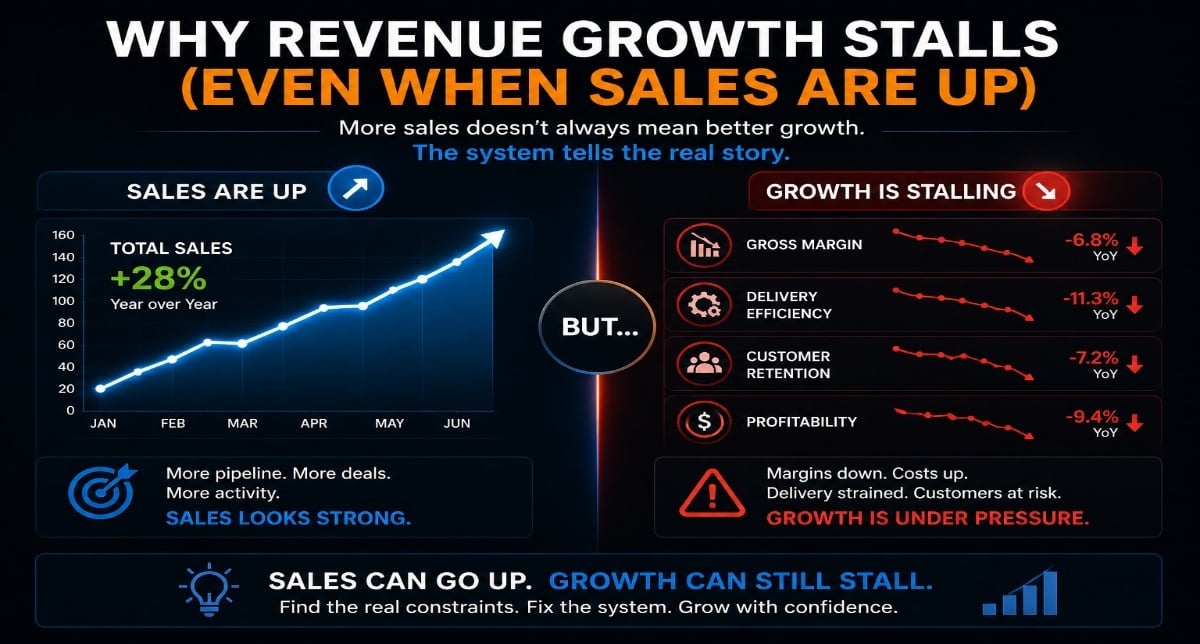
Why Revenue Growth Stalls (Even When Sales Are Up)
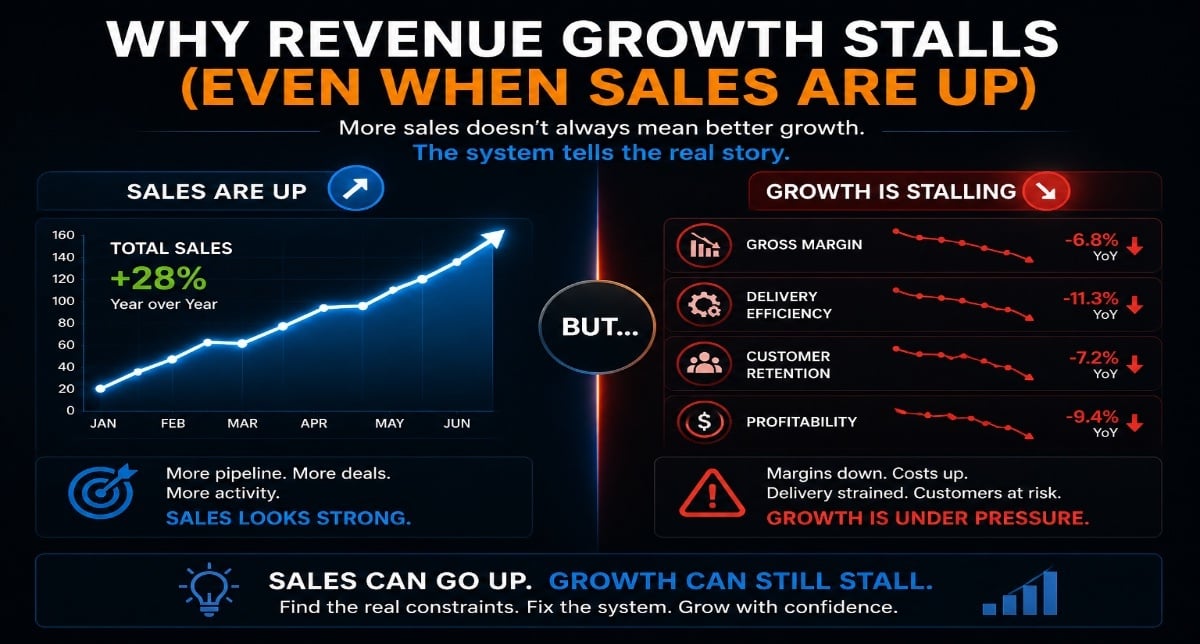
Sales are up.
Pipeline looks active.
Deals are closing.
And yet…
Growth feels harder than it should.
Margins are under pressure.
Delivery is strained.
Forecasts feel less reliable.
This is more common than most leaders expect.
Executive Summary
Many businesses assume that increasing sales automatically leads to stronger revenue growth.
In practice, that is not always true.
Organizations can experience rising sales while simultaneously facing declining margins, overloaded delivery teams, increasing customer churn, higher acquisition costs, and growing operational complexity. From the outside, performance appears healthy. Inside the business, however, the systems required to support sustainable growth may be weakening.
This distinction between sales growth and revenue growth is one of the most important concepts leaders can understand. Sales growth measures activity and transactions. A good revenue growth rate reflects the organization’s ability to generate, deliver, retain, and expand profitable customer relationships over time.
This article explores why revenue growth often stalls despite increasing sales, the role that offer design plays in attracting the right customers, and the system-level factors that determine whether growth becomes sustainable or increasingly difficult to maintain.
Key Takeaways
- Sales growth and revenue growth are not the same thing.
- Revenue growth depends on Demand, Conversion, Delivery, Retention, and Cost Structure working together.
- A poorly aligned offer can create downstream problems throughout the business.
- More customers do not always mean better customers.
- Pareto analysis often reveals that a small percentage of customers create a disproportionate share of profit.
- Revenue leakage, delivery strain, and weak retention can offset gains from new sales.
- Sustainable revenue growth requires optimizing the entire revenue system rather than isolated departments.
The organizations that achieve consistent revenue growth are not simply generating more sales. They are building systems capable of turning sales into profitable, repeatable, and scalable business outcomes.
Why Sales Growth Doesn’t Guarantee Revenue Growth
Sales and growth are not the same thing.
You can increase sales while:
- profitability declines
- delivery costs rise
- churn increases
- inefficiencies multiply
From the outside, things look healthy.
Inside the system, pressure builds.
The issue is not activity.
It is quality.
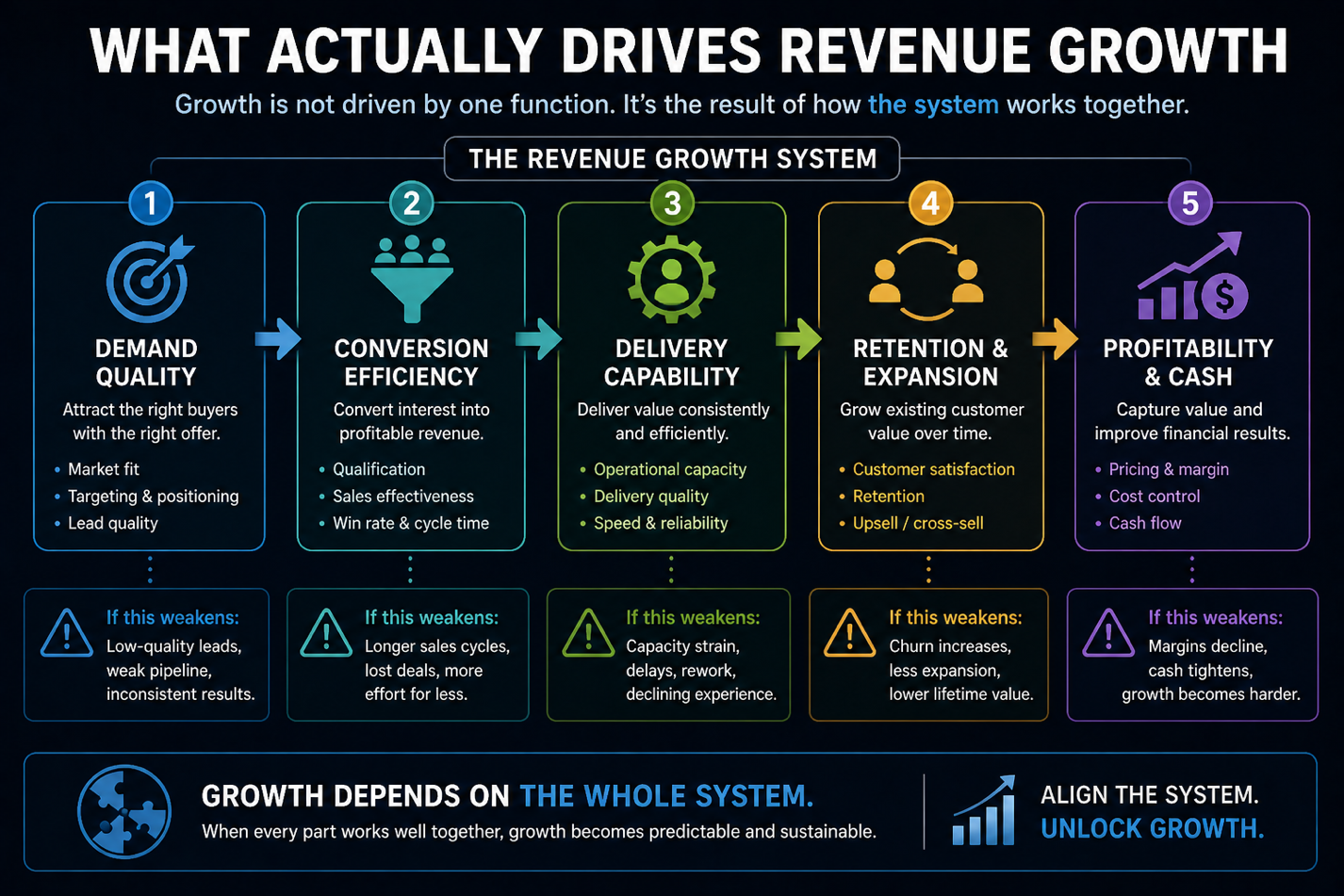
The Hidden Forces Behind Stalled Growth
Revenue is not driven by one function.
It is the result of how several parts of the business work together:
- Demand quality
- Conversion efficiency
- Delivery capability
- Retention and expansion
- Cost structure
If one weakens, the system absorbs it.
If several weaken, growth slows—even if sales increase.
The Role Most Teams Miss: The Offer
There is one element that quietly influences every part of the system.
The offer.
What you sell determines:
- who you attract
- how easily you sell
- how much you can charge
- how well you can deliver
- how likely customers are to stay and expand
- whether other revenue streams are realistic and profitable
If the offer is misaligned, problems show up everywhere.
More leads—but lower quality.
More deals—but more discounting.
More sales—but harder delivery.
I wrote about this in Knowing What You Sell.
The core idea is simple:
When you truly understand what you sell—and who values it most—you can align pricing, positioning, and delivery in a way that improves the entire system.
What a Better Offer Actually Does
A well-aligned offer does more than increase conversion.
It improves the economics of the business.
- It attracts the right customers
- It reduces friction in the sales process
- It supports stronger pricing
- It aligns expectations for delivery
- It increases customer retention and expansion
In many cases, improving the offer is faster and more effective than increasing activity.
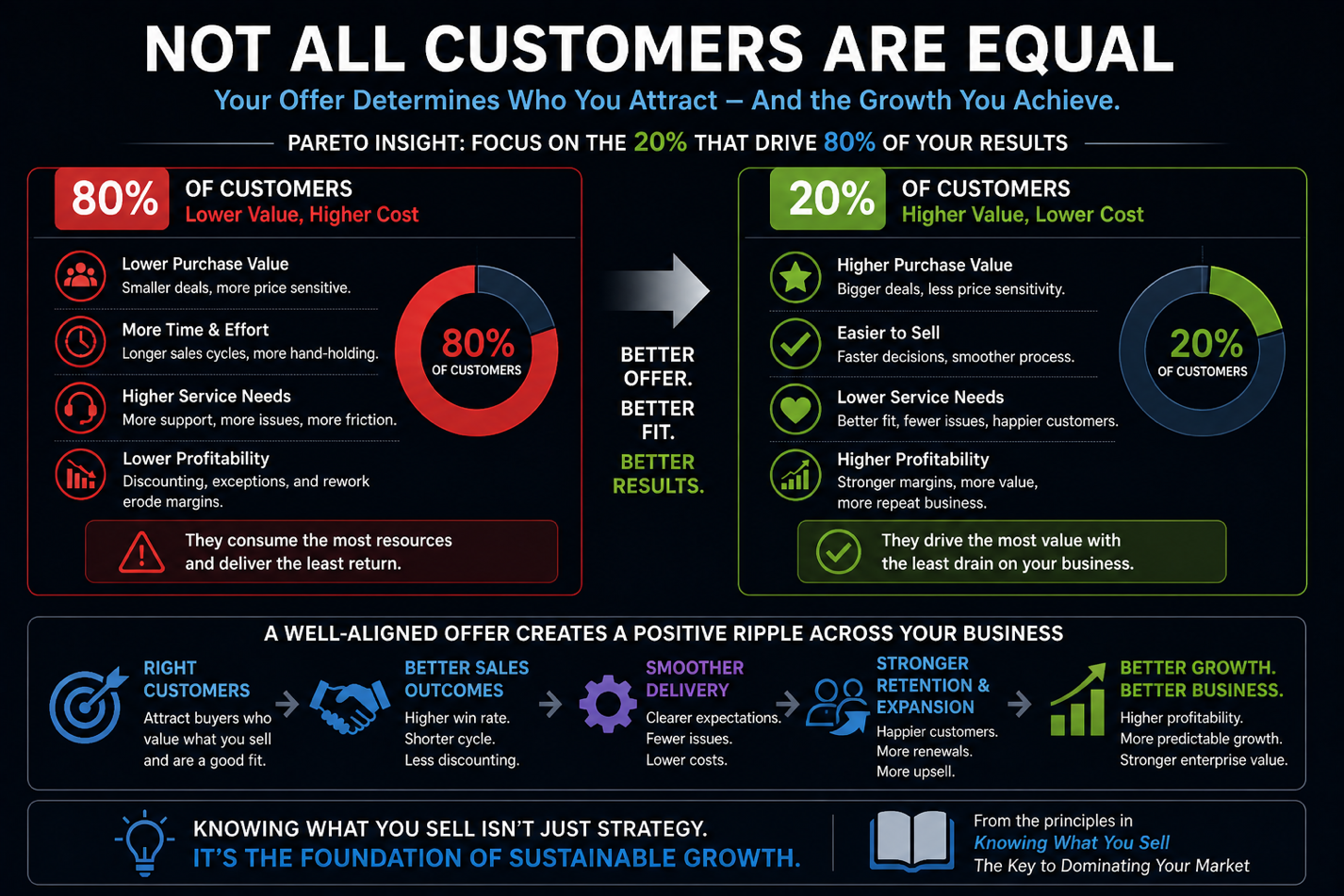
The Pareto Insight Most Businesses Overlook
Not all customers are equal.
A small percentage of customers often:
- pay more
- decide faster
- require less support
- stay longer
- generate more value
A simple Pareto analysis usually reveals this pattern.
Yet many businesses continue to optimize for volume instead of fit.
They attract more customers.
But not better ones.
That gap shows up later as:
- margin pressure
- delivery strain
- inconsistent growth
5 Common Reasons Growth Stalls
1. Low-Quality Demand
More leads, but weaker buyers.
Often driven by:
- broad targeting
- weak positioning
- campaigns optimized for volume instead of fit
2. Conversion Inefficiency
More pipeline, but less effective closing.
- longer sales cycles
- inconsistent qualification
- increased effort per deal
3. Delivery Strain
Sales outpaces the system’s ability to fulfill.
- overloaded teams
- rework
- declining customer experience
4. Revenue Leakage
Value is created, but not fully captured.
- discounting
- churn
- missed expansion
- wasted spend
5. Misaligned Incentives
Teams optimize for their own metrics.
- marketing drives volume
- sales pushes deals
- delivery absorbs the impact
Local success.
System friction.
A Systems View of Growth
Growth is not created in one department.
It emerges from how Demand, Conversion, and Delivery work together. In practice, this is what effective revenue growth management requires: visibility across the full system rather than isolated performance inside one department.
When they are aligned:
Growth becomes smoother and more predictable.
When they are not:
Growth becomes harder—even when sales increase.
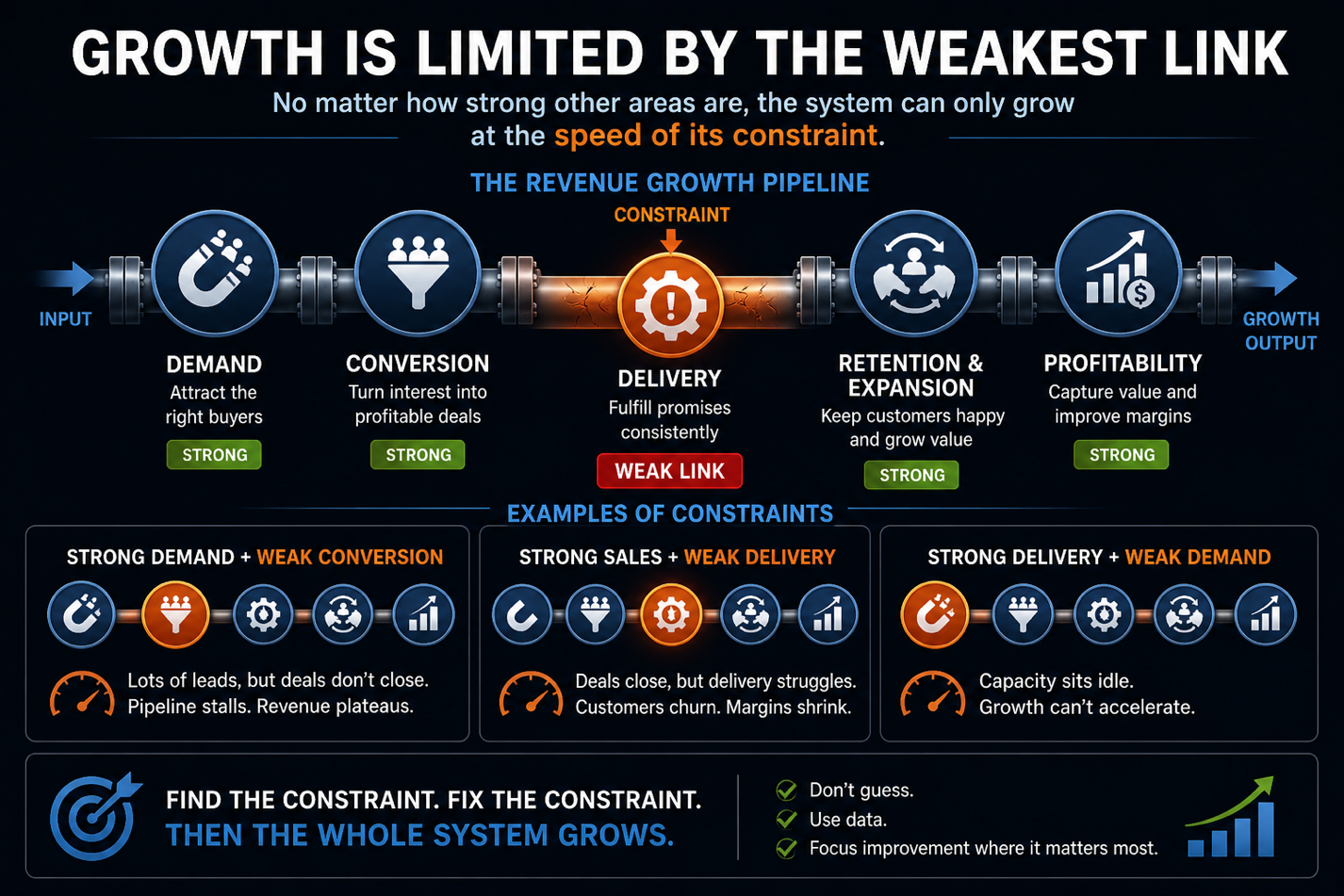
The Constraint Perspective
Every system has a constraint.
At any given moment, one part of the business is limiting overall performance.
- strong demand + weak conversion → stalled pipeline
- strong sales + weak delivery → operational strain
- strong delivery + weak demand → idle capacity
The system moves at the speed of that constraint.
Working harder does not remove it.
It often amplifies it.
What to Look at Instead
Instead of asking:
“How do we sell more?”
Ask:
- Where is growth slowing?
- Where is effort increasing without better results?
- Where are margins declining?
- Where is the system under stress?
- Are we attracting the right customers?
Those answers usually point to what matters.
This is why many common revenue growth strategies fall short when they focus on isolated tactics instead of the full revenue system.
What Strong Companies Do Differently
They:
- focus on growth quality, not just volume
- align their offer with the right customers
- design systems that support delivery
- identify constraints early
- improve what limits performance first
They do not just grow.
They grow well.
Revenue Growth Is a System Outcome
One of the biggest misconceptions in business is that revenue growth is created by sales alone.
Sales certainly matter.
But sustainable revenue growth occurs when multiple parts of the organization work together effectively.
The right customers must be attracted.
The right opportunities must be converted.
The business must be capable of delivering consistently.
Customers must receive enough value to remain, renew, and expand.
And leadership must have visibility into how all of those functions interact.
When any one of those elements weakens, growth becomes more difficult, regardless of how many deals are being closed.
This is why many organizations find themselves working harder every year while achieving smaller gains.
The issue is rarely effort.
The issue is usually alignment.
When leadership improves alignment across demand, conversion, delivery, and retention, it creates a stronger foundation for future revenue growth.
Ready to Accelerate Revenue Growth?
If your company is experiencing strong sales activity but inconsistent revenue growth, the challenge may not be generating more demand.
The challenge may be identifying where growth is being constrained.
My Revenue System Assessment helps leadership teams evaluate the complete revenue system—including Demand, Conversion, Delivery, Data, and Offer Alignment—to identify the specific factors limiting sustainable growth.
The assessment provides a structured framework for uncovering hidden bottlenecks, reducing revenue leakage, improving visibility, and creating a practical roadmap for increasing profitable revenue growth.
Rather than guessing where to invest next, you'll gain clarity on where improvements will have the greatest impact. That clarity helps leadership teams make better decisions about operational priorities, customer fit, and investments that support future revenue growth.
Schedule a Revenue System Assessment and discover what is truly limiting your revenue growth.