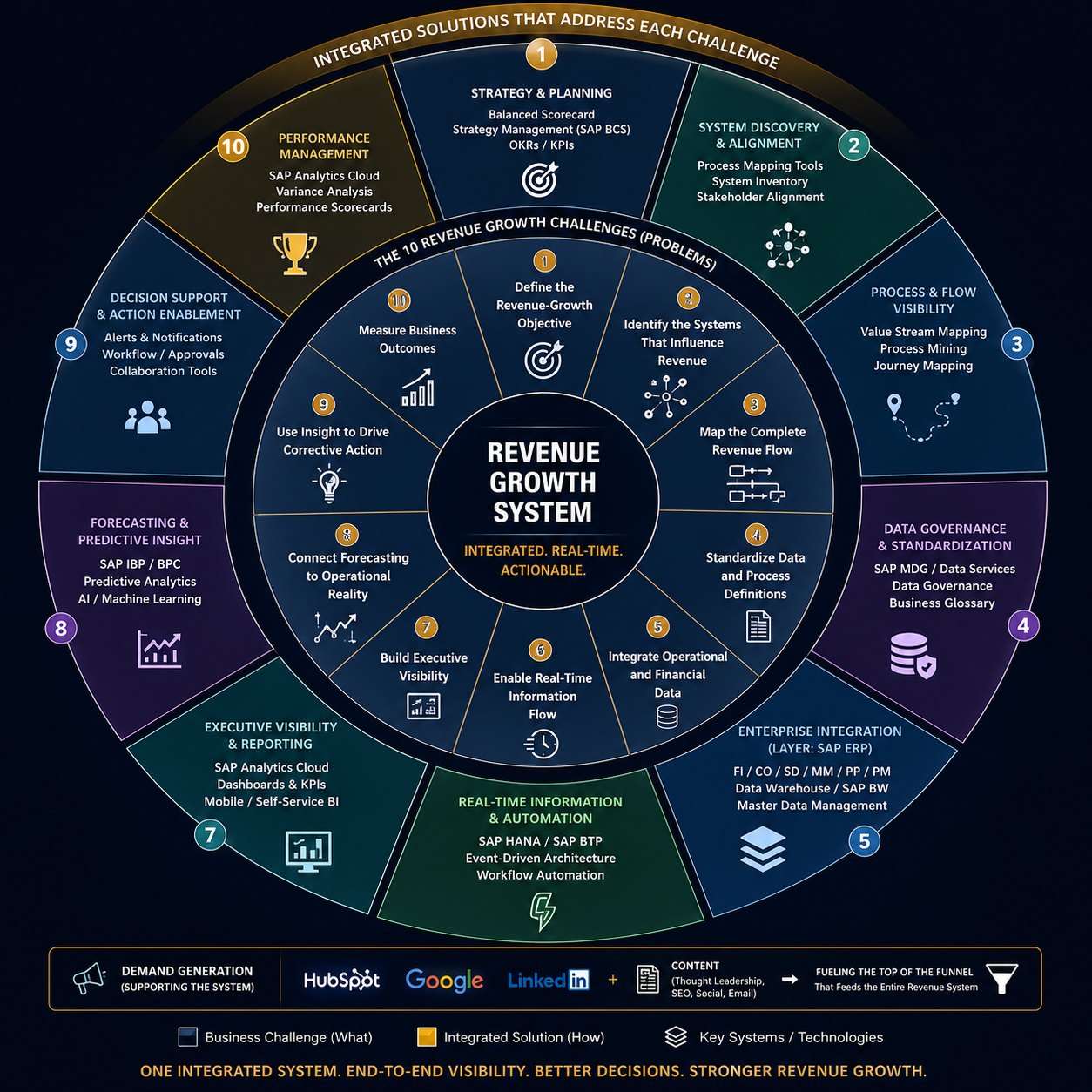
Many companies I work with do not have a real Revenue System.
-
They have activity.
-
They have effort.
-
They have software.
What they often do not have is a connected system for turning demand into profitable revenue.
-
Marketing runs campaigns.
-
Sales manages opportunities.
-
Operations delivers the work.
-
Finance reports the results.
All important.
But that is not the same as having a Revenue System.
That distinction matters because disconnected activity can still produce busy teams, inconsistent forecasts, strained delivery, and missed growth targets.
What is a revenue system?
If you are asking what a Revenue System is, the short answer is this:
A Revenue System is the connected business system that turns demand into measurable, profitable revenue.
It aligns marketing, sales, service delivery, finance, reporting, and leadership decision-making so revenue does not depend on isolated effort or guesswork.
In many B2B companies, HubSpot should sit at the center of that system because it can connect lead generation, CRM activity, lifecycle movement, pipeline management, automation, attribution, and clear, interactive dashboards into a single source of truth.
-
A Revenue System is not just about generating leads.
-
It is not just about closing deals.
-
It is about generating profitable, repeatable revenue with enough visibility to understand what is working, what is breaking, and what needs to improve next.
When the system is aligned, growth becomes more predictable.
When it is not, growth feels harder than it should.
Why HubSpot Should Sit at the Center of a Revenue System
For many growing B2B companies, HubSpot is the practical center of a Revenue System because it connects the activities that usually end up scattered across disconnected tools and spreadsheets.
Marketing can measure Lead Generation, campaign response, channel performance, and conversion paths.
Sales can manage qualification, pipeline movement, follow-up, and forecast visibility.
Leadership can see conversion rates, source performance, deal progression, and revenue trends in one place instead of piecing together reports from multiple systems.
That matters because a Revenue System only works when the business can see how revenue actually moves from first touch to closed business to delivered results.
HubSpot by itself will not fix a broken process.
But when the underlying process is sound, HubSpot gives you the structure, automation, reporting, and accountability needed to turn disconnected activity into coordinated growth.
The Five Characteristics of Every Effective Revenue System
A Revenue System is more than a collection of marketing campaigns, sales activities, or business software. High-performing organizations share several common characteristics that enable them to generate predictable, profitable growth over time.
1. Predictable Demand Generation
Effective Revenue Systems consistently create qualified demand through coordinated marketing, sales, referrals, partnerships, and other growth channels rather than relying on sporadic opportunities.
2. Coordinated Business Execution
Marketing, sales, finance, operations, and customer success work from shared objectives and consistent information, reducing friction between departments and improving the customer experience.
3. Executive Visibility
Leadership teams have timely access to the operational and financial information needed to identify bottlenecks, monitor performance, and make informed decisions before small issues become major problems.
4. Forecast Integrity
Reliable forecasting depends on more than CRM data. Effective Revenue Systems integrate operational, financial, and customer information to provide executives with realistic expectations and greater planning confidence.
5. Continuous Improvement
The best Revenue Systems are continuously refined. Organizations regularly identify constraints, measure outcomes, improve processes, and strengthen the system as markets, customers, and business priorities evolve.
These five characteristics provide a practical way to evaluate any organization's Revenue System. When one or more of them is weak, growth often becomes less predictable, operational complexity increases, and revenue performance begins to suffer.
What a Revenue System Means in Practice
The meaning of a Revenue System becomes clearer when you look at how revenue actually moves through a business.
-
A prospect finds you.
-
Marketing attracts interest.
-
Sales qualifies the opportunity.
-
Delivery fulfills the promise.
-
Leadership measures whether the outcome was profitable, repeatable, and worth scaling.
If those steps are disconnected, revenue may still happen, but it will be harder to forecast, harder to improve, and harder to scale.
If those steps are connected inside one operating model, the business gains visibility, accountability, and a better foundation for growth.
This is why a Revenue System is not just a sales concept or a marketing concept.
It is a business-wide operating system for revenue.
What Most Companies Have Instead
In many businesses, each department is trying to improve its own results.
-
Marketing wants more leads.
- Sales wants more pipeline.
-
Operations wants fewer disruptions.
-
Finance wants cleaner forecasts.
Reasonable goals.
But if each area improves in isolation, the overall business may not improve at all.
I’ve seen companies generate more demand that sales cannot convert.
I’ve seen sales outperform targets while delivery struggles to keep up.
I’ve seen teams add tools, dashboards, and process—yet still miss revenue goals.
Why?
Because they optimized parts of the business, not the whole.
What a Revenue System Looks Like in a Service Business
This matters even more in a service business.
If you sell consulting, implementation, managed services, agency work, or project-based delivery, revenue does not stop at the signed agreement.
Revenue depends on whether the opportunity was qualified correctly, whether the scope was realistic, whether delivery can execute profitably, and whether the client experience creates retention, referrals, or expansion.
That is why service firms need more than lead generation.
They need a Revenue System that connects demand, qualification, delivery readiness, reporting, and executive visibility.
For a consultancy, a dev shop, or a B2B services firm, a weak Revenue System usually shows up as one of two problems:
-
Too much poor-fit demand that sales cannot close profitably.
-
Or too many closed deals that delivery struggles to fulfill cleanly.
Neither problem gets solved by adding more activity.
Both problems require a better system.

The 3 Core Engines of a Revenue System
While every business has its own nuances, most Revenue Systems rely on three connected engines:
1. Demand
This is how the market discovers you and becomes interested.
Examples:
- inbound marketing
- outbound outreach
- referrals
- partnerships
- paid media
- thought leadership
The goal is not traffic for its own sake.
Demand matters, but demand by itself is not the Revenue System.
A company can generate traffic, leads, and even meetings without generating profitable growth.
The real question is whether marketing is attracting the right opportunities, whether those opportunities convert, and whether the business can fulfill what it sells without margin erosion or delivery strain.
The goal is qualified buying intent entering the system.
2. Conversion
This is how interest becomes customers.
Examples:
- qualification
- discovery
- proposals
- demos
- follow-up
- negotiation
- closing process
Many businesses have demand.
Fewer have a consistent conversion system.
That gap is expensive.
In many companies, this is where the Revenue System starts to break.
The pipeline may look active, but qualification is inconsistent, follow-up is uneven, forecasting is optimistic, or sales is pursuing business that delivery should never have accepted in the first place.
That is why conversion needs structure, not just effort.
3. Delivery
This is where promises become outcomes.
Examples:
- onboarding
- implementation
- project execution
- support
- account growth
- renewal
This is the area many companies treat as “after the sale.”
That is usually a mistake.
Delivery affects referrals, retention, reputation, margin, and future revenue.
It belongs inside the system—not outside it.
When delivery sits outside the Revenue System, leadership loses visibility into one of the most important parts of growth.
A company may think it has a sales problem when the real issue is fulfillment strain, poor onboarding, weak handoff quality, or unprofitable execution.
You cannot improve revenue consistently if delivery performance is disconnected from the rest of the system.
How to Know If Your Revenue System Is Broken
Usually, the symptoms show up before the cause is clear.
You may see:
- strong traffic, weak conversion
- active pipeline, inconsistent close rates
- growing sales, operational strain
- missed forecasts despite high effort
- teams blaming other departments
- more activity without better outcomes
Those are rarely isolated problems.
They are system signals.
A broken Revenue System usually shows up in four places: lead quality, pipeline movement, delivery execution, and forecast accuracy.
If those areas are consistently under strain, the issue is rarely that one team is not working hard enough.
The issue is that the business does not have a connected system for generating, converting, delivering, and measuring revenue.
Why Working Harder Usually Fails
When results disappoint, many teams respond with more effort.
-
More campaigns.
-
More meetings.
-
More Calls.
- More Tools.
- More Reporting.
Sometimes effort is necessary.
But working harder is not the same as improving the system.
If the real constraint remains untouched, added effort often creates noise, not progress.
The better question is:
What is the one point limiting performance right now?
Find that first.
How to Build a Revenue System
If you want to build a Revenue System, start by identifying the point where revenue flow is breaking down.
In one business, the issue may be weak Lead Generation.
In another, it may be poor qualification, inconsistent follow-up, delivery bottlenecks, weak reporting, or forecast visibility that leadership cannot trust.
Once the constraint is clear, build the system around five practical elements:
- Clear revenue goals
- Defined handoffs between marketing, sales, and delivery
- HubSpot as the central system for CRM, automation, and reporting
- Shared performance metrics across teams
- Executive visibility through clear, interactive dashboards
That is what turns revenue growth from a series of disconnected efforts into a system that can be measured, improved, and scaled.
What an Aligned Revenue System Looks Like
When the system is working:
-
Marketing attracts the right opportunities.
-
Sales moves deals forward with structure.
-
Delivery fulfills without constant strain.
-
Leadership sees clear metrics.
-
Revenue becomes easier to forecast.
-
Growth becomes less dramatic—and more dependable.
That last point matters.
Many companies chase spikes.
Strong businesses build flow.
Revenue System vs. Revenue Management System
A Revenue System is not the same thing as a Revenue Management System.
Revenue management usually refers to pricing, yield, inventory, or capacity optimization in industries like hospitality, travel, or subscription-based software.
A Revenue System is broader.
It includes the people, processes, tools, reporting, and executive decision-making required to generate demand, convert opportunities, deliver outcomes, and measure profitable growth across the business.
That distinction matters because many companies do not have a pricing problem.
They have a systems problem.
Where Technology Fits
Technology can be a force multiplier—but only when it supports the system.
That may include:
- HubSpot
- CRM platforms
- SAP
- Analytics tools
- Automation
- Dashboards
Good tools help a good system move faster.
Bad systems simply become digitized confusion.
Software alone is rarely the answer.

Final Thought
A Revenue System is not a dashboard.
It is not a campaign.
It is not a sales script.
It is the way your business consistently turns opportunity into profitable results.
Most growth problems become clearer the moment you stop asking:
“How do we get more leads?”
…and start asking:
“How does revenue actually happen here?”
That is where real improvement begins.
If You’d Like a Practical Outside View
I’ve built a focused Revenue System Assessment for businesses that need a practical outside view of where revenue is getting stuck.
If your challenge is weak demand, inconsistent conversion, delivery strain, unclear reporting, or forecast visibility that leadership cannot trust, this assessment is designed to identify the constraint and show you what to improve first.
You can learn more by clicking the button: