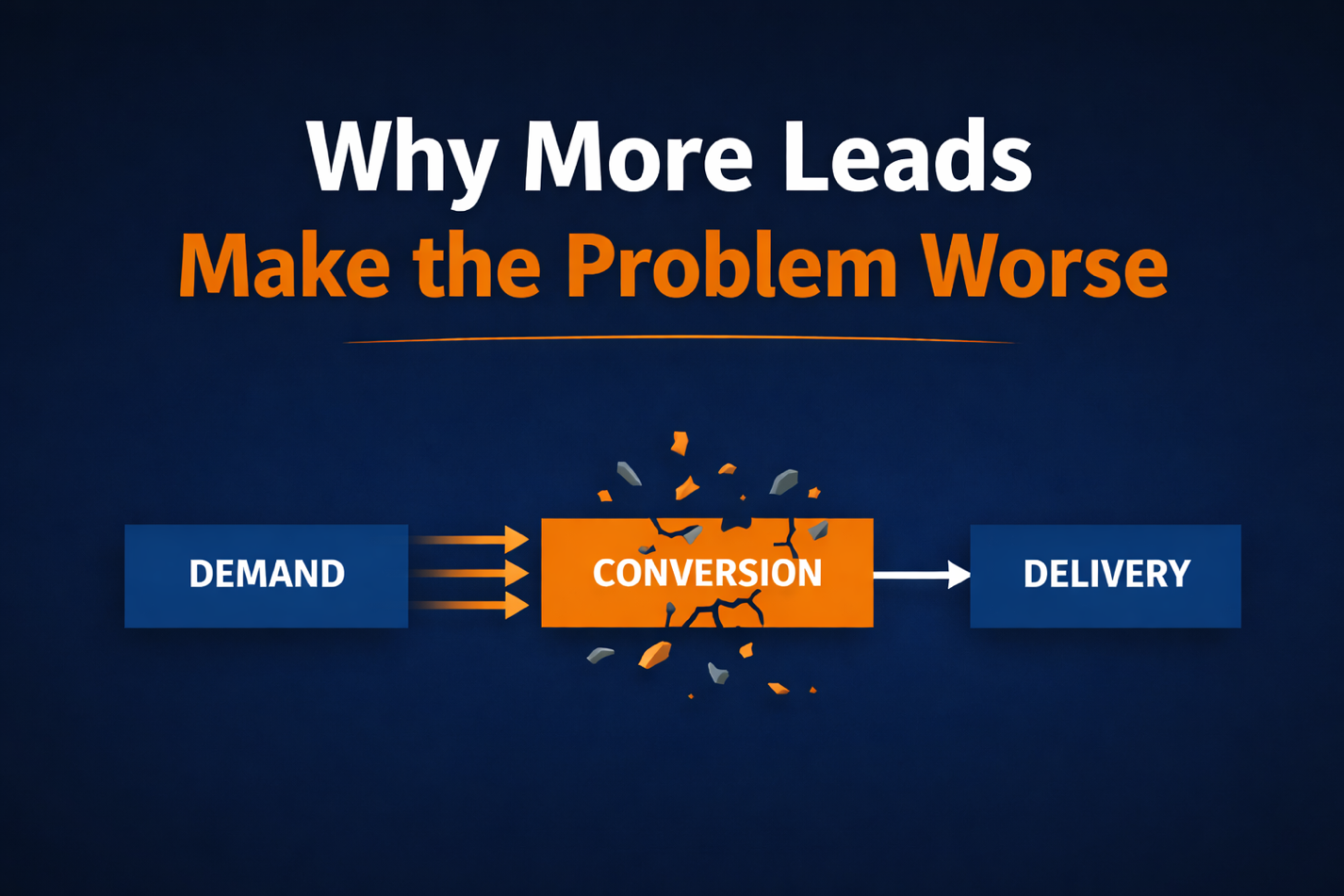
Where Your Revenue System Is Breaking (And Why Fixing It Changes Everything)
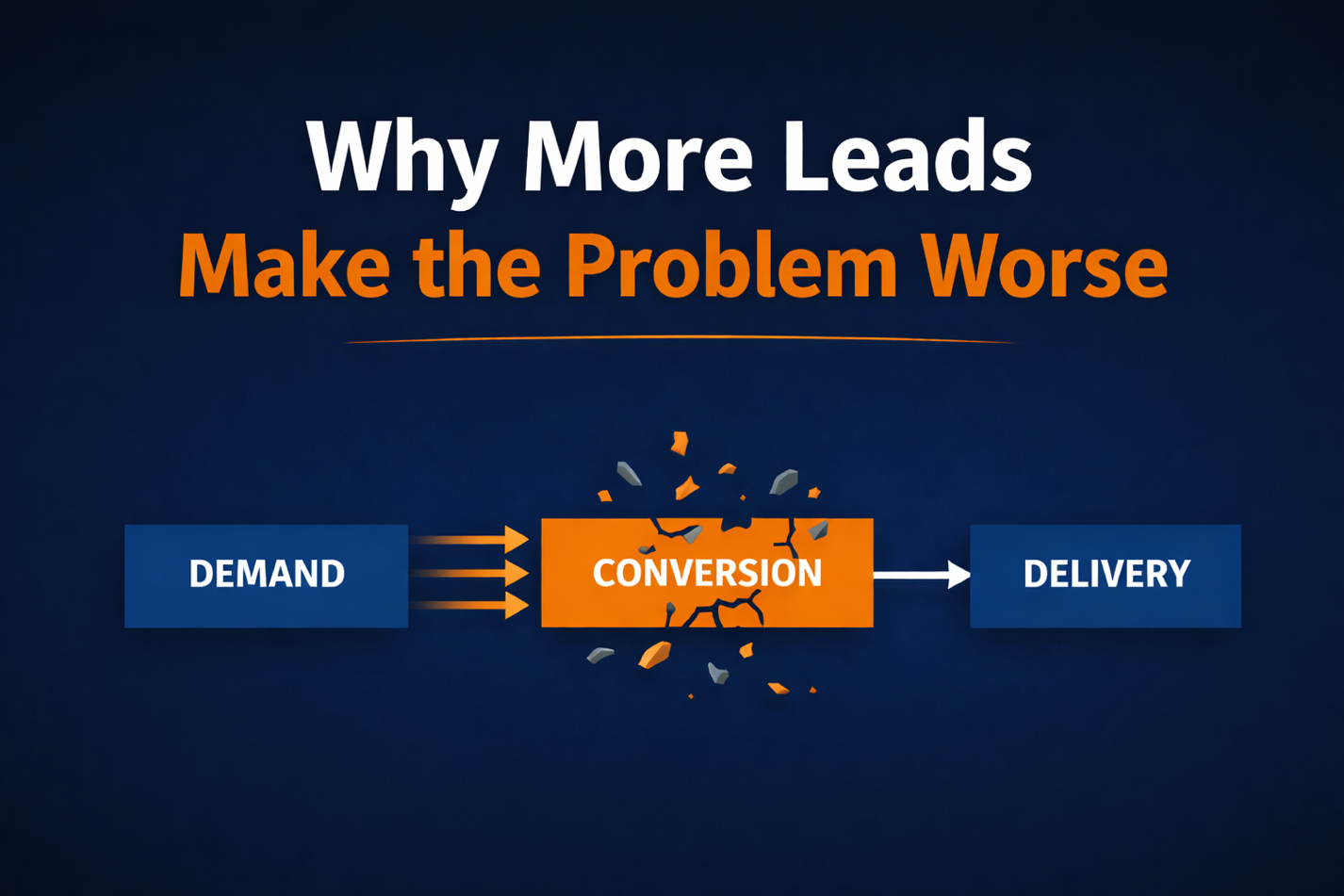
Most companies don’t know where their growth is breaking.
They just know something isn’t working.
So they try to fix everything:
More campaigns More sales activity More tools
And the problem stays.
Executive Summary
When revenue growth slows, many leadership teams assume they need more marketing, more sales activity, more technology, or more reporting.
Unfortunately, those efforts often increase complexity without improving results.
The reason is simple: businesses do not grow because individual departments perform well. Businesses grow when the entire revenue system works together.
In most organizations, growth is limited by a specific constraint that interrupts the flow between Demand, Conversion, Delivery, and Data. Until that constraint is identified and addressed, improvements elsewhere frequently create additional activity while leaving the underlying problem untouched.
This article introduces a practical framework for diagnosing where revenue momentum is breaking, explains the three most common bottlenecks that limit growth, and shows why high-performing organizations focus on system optimization rather than departmental optimization.
Key Takeaways
- Most growth challenges are system problems rather than departmental problems.
- Revenue constraints typically appear in Demand, Conversion, or Delivery.
- Improving non-constrained areas often increases activity without improving outcomes.
- The most valuable question leaders can ask is, "Where does momentum break?"
- Strong businesses optimize the entire revenue system rather than individual functions.
- Sustainable growth occurs when marketing, sales, and delivery operate as one connected system.
- Finding and removing the current constraint often creates larger gains than dozens of smaller improvement initiatives.
The organizations that scale most successfully are not necessarily doing more than their competitors. They are simply better at identifying and eliminating the bottlenecks that restrict growth.
The Real Issue Isn’t Effort. It’s the System.
Across different industries, teams, and technologies, I see the same pattern:
The issue is rarely inside one function.
It’s between them.
Marketing is doing its job. Sales is working hard. Delivery is trying to keep up.
But the system connecting them isn’t aligned.
And that’s where growth slows down.
There’s Usually One Constraint
In most cases, there is one point in the system where:
-
Leads stop moving
-
Deals stall
-
Work begins to pile up
That point is the constraint.
Until that constraint is identified and addressed, improving other areas tends to create more complexity—not better results.
A Simple Way to Diagnose the Problem
You don’t need weeks of analysis to start seeing this.
You can usually identify where things are breaking by asking one question:
Where does momentum break?
If leads are low or poor quality → it’s Demand
This often shows up as:
-
Traffic that doesn’t convert
-
Messaging that attracts attention, not intent
-
Leads that aren’t ready—or able—to buy
Marketing may look active, but it isn’t creating real forward movement.
If leads exist but don’t convert → it’s Conversion
This typically looks like:
-
A full pipeline that doesn’t move
-
Inconsistent follow-up
-
CRM systems that track activity but don’t drive it
Sales is busy—but momentum is missing.
If deals close but things break after → it’s Delivery
This is where many growth efforts stall:
-
Sales outpaces execution
-
Teams become overloaded
-
Processes break under pressure
The business grows—but can’t sustain it.
The 3 Most Common Revenue Bottlenecks
After working across different organizations, these patterns show up repeatedly:
1. High Traffic. Low Conversion.
Marketing is working.
Leads are coming in.
But sales struggles to convert them.
What’s really happening:
-
Messaging attracts interest, not buying intent
-
Leads enter at the wrong stage
-
Sales spends time qualifying instead of closing
This isn’t a lead problem.
It’s a Demand → Conversion disconnect
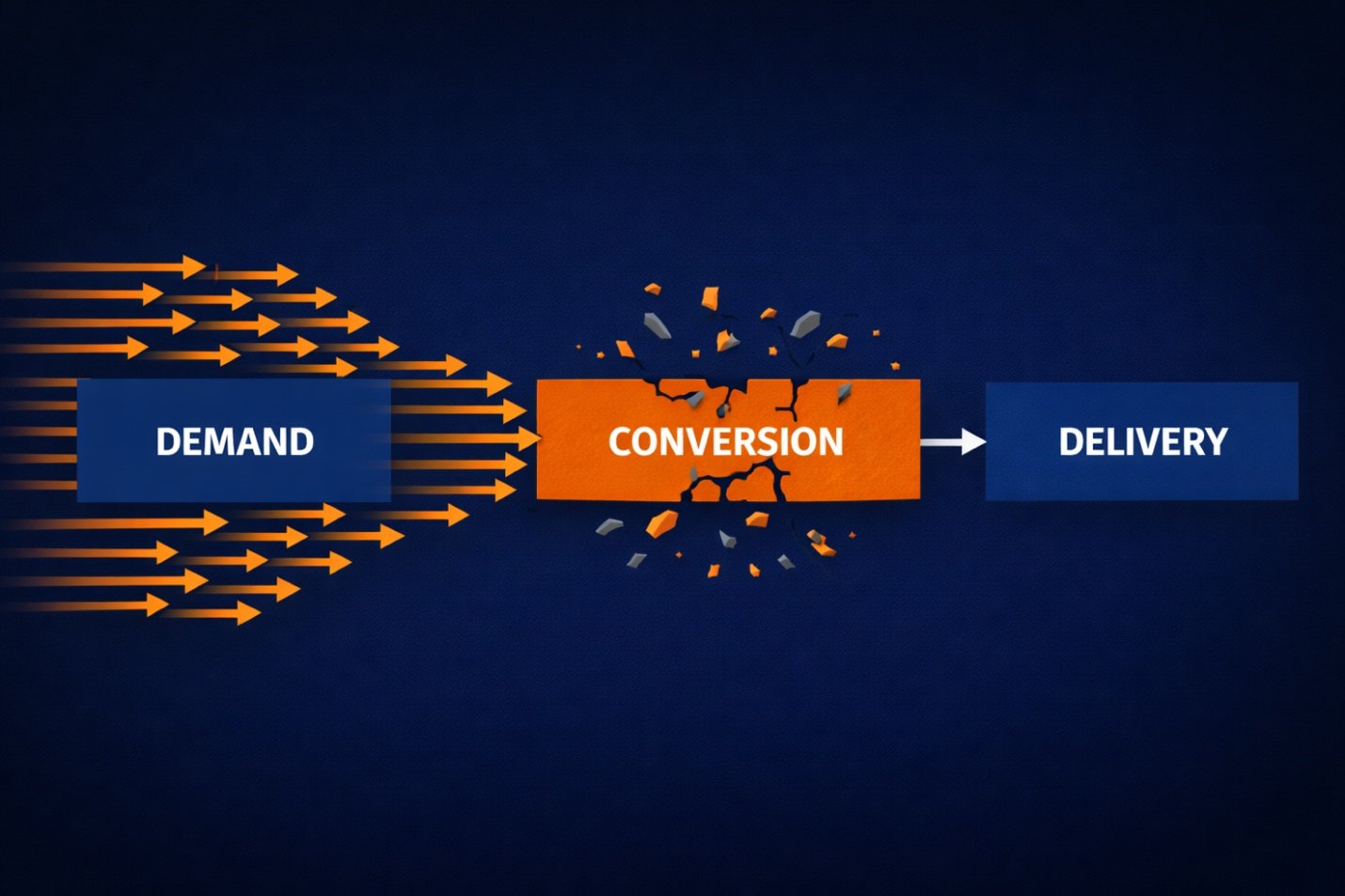
The Demand Conversion Disconnect
2. Full Pipeline. Weak Close Rate.
The CRM looks healthy.
There’s activity, opportunities, movement.
But deals don’t close consistently.
What’s really happening:
-
Pipeline stages don’t reflect reality
-
Momentum is lost between steps
-
Follow-up lacks structure
This isn’t a sales effort issue.
It’s a Conversion system problem.
3. Strong Sales. Broken Delivery.
Deals are closing.
Revenue is coming in.
And then the system starts to strain.
What’s really happening:
-
Sales outpaces operations
-
Delivery isn’t designed to scale
-
Execution becomes the limiting factor
This isn’t growth.
It’s a Delivery constraint.
Why Most Fixes Don’t Work
Most companies respond by trying to improve everything at once:
-
More leads
-
More sales activity
-
More process
But this usually increases complexity without improving performance.
Because the constraint hasn’t been addressed.
What Actually Works
The approach that consistently produces results is simpler:
Find the constraint. ->Fix that first<-. Then reassess the system.
When the constraint is addressed:
-
Leads begin to move
-
Sales regains momentum
-
Delivery stabilizes
And the system starts to flow.
The Shift Most Teams Need to Make
Growth isn’t about optimizing isolated functions – commonly known as the local optima.
It’s about aligning the system or optimizing at global optima level.
That means:
-
Marketing is built around how sales actually converts
-
Sales is built around how delivery actually works
-
Delivery is designed to support how the business grows
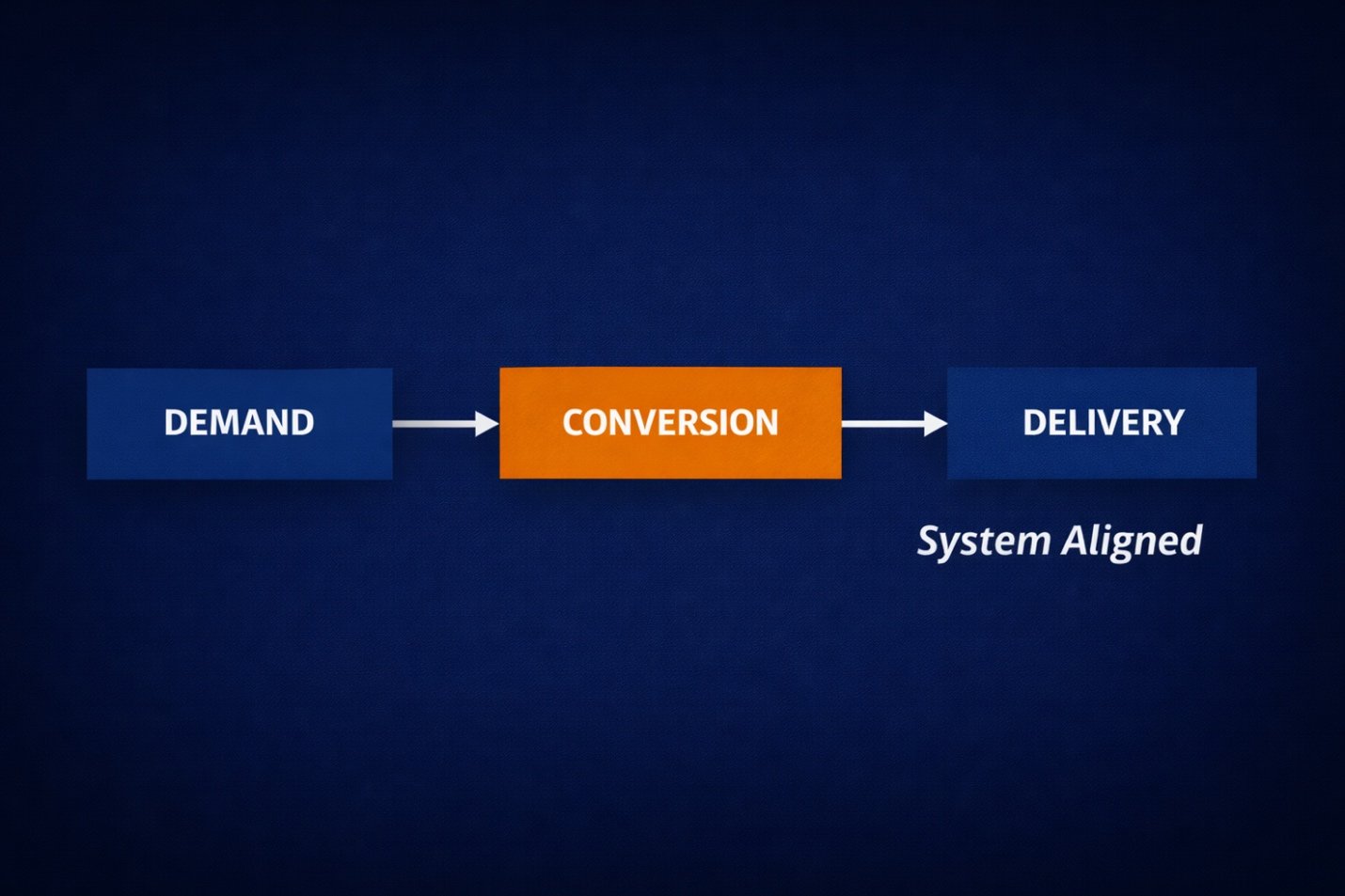
An aligned system
The Competitive Advantage Most Companies Miss
Many organizations spend years optimizing individual departments.
Marketing tries to generate more leads.
Sales tries to increase activity.
Operations tries to improve efficiency.
Technology teams implement new platforms.
Each initiative may produce incremental improvements.
Yet leadership still struggles to achieve predictable growth.
Why?
Because revenue is not created by individual functions.
Revenue is created by the interactions between those functions.
When marketing, sales, delivery, and data operate independently, growth becomes difficult to predict and even harder to scale.
When they operate as a connected system, momentum compounds.
Forecasts become more accurate.
Customer acquisition becomes more efficient.
Delivery becomes more consistent.
Growth becomes more sustainable.
The difference is not effort.
The difference is alignment.
Ready to Find the Constraint Limiting Growth?
Most executives already know something is slowing performance.
The challenge is determining exactly where it is happening.
My Revenue System Assessment helps leadership teams identify where momentum is breaking across Demand, Conversion, Delivery, and Data. Rather than focusing on isolated symptoms, the assessment evaluates how the entire revenue system functions together and identifies the specific constraints limiting growth.
The result is a practical roadmap that helps prioritize improvement efforts, eliminate bottlenecks, and create greater visibility across the organization.
If growth feels harder than it should, the answer may not be more activity.
It may be understanding where your revenue system is breaking—and fixing that first.
Schedule a Revenue System Assessment and uncover the one constraint that is holding back your next stage of growth.