
Ever wonder what separates a thriving sales team from one that constantly struggles? The answer often lies in their approach to sales pipeline stages. These steps create a clear path that guides potential customers from their first interaction to the final handshake, turning prospects into paying customers.
A well-defined pipeline is more than just a series of boxes to check; it is the framework for your entire sales strategy. Let's break down these essential stages and explore how they can transform your sales efforts from chaotic to consistent.
For B2B companies using HubSpot, optimizing sales pipeline stages requires more than configuring a series of deal stages in a CRM. Each stage should represent meaningful progress toward a purchasing decision, with clearly defined entry and exit criteria, accountable sales owners, and measurable conversion rates.
An effective HubSpot sales pipeline gives sales managers visibility into deal progression, helps identify opportunities that have stalled, and provides the data needed to improve sales forecasting. More importantly, it helps executives determine whether revenue growth is being constrained by insufficient qualified opportunities, poor stage-to-stage conversion, lengthy sales cycles, or other limitations in their revenue system.
The goal is not simply to move more deals through the pipeline. It is to improve the rate at which qualified opportunities become profitable customers. Achieving that requires aligning your B2B sales pipeline stages with how customers actually make purchasing decisions, then using HubSpot to measure performance and continuously improve the process.

Use Our Hubspot Inbound Marketing and Sales ROI Calculator to Find out the ROI you can Get From Using Hubspot Inbound Marketing and Sales Software.
Understanding Sales Pipeline Stages
The sales pipeline represents a visual journey of a prospect's progression through your sales process. Each stage signifies a milestone, moving a potential buyer closer to making a purchase. It provides a clear view of where every deal stands at any given moment.
Having distinct stages is fundamental for effective sales pipeline management. It allows sales leaders to forecast sales with greater accuracy, identify bottlenecks where deals slow down, and coach their sales reps more effectively. Without this structure, you're navigating your sales cycle with no map.
It is important to distinguish between a sales pipeline and a sales funnel. A sales funnel illustrates the customer's buying journey and tracks conversion rates from a broader marketing perspective. In contrast, the key sales pipeline is built from the viewpoint of a sales rep, outlining the specific actions they must take to close deals.
The Typical Sales Pipeline Stages
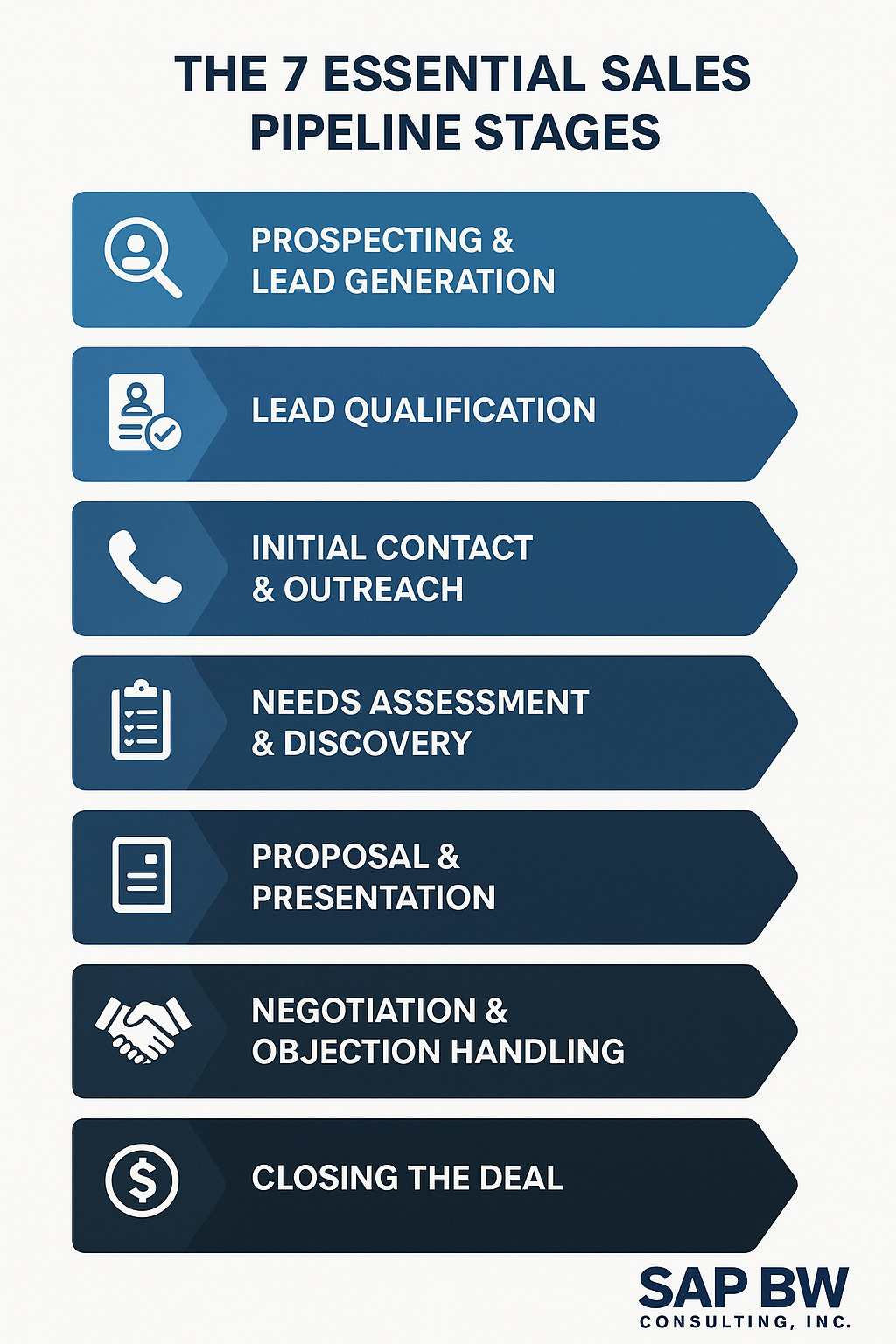
While the exact steps can vary by industry and company, most B2B sales organizations follow a similar pattern. These typical sales pipeline stages provide a solid foundation for building a process that works for your team. This framework is a great starting point for business owners looking to formalize their approach.
Here are the common stages found in a great sales pipeline:
- Prospecting & Lead Generation
- Lead Qualification
- Initial Contact & Outreach
- Needs Assessment & Discovery
- Proposal & Presentation
- Negotiation & Objection Handling
- Closing the Deal
How Should You Define B2B Sales Pipeline Stages?
The most effective B2B sales pipeline stages reflect measurable progress in the buyer's purchasing journey, not merely activities performed by a salesperson. This distinction becomes especially important in complex B2B sales, where multiple stakeholders, lengthy approval processes, and competing priorities can influence whether an opportunity moves forward.
For example, sending a proposal does not necessarily mean an opportunity has progressed to the proposal stage. The buyer may not have confirmed the requirements, agreed to evaluate the solution, or established a decision timeline. Advancing the deal prematurely can make the pipeline appear healthier than it actually is.
A well-designed pipeline should therefore answer three questions for every stage:
- Entry criteria: What evidence must exist before an opportunity enters this stage?
- Exit criteria: What must the buyer or sales team accomplish before the opportunity advances?
- Management accountability: Who is responsible for confirming that the required conditions have been satisfied?
These definitions create a consistent basis for evaluating opportunities across sales representatives, improving pipeline reporting, and identifying where deals are becoming stalled.
What Qualifies a Deal to Enter a Pipeline Stage?
Each stage should represent a meaningful milestone in the buying process. The specific criteria will depend on your sales model, but the following examples illustrate how the seven typical sales pipeline stages can be translated into measurable conditions.
| Sales Pipeline Stage | Example Entry Criteria | Example Exit Criteria |
|---|---|---|
| Prospecting & Lead Generation | A potential customer matching the target market has been identified. | Sufficient information exists to begin qualification. |
| Lead Qualification | The prospect is being evaluated against qualification requirements. | A credible business need, potential fit, and reason to continue have been established. |
| Initial Contact & Outreach | A qualified prospect has been assigned for outreach. | The prospect has engaged and agreed to a meaningful sales conversation. |
| Needs Assessment & Discovery | The prospect has agreed to discuss business requirements. | Business needs, decision stakeholders, and evaluation requirements are sufficiently understood. |
| Proposal & Presentation | The buyer has confirmed requirements and agreed to evaluate a proposed solution. | The buyer has reviewed the proposal and identified remaining questions or commercial conditions. |
| Negotiation & Objection Handling | The buyer is actively evaluating commercial terms or resolving final objections. | The parties have agreed on terms and are ready for formal commitment. |
| Closing the Deal | The opportunity has reached the final commitment process. | The deal is recorded as Closed Won or Closed Lost, with the outcome documented. |
These are illustrative criteria, not mandatory HubSpot settings. Some organizations combine stages, while others require additional approval, procurement, or technical validation milestones.
Also, not every lead belongs in a deal pipeline. In HubSpot, early prospecting and qualification activities can be managed through contact and company records before a qualified opportunity is represented as a deal. This helps prevent unqualified leads from inflating pipeline value and distorting sales forecasts.
Why Stage Exit Criteria Matter for Forecast Accuracy
A sales forecast is only as reliable as the information and assumptions supporting it.
Consider two sales representatives managing opportunities worth $100,000 each. Both opportunities are recorded in the proposal stage. However, one prospect has confirmed the business case, secured executive sponsorship, and scheduled a final decision meeting. The other has simply received a proposal and has not responded.
If both deals receive the same stage-based probability, their forecast values may be identical despite having substantially different levels of buyer commitment.
Clearly defined exit criteria help reduce this problem by establishing consistent evidence requirements before opportunities advance.
However, stage definitions alone are not sufficient. Sales managers should also evaluate:
- Stage conversion rates: What percentage of opportunities successfully advance to the next stage?
- Time in stage: How long do opportunities remain in each stage before advancing, closing, or becoming inactive?
- Buyer commitment: What evidence demonstrates that the customer intends to continue the purchasing process?
- Forecast accuracy: How closely do projected sales outcomes match actual closed revenue?
- Opportunity quality: Are sales representatives pursuing opportunities with a realistic probability of becoming profitable customers?
When these measures are consistently captured, management can distinguish between a genuine shortage of qualified opportunities and a sales execution problem occurring later in the pipeline.
The management objective is not to maximize the number of deals advancing through each stage. It is to improve the economic performance of the entire sales process.
This requires defining pipeline stages consistently, measuring actual conversion behavior, and improving the constraints that most directly limit profitable revenue growth.
The seven stages below provide a practical starting framework for designing that process.
Stage 1: Prospecting & Lead Generation
This is where the journey begins. Lead generation is the process of attracting and identifying potential buyers for your products or services. It is the top of your sales funnel, where you cast a wide net to capture interest from your ideal customer.
Methods for lead generation are diverse, including inbound strategies like content marketing, SEO, and social media, as well as outbound efforts like cold calling and email campaigns. Many companies also offer a free trial to let prospects experience the product firsthand. The goal is to fill your pipeline with individuals or businesses that could benefit from your solution.
Effective lead generation isn't just about quantity; it's about quality. Targeting the right audience from the start saves time and resources down the line. This is why having a clear profile of your ideal customer is essential for all sales professionals.
Stage 2: Lead Qualification
Once you have a pool of leads, the next step is lead qualification. This critical stage involves filtering your leads to determine which ones have a genuine potential to become customers. It helps sales reps focus their energy on opportunities that are most likely to convert.
A popular framework for qualification is BANT, which stands for Budget, Authority, Need, and Timeline. A sales rep will ask questions to find out if the prospect has the necessary budget, if they are the decision-maker, if there is a real business need, and if their timeline for a purchase aligns with your sales cycle length. This initial check helps to address potential roadblocks early.
Proper qualification is a cornerstone of an efficient sales process. It prevents your pipeline from getting clogged with dead-end leads and allows your team to dedicate their attention to nurturing promising relationships that will grow revenue faster.
Stage 3: Initial Contact & Outreach
With a qualified lead identified, it is time for the initial contact. This is the first direct interaction your sales rep has with the prospect. The primary goal is not to make a sale but to establish a connection and schedule a more in-depth conversation or meeting.
This outreach could be a personalized email, a phone call, or a message on a professional networking site. The key is to be prepared, professional, and focused on the prospect's potential challenges. A great first impression can set a positive tone for the entire sales cycle.
This stage is about opening a dialogue and showing the prospect you have done your research. By referencing a specific pain point or a recent company event, you demonstrate genuine interest. This builds the foundation for a mutually beneficial relationship.
Stage 4: Needs Assessment & Discovery
Now you can dig deeper into the prospect's world. The needs assessment stage, often called the discovery call, is where you learn about your prospect's specific challenges, goals, and pain points. Your job is to listen more than you talk.
During this conversation, sales professionals ask open-ended questions to understand the full scope of the problem. What are their current frustrations? What have they tried before? What does success look like for them?
The valuable insights gathered here are priceless. They allow you to position your product or service as the perfect solution in the next stage. This detailed understanding helps sales reps build a strong business case for the prospect.
Stage 5: Proposal & Presentation
Armed with a deep understanding of the prospect's needs, you can now present your solution. In the proposal stage, you formally outline how your product or service will solve their specific problems. This can be a formal document, a slide deck, or a live product demonstration.
A winning proposal focuses on value and benefits, not just features. It should directly address the pain points uncovered during discovery and clearly articulate the return on investment. The main content should be customized to resonate with the prospect's business goals.
This is your chance to showcase your expertise and build confidence. You are demonstrating that you not only understand their problems but also have a clear plan to help them succeed. This moves you one step closer to closing the deal.
Stage 6: Negotiation & Objection Handling
Even after a compelling presentation, prospects often have questions or concerns. The negotiation stage is a natural part of the buying journey where you work through objections and finalize the terms of the agreement. This might involve discussions about pricing, contract length, or implementation details.
Successful negotiation requires flexibility and a focus on finding common ground. Great sales reps listen to objections carefully, validate the prospect's concerns, and provide confident answers. The goal is to create an agreement that benefits both parties and sets the stage for a long-term partnership.
Handling this stage well is a mark of skilled sales professionals. It reinforces the prospect's trust and confirms they are making the right decision. A solid sales operation often provides reps with training and resources to handle common objections effectively.
Stage 7: Closing the Deal
This is the moment all your hard work leads up to. The closing stage is when the prospect commits to the purchase, signs the contract, and officially becomes a customer. It is the culmination of the entire sales process.
Successfully closing deal after deal requires clear next steps. The sales rep should confirm all details, get the necessary signatures, and manage the transition to an onboarding or customer success team. A smooth handoff is vital for long-term customer satisfaction.
A successful close is not the end of the road; it's the beginning of a relationship with a new customer. A positive experience at this final stage can lead to future business and referrals, contributing to sustainable growth for business leaders.
How to Configure and Optimize HubSpot Sales Pipeline Stages
Understanding the stages of a B2B sales pipeline is essential, but translating those stages into a properly configured CRM is what makes consistent sales execution and reliable management reporting possible.
A well-designed HubSpot sales pipeline should do more than display deals in columns. It should establish a consistent sales process, capture the information required to evaluate opportunities, support appropriate automation, and provide management with reliable evidence about where revenue is being gained or lost.
The following five steps provide a practical framework for configuring and optimizing HubSpot deal pipeline stages.
1. Configure Deal Stages Around Your Actual Sales Process
In HubSpot, navigate to Settings → Data Management → Objects → Deals → Pipelines to review and customize your deal pipeline.
You can rename stages, change their order, add stages, and configure the probability associated with each stage.
However, your HubSpot deal stages should reflect how your customers actually make purchasing decisions, rather than simply reproducing a generic sales methodology.
For example, a company selling complex enterprise software may need separate stages for technical validation, executive approval, and contract negotiation. A professional services company may use a simpler pipeline built around discovery, proposal, and agreement.
If your organization needs assistance translating its sales methodology into a working CRM configuration, our HubSpot consulting services include sales pipeline setup, automation, and management reporting.
Before configuring the pipeline, answer three questions:
- What evidence demonstrates that an opportunity has entered each stage?
- What conditions must be satisfied before the deal advances?
- Who is responsible for verifying those conditions?
As discussed earlier, not every prospect needs to become a deal immediately. HubSpot lifecycle stages help classify contacts and companies according to their relationship with your business, while deal pipeline stages track the progress of specific sales opportunities.
Keeping these concepts distinct helps prevent unqualified leads from inflating the value of your sales pipeline.
2. Define Required Deal Properties and Stage Exit Criteria
One of the most common problems in CRM implementations is inconsistent data entry.
Sales representatives may advance deals without recording essential information, such as the buyer's business requirements, decision process, expected close date, or next agreed action.
HubSpot supports conditional stage properties that can prompt users to provide specific information when creating a deal in a stage or manually moving it into that stage. Supported properties can be made required.
For example, you might establish the following information requirements:
- Qualification: Business need, estimated opportunity value, and qualification status.
- Discovery: Documented requirements, key stakeholders, and agreed next steps.
- Proposal: Proposed solution, deal amount, expected close date, and proposal status.
- Negotiation: Outstanding commercial issues, decision authority, and expected agreement date.
- Closing: Final outcome, closed-lost reason where applicable, and customer handoff information.
These are recommended business requirements, not necessarily standard HubSpot properties. Some may require custom properties.
For additional control, supported HubSpot subscriptions offer pipeline rules that can restrict stage skipping or backward movement.
The objective is not to burden salespeople with unnecessary administrative work. It is to ensure that the information required for effective sales management is available, accurate, and consistently maintained.
3. Configure Deal Probabilities for More Reliable Sales Forecasting
HubSpot allows you to associate a probability of closing with each deal stage.
For example, a $100,000 opportunity in a stage with a 40% probability has a stage-weighted value of $40,000.
Weighted Pipeline Value = Deal Amount × Deal Probability
However, the assigned probability should not be confused with an objective prediction of whether a particular opportunity will close.
If a company assigns an 80% probability to every deal in negotiation, but historical data shows that only 45% of those opportunities close successfully, the resulting weighted pipeline may substantially overstate expected revenue.
A more reliable approach is to review historical conversion rates, segment opportunities where appropriate, and periodically recalibrate stage probabilities.
HubSpot also supports forecast categories and additional forecasting capabilities, depending on the subscription.
Sales managers should distinguish between:
- Pipeline value: The total potential value of open opportunities.
- Weighted pipeline value: Opportunity value adjusted by deal probability.
- Forecast commitments: Revenue that management expects to close within a defined period.
- Actual closed revenue: The economic result against which forecasts should ultimately be evaluated.
For executives, the objective is not simply to produce a forecast. It is to understand the assumptions behind that forecast, the risks that could prevent its achievement, and the actions required to improve its reliability.
4. Automate Routine Pipeline Activities Without Automating Poor Decisions
HubSpot automation can help reduce administrative work, improve follow-up consistency, and maintain data quality.
Depending on your HubSpot subscription and configuration, useful automation opportunities may include:
- Creating follow-up tasks when deals enter designated stages.
- Notifying sales managers when opportunities remain inactive beyond an established threshold.
- Updating appropriate deal properties when defined business events occur.
- Triggering customer onboarding activities after a deal closes successfully.
- Routing exceptions to the appropriate manager for review.
However, automation should reinforce a well-designed sales process, not compensate for a poorly defined one.
For example, automatically advancing a deal because a proposal was sent may create the appearance of progress without evidence that the buyer has accepted the next step.
A more effective approach is to automate routine administrative actions while retaining appropriate human judgment over qualification, buyer commitment, forecasting, and exceptions.
Automate the routine. Manage the exceptions. Improve the system.
This principle helps organizations scale their sales operations without sacrificing the quality of their management decisions.
5. Build HubSpot Pipeline Reports That Support Management Decisions
Once your HubSpot sales pipeline stages are configured, the next step is to turn the resulting data into useful management information.
A sales dashboard should help managers understand not only what happened, but also where intervention is required.
At a minimum, consider tracking:
- Stage conversion rates: The percentage of opportunities progressing successfully between stages.
- Time in stage: How long opportunities remain at each point in the sales process.
- Pipeline aging: Opportunities that have remained open longer than expected.
- Win and loss rates: The proportion of opportunities that result in successful sales or losses.
- Sales cycle length: The time required to convert qualified opportunities into customers.
- Forecast accuracy: The difference between projected and actual sales results.
- Pipeline value by stage: The distribution of potential revenue across the sales process.
HubSpot reporting capabilities vary by subscription, and some analyses may require custom reports or additional configuration.
The most important consideration, however, is not the number of reports available.
It is whether those reports help management identify the constraints preventing the business from achieving its revenue objectives.
For example, a declining win rate may indicate a qualification problem, competitive disadvantage, pricing issue, or ineffective sales execution. The appropriate response depends on understanding the underlying cause, not simply observing the metric.
Similarly, increasing the number of qualified opportunities may produce little additional revenue if the sales organization lacks sufficient capacity to process them.
An effective HubSpot sales pipeline should therefore support a continuous management cycle:
Measure performance → Identify the constraint → Take corrective action → Evaluate the result → Improve the process.
When pipeline configuration, data quality, forecasting, and management practices work together, HubSpot becomes more than a repository of sales opportunities. It becomes an important component of a connected revenue management system.
Optimizing Your Sales Pipeline Stages
Configuring your HubSpot sales pipeline establishes the foundation for effective sales management. However, even a well-designed pipeline requires continuous evaluation and improvement. The next challenge is determining which changes to your sales process will produce the greatest improvement in conversion rates, sales productivity, and profitable revenue growth.
Effective pipeline management ensures deals move smoothly from one stage to the next. It helps you spot trends, fix issues before they derail a quarter, and empower your team to perform at their best. An optimized process helps sales close deals at a higher rate.
Key Sales Pipeline Metrics to Track
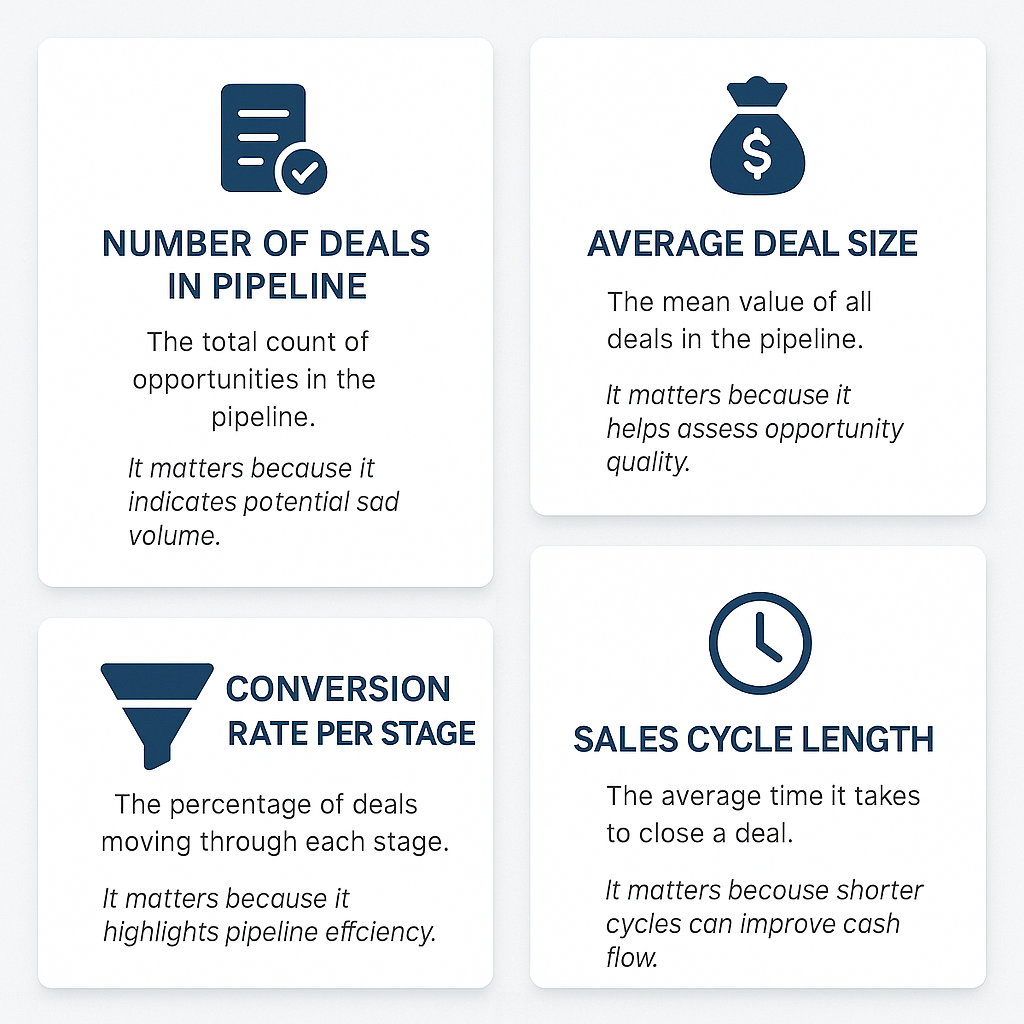
You cannot improve what you do not measure. Tracking key sales metrics at each stage provides the data you need to make informed decisions. A CRM platform is invaluable here, acting as a single source of truth for all sales activities and performance data.
A regular pipeline review meeting is essential for sales management. In these meetings, sales leaders and their teams can analyze metrics, discuss stalled deals, and strategize on how to move opportunities forward. This keeps the entire sales team aligned and focused.
Here is a table of important metrics to monitor for a more efficient sales process:
| Metric | Description | Why It Matters |
|---|---|---|
| Number of Deals in Pipeline | The total volume of opportunities your team is currently working on. | Indicates the overall health and potential of your sales pipeline. |
| Average Deal Size | The average revenue value of a single closed deal. | Helps in forecasting revenue and understanding the value of your pipeline. |
| Conversion Rate per Stage | The percentage of deals that successfully move from one stage to the next. | Identifies bottlenecks and stages where sales reps may need more coaching. |
| Sales Cycle Length | The average amount of time it takes for a deal to move from initial contact to close. | Helps in predicting when deals will close and highlights process inefficiencies. |
| Pipeline Value | The total potential revenue of all deals currently in your pipeline. | Provides a high-level view of your future revenue potential. |
By monitoring these conversion rates and other metrics, you gain valuable insights into the health of your sales operation. This data-driven approach allows you to build a robust sales machine that consistently delivers results and helps you grow revenue faster than the competition.
How to Identify and Remove Sales Pipeline Bottlenecks
Tracking sales pipeline metrics is essential, but improving those metrics requires understanding how the entire sales process behaves as a system.
A useful starting point is measuring sales pipeline conversion rates at each stage, then examining whether those results reflect lead qualification problems, sales execution issues, or limitations elsewhere in the revenue system.
A common mistake in sales pipeline optimization is assuming that every stage should be improved equally. Sales managers may focus on increasing prospecting activity, reducing time in stage, or improving proposal conversion rates without first determining which part of the sales process is actually limiting revenue growth.
The Theory of Constraints (TOC) provides a more effective management approach:
Identify the constraint limiting the performance of the overall system, improve its effectiveness, and then reassess where the constraint has moved.
In a B2B sales pipeline, the constraint might be insufficient qualified opportunities, limited discovery capacity, poor proposal conversion, lengthy procurement cycles, or an inability to onboard additional customers.
The critical question is not simply, "Which stage has the lowest conversion rate?" It is "Which constraint, if improved, would produce the greatest increase in profitable revenue?"
A Practical Example: Improving Sales Pipeline Conversion Rates
Consider a B2B company that generates 200 qualified sales opportunities per month, with an average deal value of $20,000.
Its sales pipeline performance looks like this:
| Pipeline Milestone | Monthly Opportunities | Conversion Rate |
|---|---|---|
| Qualified Opportunities | 200 | — |
| Discovery Completed | 120 | 60% |
| Proposal Submitted | 60 | 50% |
| Negotiation | 30 | 50% |
| Closed Won | 15 | 50% |
The company generates approximately $300,000 in monthly closed-won sales from these opportunities, assuming the deals progress through the modeled stages within the measurement period.
Management initially considers increasing lead generation by 25%. If all downstream conversion rates remain unchanged and sufficient sales capacity exists, this would theoretically increase closed-won deals from 15 to approximately 19 per month.
However, suppose the company's actual operational constraint is limited proposal preparation capacity. The team can complete only 60 qualified proposals per month, regardless of how many additional opportunities enter the pipeline.
Under those conditions, generating more leads will not necessarily increase closed revenue. Instead, it may increase work in progress, delay proposals, and reduce responsiveness to prospective customers.
A more economically effective intervention may be to increase proposal preparation capacity from 60 to 80 proposals per month.
If the existing downstream conversion rates remain unchanged, the results would be:
| Performance Measure | Before Improvement | After Improvement |
|---|---|---|
| Qualified Opportunities | 200 | 200 |
| Completed Proposals | 60 | 80 |
| Negotiations | 30 | 40 |
| Closed-Won Deals | 15 | 20 |
| Average Deal Value | $20,000 | $20,000 |
| Monthly Closed-Won Sales | $300,000 | $400,000 |
In this illustrative scenario, improving the constraint produces a 33.3% increase in monthly closed-won sales without generating a single additional qualified opportunity.
The example assumes sufficient downstream capacity, unchanged conversion rates, and a steady-state sales process. The additional $100,000 represents sales value, not necessarily incremental profit. The economic benefit must also account for the cost of increasing proposal capacity and delivering the additional business.
Use Pipeline Velocity to Evaluate Revenue Performance
Sales pipeline velocity provides another useful perspective on how efficiently opportunities are converted into revenue.
A common pipeline velocity calculation is:
Pipeline Velocity = Number of Qualified Opportunities × Average Deal Value × Win Rate ÷ Average Sales Cycle Length
For example, a pipeline containing 100 qualified opportunities, with an average deal value of $20,000, a 20% win rate, and an average sales cycle of 50 days, produces:
Pipeline Velocity = 100 × $20,000 × 20% ÷ 50 = $8,000 per day
This is a modeled revenue-throughput indicator, not a guarantee of daily sales or cash receipts.
Pipeline velocity can help managers understand the combined effects of opportunity volume, deal value, conversion rates, and sales cycle length.
However, improving one component does not necessarily improve the entire system. For example, increasing opportunity volume may reduce velocity if sales capacity becomes overloaded and sales cycles lengthen.
The objective should be to improve sustainable economic throughput, not simply maximize individual pipeline metrics.
Prioritize Pipeline Improvements by Economic Impact
When evaluating competing improvement opportunities, sales leaders should consider four questions:
- Where is the current constraint? Determine which limitation is restricting the company's ability to generate additional profitable revenue.
- What is the economic impact? Estimate the incremental contribution margin or throughput that could result from improving that constraint.
- What investment is required? Consider additional personnel, technology, training, automation, and management effort.
- What happens after the improvement? Determine whether another stage, resource, or business process will become the next constraint.
Pareto Power Laws can also help identify where economic value is concentrated. For example, a relatively small segment of customers or opportunities may account for a disproportionate share of contribution margin.
This means pipeline optimization should consider not only the number and value of opportunities but also their potential economic contribution.
A sales organization that closes more deals is not necessarily performing better if those deals consume disproportionate delivery capacity or generate inadequate margins.
Turn HubSpot Pipeline Reporting Into a Continuous Improvement Process
HubSpot provides the opportunity to combine deal-stage information, conversion metrics, sales activity, and forecasting data into a more disciplined management process.
Rather than reviewing pipeline reports simply to identify which deals might close this month, management should use them to answer:
- Where are opportunities accumulating or becoming stalled?
- Which limitations are preventing additional profitable sales?
- Are salespeople working on the most economically valuable opportunities?
- Is the current constraint caused by insufficient demand, poor conversion, limited capacity, or another factor?
- What specific intervention should management authorize, and how will its results be measured?
These questions transform pipeline reviews from reporting exercises into management decision-making sessions.
The ultimate objective of sales pipeline optimization is not to maximize activity at every stage. It is to continuously improve the rate at which the entire revenue system generates profitable customer outcomes.
How to Align Your Inbound Marketing and HubSpot Sales Pipeline
An optimized sales pipeline does not begin when a salesperson creates a deal in HubSpot. It begins with the organization's ability to attract the right prospects, qualify their potential economic value, and transfer qualified opportunities into a sales process designed to convert them into profitable customers.
This is why inbound marketing and sales pipeline alignment is essential to sustainable revenue growth.
A marketing team may generate thousands of leads while the sales organization struggles to meet its revenue targets. Conversely, a highly effective sales team may lack sufficient qualified opportunities to utilize its available capacity.
Neither problem can be solved by optimizing the sales pipeline in isolation.
The objective is to connect demand generation, lead qualification, sales execution, and customer acquisition into a single measurable revenue system.
Understand HubSpot Lifecycle Stages Versus Deal Stages
One of the most important distinctions in HubSpot is the difference between lifecycle stages and deal stages.
Lifecycle stages describe where a contact or company stands in its overall relationship with your business. Common lifecycle stages include Lead, Marketing Qualified Lead (MQL), Sales Qualified Lead (SQL), Opportunity, and Customer.
Deal stages, by contrast, describe the progress of a specific sales opportunity through your defined selling process.
For example, a contact may already be classified as a Customer while simultaneously being associated with a new deal for an additional product or service.
Similarly, a marketing qualified lead does not automatically represent a qualified sales opportunity that should be included in your revenue forecast.
This distinction matters because incorrectly treating every marketing lead as a sales opportunity can inflate pipeline values, distort conversion rates, and create misleading forecasts.
A well-designed HubSpot implementation should define the relationship between lifecycle stages, lead qualification, and deal creation while preserving their different management purposes.
Establish Clear Marketing-to-Sales Handoff Criteria
Effective marketing-to-sales pipeline management requires agreement on when a lead is ready for sales engagement.
Establishing effective marketing and sales alignment also requires shared performance measures, clearly defined responsibilities, and regular feedback between the teams responsible for generating and converting demand.
Marketing and sales leaders should establish documented qualification criteria based on the company's ideal customer profile, business requirements, purchasing intent, and potential economic value.
These criteria should answer several practical questions:
- What characteristics make a lead a good fit for the business?
- What behaviors or interactions indicate meaningful purchasing interest?
- When should marketing transfer responsibility to sales?
- Who owns the lead after the handoff?
- How quickly should sales respond?
- What happens when sales determines that a lead is not yet qualified?
HubSpot can support this process through lifecycle stages, lead scoring, record ownership, task management, and workflow automation, depending on the organization's subscription and configuration.
However, technology cannot resolve a disagreement about what constitutes a qualified opportunity.
If marketing is rewarded primarily for lead volume while sales is measured on closed revenue, the two teams may optimize different objectives.
A more effective approach establishes shared accountability for qualified pipeline creation, opportunity conversion, customer acquisition, and profitable revenue.
Connect Marketing Attribution to Closed-Won Revenue
One of the greatest advantages of using HubSpot for inbound marketing and sales is the opportunity to connect marketing activity with downstream sales outcomes.
Consider two marketing campaigns:
| Performance Measure | Campaign A | Campaign B |
|---|---|---|
| Leads Generated | 200 | 100 |
| Customers Acquired | 10 | 25 |
| Lead-to-Customer Conversion Rate | 5% | 25% |
Campaign A generates twice as many leads as Campaign B.
However, Campaign B produces 2.5 times as many customers from half as many leads.
If management evaluates marketing performance primarily through lead volume or cost per lead, it may incorrectly conclude that Campaign A is the better investment.
The more useful questions are:
- What is the cost of acquiring a customer from each campaign?
- How much revenue does each campaign generate?
- What is the contribution margin associated with those customers?
- How long does it take to recover customer acquisition costs?
- Which campaign attracts customers with the greatest long-term economic value?
Answering these questions requires connecting marketing source information to contact records, deal progression, and closed-won outcomes.
HubSpot provides attribution and reporting capabilities that can support this analysis, although the available reporting models depend on the subscription and the quality of the underlying data.
Where necessary, integrating HubSpot with ERP, financial, or other operational systems can extend this analysis beyond booked sales revenue to actual profitability.
The objective is to optimize marketing investment based on profitable customer acquisition, not simply the number of leads generated.
Create a Closed-Loop Revenue Improvement Process
A connected inbound marketing and sales process should produce a continuous flow of information between demand generation, sales execution, and management decision-making.
For example, when sales representatives consistently reject leads from a particular campaign, marketing should be able to investigate whether the problem involves targeting, messaging, qualification criteria, or an ineffective handoff.
Likewise, when a particular customer segment demonstrates higher win rates, shorter sales cycles, and stronger contribution margins, that information should influence future marketing investment.
This creates a closed-loop management process:
Marketing generates demand → Sales qualifies opportunities → Customers are acquired → Economic outcomes are measured → Marketing and sales investments are adjusted.
The process should also account for capacity constraints.
Generating additional qualified leads may not improve revenue if the sales organization lacks sufficient capacity to process them. Similarly, increasing sales may not improve profitability if customer onboarding or service delivery becomes the next constraint.
The management challenge is to continuously identify and improve the limitations affecting the performance of the entire revenue system.
When inbound marketing, HubSpot sales pipeline management, and financial performance measurement operate as connected capabilities, executives gain a clearer understanding of which investments are actually driving sustainable, profitable growth.
Conclusion
A well-designed sales pipeline provides more than visibility into opportunities. It gives management a structured way to understand how qualified prospects become customers, where sales performance is being constrained, and which improvements are most likely to produce profitable revenue growth.
For organizations using HubSpot, the process begins with clearly defined deal stages, measurable entry and exit criteria, reliable CRM data, and reporting that supports management decisions. But configuring the technology is only part of the solution.
Sustainable improvement requires connecting demand generation, sales execution, forecasting, and customer delivery into a coordinated revenue system.
The most important question is not whether your sales pipeline could be improved. It is which improvement would generate the greatest economic benefit for your business.
Find Out What's Limiting Your Sales Pipeline Performance
If your organization is generating leads but struggling to convert them into customers, experiencing inconsistent forecasts, or finding that additional sales activity is not producing the expected revenue growth, the problem may extend beyond your HubSpot configuration.
At SAP BW Consulting, we evaluate how marketing, sales, CRM processes, and operational capabilities work together to generate profitable revenue.
Our Revenue System Assessment is designed to identify where opportunities are being lost, determine the constraints limiting performance, and establish priorities for improvement.
Rather than recommending more leads, more automation, or additional sales activity without understanding the underlying problem, we begin by identifying what is actually preventing your revenue system from performing as intended.
Schedule Your Revenue System Assessment
Identify your primary revenue constraint and determine what to improve first.

We are a full-service Hubspot Certified Inbound Marketing and Sales Agency. In addition, we work to integrate your SAP System with Hubspot and Salesforce, where we have a deep delivery capability based on years of experience. Please our book a meeting service to get started.