Executive Summary
Many organizations assume revenue problems require more activity—more marketing campaigns, more sales outreach, more reporting, or more technology. In reality, revenue growth is often limited by a single bottleneck that constrains the performance of the entire business system.
This article introduces a practical way to identify the real constraint behind stalled growth by examining three critical areas: Demand, Conversion, and Delivery. Rather than treating symptoms independently, leaders can achieve significantly better results by identifying where momentum actually breaks and focusing improvement efforts there first.
Key Takeaways
- Most revenue challenges are symptoms of a deeper system constraint.
- The primary revenue constraint typically exists in Demand, Conversion, or Delivery.
- Improving non-constrained areas often creates activity without meaningful business impact.
- Strong organizations focus on improving system performance rather than departmental performance.
- Sustainable growth comes from continuously identifying and elevating the current constraint.
- Revenue visibility improves dramatically when leaders understand where flow is being restricted.
The most important question is not, "What should we improve?" It is, "What is limiting growth right now?"
Most companies try to solve revenue problems by fixing several things at once:
-
More campaigns.
- More outreach.
- More meetings.
- More tools.
- More reporting.
Sometimes all at the same time.
It feels productive.
But it often produces the same result:
-
A busier business with the same revenue problem.
-
That happens because many revenue problems are not separate problems.
-
They are symptoms of one deeper issue.
A constraint.
Why Revenue Problems Are Often Symptoms
When revenue underperforms, the visible issues usually get the attention first.
Examples:
- lead volume is down
- close rates are inconsistent
- forecasts are unreliable
- delivery teams are overloaded
- customer growth has stalled
- teams are blaming each other
All real issues.
But not always the root cause.
Many of these problems are connected. Fixing one symptom while ignoring the real limiting factor can create motion without progress.
That is why some businesses work harder every quarter yet feel stuck.
What a Constraint Actually Is
A constraint is the one point in the system that is limiting overall performance right now.
Not forever.
Right now.
Every business has many moving parts, but usually one area is setting the pace for the whole system.
Until that point improves, gains elsewhere tend to have limited impact.
In some cases, they create even more pressure.
That is why adding demand to a weak sales process can increase waste.
And why increasing sales into a strained delivery model can create churn, rework, and margin erosion.
The system can only move at the speed of its current constraint.
Where Most Revenue Constraints Show Up
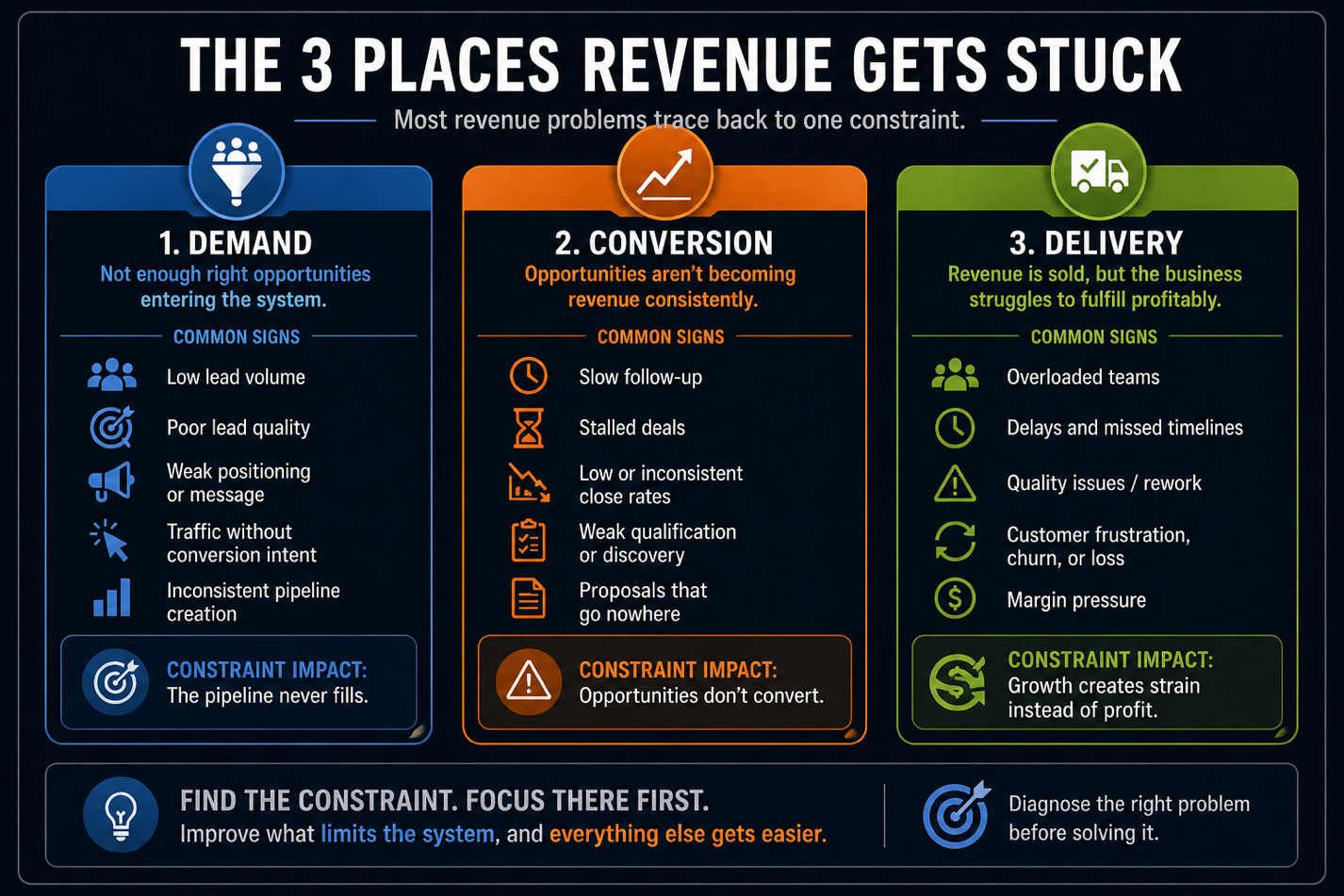
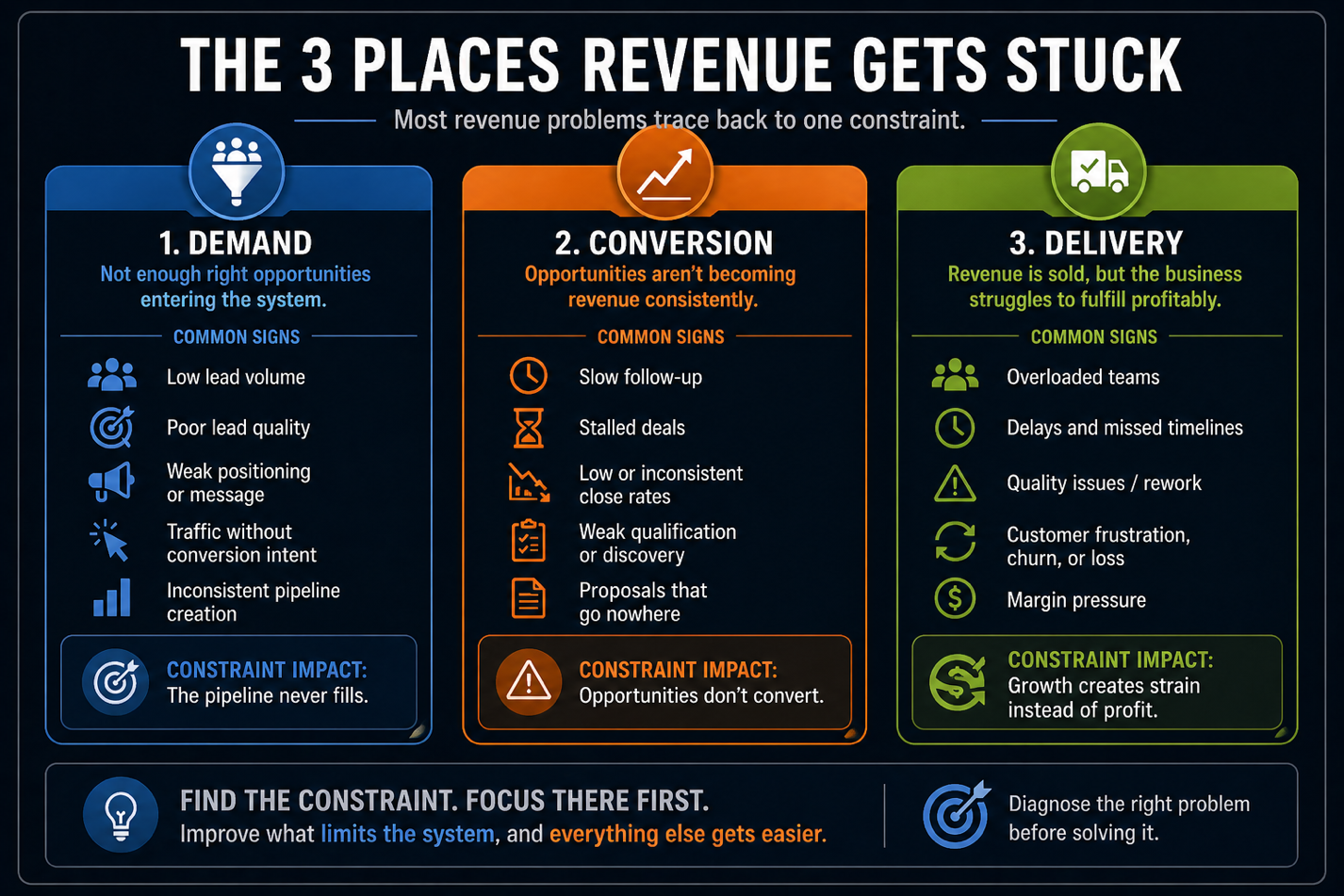
In practical terms, revenue constraints usually appear in one of three places:
1. Demand
The business is not attracting enough qualified buying opportunities.
Common signs:
- low lead volume
- poor lead quality
- weak positioning
- traffic without conversion intent
- inconsistent pipeline creation
The issue is not “marketing activity.”
It is whether the right opportunities are entering the system.
2. Conversion
Interest exists, but it is not becoming revenue consistently.
Common signs:
- slow follow-up
- low close rates
- stalled deals
- weak qualification
- long sales cycles
- proposals that go nowhere
Many businesses believe they need more leads when the real issue is conversion.
That mistake can be expensive.
3. Delivery
Revenue is being sold, but the business struggles to fulfill profitably.
Common signs:
- overloaded teams
- delayed implementation
- customer frustration
- quality issues
- margin pressure
- weak retention or expansion
This is where growth can quietly become dangerous.
More sales is not always better if the system cannot absorb them well.
How to Find the Real Constraint
Start with one question:
Where does momentum break?
-
Not where people complain the loudest.
-
Not where the dashboard has the most colors.
-
Not where the latest software promises a fix.
Where does progress actually slow down or stop?
Look for:
- backlog
- waiting
- repeated handoff issues
- inconsistent outcomes
- excess rework
- rising effort without rising results
Those are usually stronger signals than opinions.
The goal is clarity, not complexity.
Why Fixing Everything Usually Fails
Many leadership teams try to improve every department at once.
-
Marketing optimization.
-
Sales training.
-
New dashboards.
-
Process redesign.
-
More meetings.
Some of those efforts may be valuable.
But if they ignore the current constraint, the overall result may barely change.
This is the difference between improving local performance and improving total performance.
A department can win while the business still loses.
That distinction matters.
What to Improve First
Once the constraint is clear, focus there first.
Not forever. First.
That may mean:
- improving positioning and lead quality
- tightening qualification
- speeding follow-up
- simplifying proposals
- reducing delivery bottlenecks
- improving onboarding
- increasing operational capacity
After that, reassess the system.
When one constraint is elevated, another often becomes visible.
That is normal.
Growth is rarely one fix. It is an ongoing process of finding and improving what limits flow now. It’s also known as POOGI – Process of Ongoing Going Improvement.
What This Looks Like in Strong Businesses
The best-performing companies are not perfect.
They simply get better at identifying the real issue faster.
They waste less time on cosmetic fixes.
They make fewer reactive decisions.
They align effort where it matters most.
And over time, that compounds into stronger forecasts, healthier margins, better customer outcomes, and more predictable growth.
The Difference Between Activity and Growth
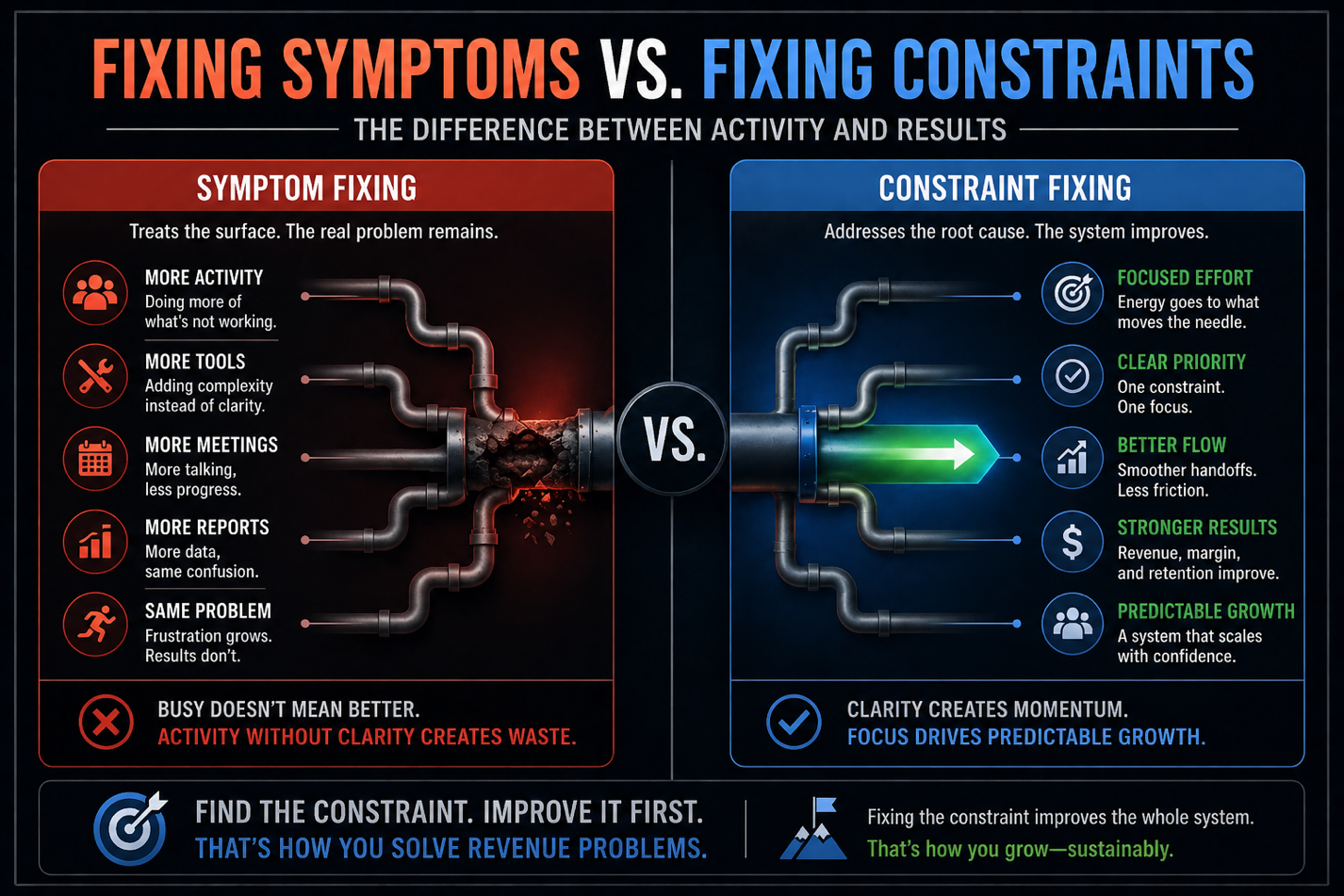
One of the most common mistakes leadership teams make is assuming that effort automatically produces progress.
When revenue stalls, organizations often respond by launching new marketing initiatives, increasing sales activity, implementing additional software, creating new reports, or restructuring processes. While those actions may be valuable, they rarely solve the problem unless they address the actual constraint limiting performance.
The businesses that consistently outperform their competitors approach growth differently.
They focus on understanding how Demand, Conversion, Delivery, and Data work together as a unified revenue system. They identify where flow is breaking down. They eliminate bottlenecks. Then they repeat the process as the business evolves.
That creates something every executive wants:
- More predictable revenue
- Better forecasting accuracy
- Improved customer experience
- Stronger margins
- Scalable growth
In other words, they stop managing symptoms and start managing the system.
Ready to Identify Your Revenue Constraint?
If your organization is generating activity but not achieving the growth you expect, the problem may not be a lack of effort. More often, it is a lack of visibility into the real constraint limiting performance.
My Revenue System Assessment is designed to help leadership teams identify whether Demand, Conversion, Delivery, or Data is currently restricting growth, and to provide a practical roadmap for improving overall system performance.
Rather than guessing where to invest next, you'll gain a structured view of how revenue flows through your organization, where bottlenecks exist, and what actions are most likely to produce measurable business results.
Schedule a Revenue System Assessment and discover the one constraint that is holding back your next stage of growth.