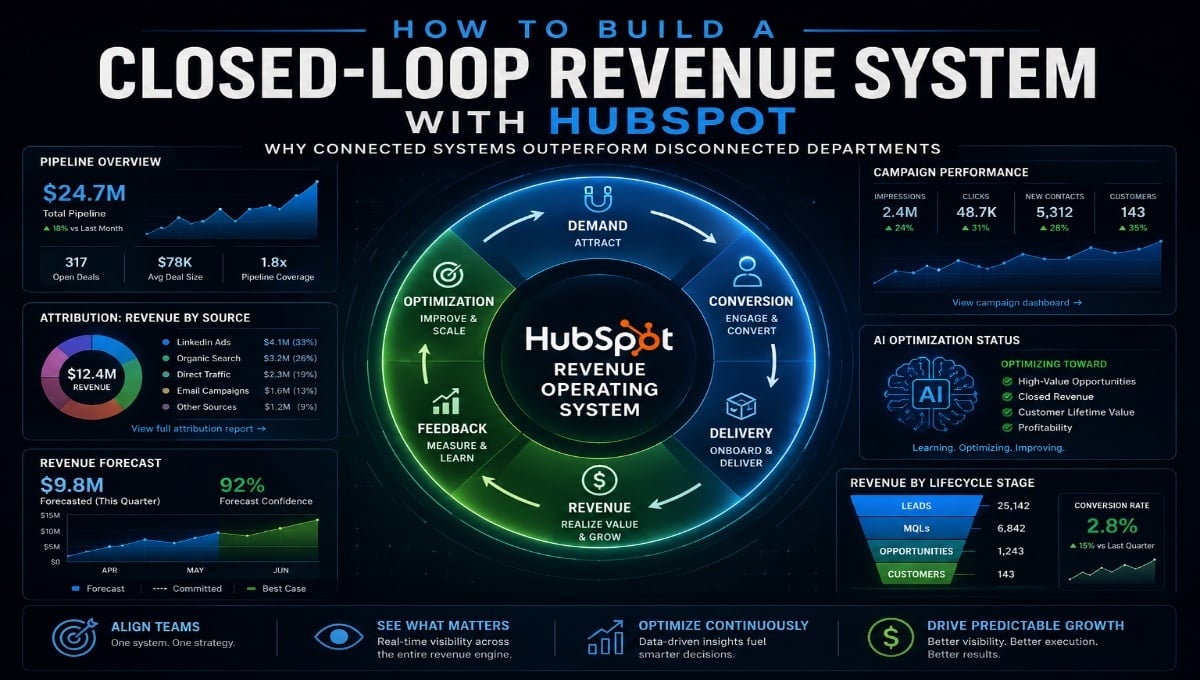
How to Build a Closed-Loop Revenue System with HubSpot
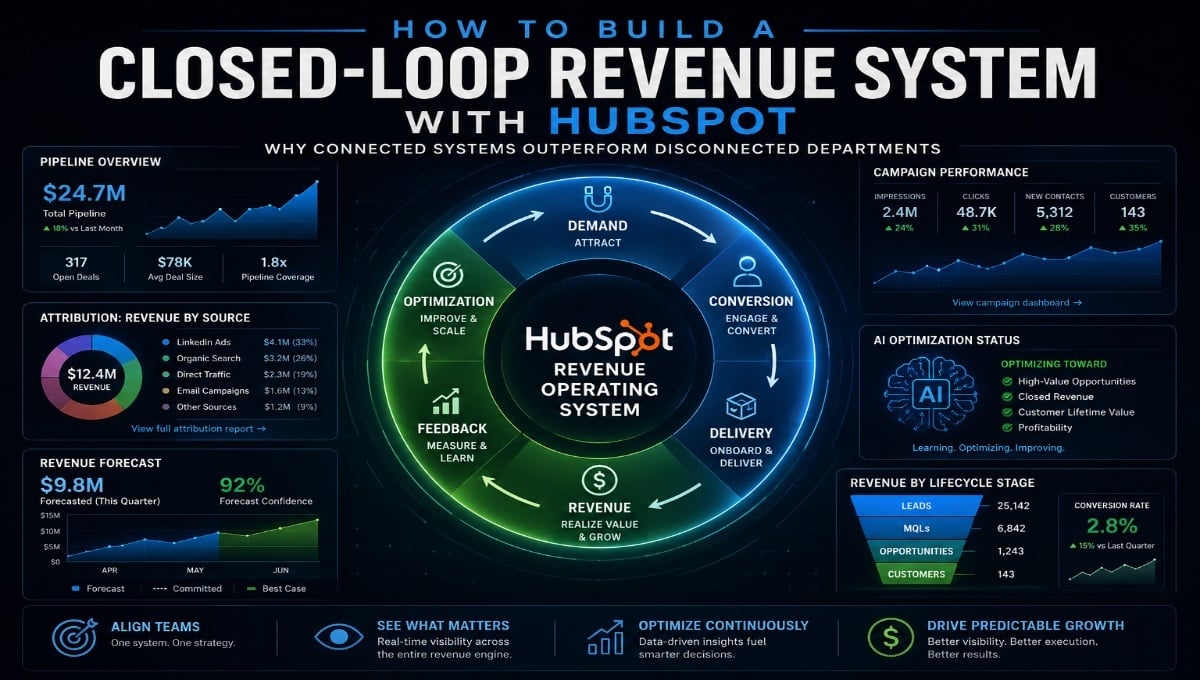
Most companies think they have a revenue system because they own software.
They have:
- a CRM
- a marketing platform
- a sales team
- dashboards
- reports
- automation workflows
But when you look closely, what they actually have is disconnected activity:
-
Marketing generates leads.
-
Sales works opportunities.
-
Operations delivers projects.
-
Finance tracks revenue.
-
Leadership reviews reports.
And almost none of it truly connects together.
That is not a revenue system.
A Closed-Loop Revenue System connects marketing, sales, delivery, finance, and leadership into a single operating model that improves visibility and decision-making.
It is a collection of departments operating beside each other.
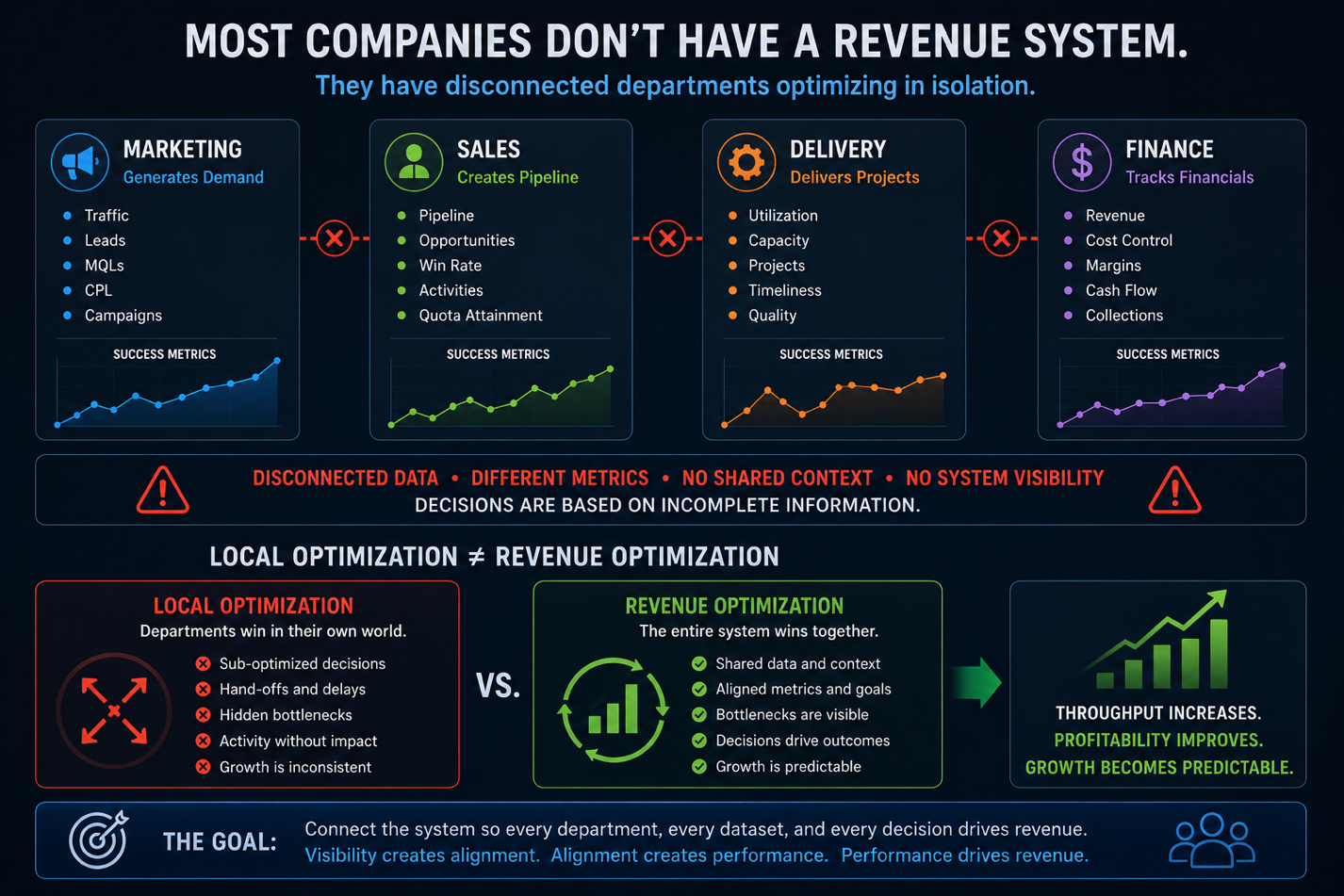
A true revenue system creates visibility across the entire business:
Demand → Conversion → Delivery → Financial Outcome → Feedback → Optimization
That feedback loop matters enormously.
Because without it, leadership cannot see reality clearly enough to improve performance.
And that is where HubSpot becomes much more than a marketing platform.
Used correctly, HubSpot becomes a Revenue Operating System.
Executive Summary
Most organizations invest heavily in marketing technology, CRM platforms, sales tools, reporting systems, and automation.
Yet many still struggle with the same problems:
- Unreliable forecasting
- Weak attribution
- Poor sales visibility
- Inconsistent growth
- Disconnected reporting
- Unclear accountability
The issue is rarely a lack of software.
The issue is that the systems are not connected.
The result is weak revenue visibility, inconsistent forecasting accuracy, and poor alignment across revenue operations.
A Closed-Loop Revenue System creates visibility across the entire customer lifecycle—from initial engagement through revenue realization, customer delivery, retention, and ongoing optimization. Instead of managing isolated departments, leadership gains visibility into how Demand, Conversion, Delivery, Financial Performance, and Feedback interact as a unified system.
This article explains how closed-loop revenue systems work, why CRM discipline is essential, how HubSpot supports revenue operations, and why executive visibility ultimately determines whether organizations improve performance or simply generate more activity.
Key Takeaways
- A Closed-Loop Revenue System connects marketing, sales, delivery, finance, and leadership.
- Most organizations optimize departments instead of optimizing the entire system.
- CRM discipline is foundational to accurate reporting and forecasting.
- Attribution becomes more valuable when customer profitability and delivery outcomes are included.
- Delivery quality directly influences future marketing performance.
- HubSpot can function as a Revenue Operating System when implemented strategically.
- Executive visibility improves decision quality and growth predictability.
The organizations that consistently outperform their competitors are not collecting more data. They are creating better visibility across the entire revenue system.
The Real Problem Is Not Marketing
Most companies assume their growth problem starts with lead generation.
Sometimes it does.
Often, it does not.
I have seen companies spend enormous amounts of money increasing traffic and lead volume while revenue barely moved at all.
Why?
Because the real constraint was somewhere else in the system.
Sometimes:
- sales follow-up was too slow
- pipeline stages were inaccurate
- forecasting was broken
- delivery capacity was constrained
- implementation quality was inconsistent
- the wrong customers were being targeted
- customer profitability was misunderstood
- CRM discipline had collapsed
The problem with disconnected systems is that every department optimizes locally.
Marketing optimizes:
- traffic
- impressions
- leads
- CPL
Sales optimizes:
- quota attainment
- pipeline size
- deal velocity
Operations optimizes:
- utilization
- staffing
- project delivery
Finance optimizes:
- cost control
- cash flow
- reporting
But local optimization does not guarantee system optimization.
In Theory of Constraints terms, improving a non-constraint does not improve throughput.
And in business:
Throughput equals closed, revenue-producing deals.
Not activity.
Not meetings.
Not clicks.
Not MQLs.
Revenue.
The 5 Components of a Closed-Loop Revenue System
A Closed-Loop Revenue System is not a single platform.
It is a connected framework that allows information to flow throughout the entire organization.
While every business is different, most high-performing revenue systems contain five core components.
1. Demand Generation
The process of attracting the right buyers through inbound marketing, paid advertising, referrals, outbound prospecting, and strategic partnerships.
2. Conversion Management
The systems, processes, and sales activities required to turn interest into qualified opportunities and closed business.
3. Delivery Execution
The operational capabilities required to fulfill customer expectations, deliver value, and maintain profitability.
4. Financial Visibility
The ability to connect operational activity to revenue, margins, profitability, customer value, and executive reporting.
5. Optimization Feedback
The continuous flow of information back into the system so leadership, sales, marketing, and operations can improve future performance.
When these five components operate independently, performance becomes difficult to predict.
When they operate together, the business gains the visibility required to improve continuously.
What a Closed-Loop Revenue System Actually Is in Practice
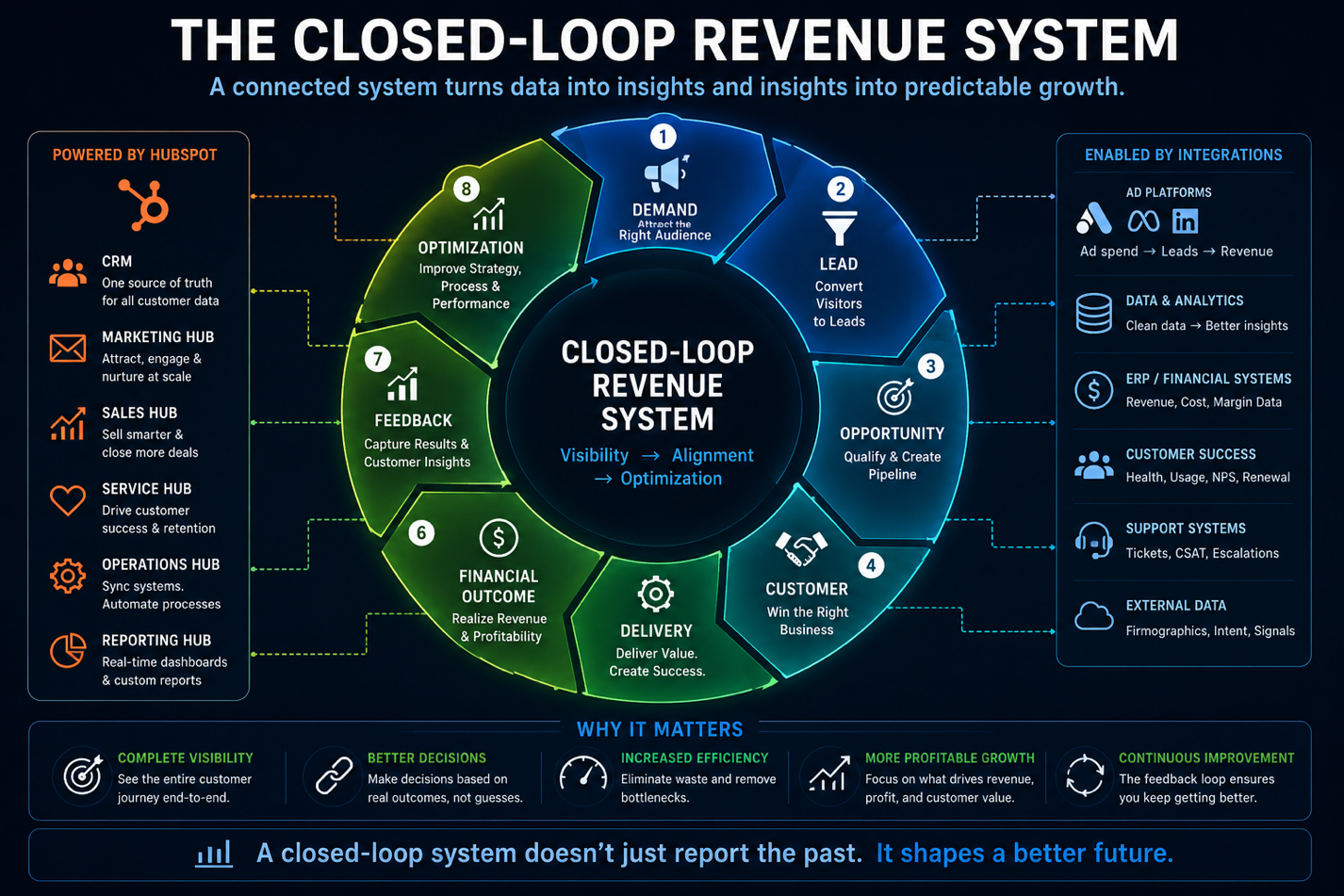
A closed-loop revenue system connects every major business function together using shared operational visibility.
At the highest level, the loop looks like this:
Traffic → Lead → Opportunity → Customer → Delivery → Financial Outcome →
Optimization Feedback
Most companies only track the first half.
That is a major mistake.
Because the most valuable information in the system often appears after the deal closes.
For example:
- Which campaigns produced the highest-profit customers?
- Which industries closed fastest?
- Which sales reps produced the healthiest customers?
- Which offers created the most delivery problems?
- Which customer types churned fastest?
- Which projects generated the highest margins?
- Which lead sources produced the worst implementation outcomes?
Most companies cannot answer those questions.
Not because the data does not exist.
Because the systems were never connected correctly.
The Customer Definition Problem
One of the most common weaknesses I see is surprisingly basic.
Many companies cannot clearly define what a customer actually is.
That sounds absurd until you start digging into the data.
For example:
- Is a customer someone who filled out a form?
- Someone who attended a demo?
- Someone who signed a contract?
- Someone who paid an invoice?
- Someone currently under contract?
- Someone who bought once?
- Someone profitable?
- Someone active in the last 12 months?
Different departments often use different definitions.
Marketing may call someone a customer once a deal closes.
Finance may not recognize them until payment is received.
Operations may not recognize them until onboarding begins.
Customer Success may only recognize active accounts.
That inconsistency destroys reporting accuracy.
Now your dashboards become unreliable.
Forecasts become questionable.
Attribution becomes distorted.
AI optimization starts learning from bad signals.
And executives begin making decisions using conflicting versions of reality.
This is one reason CRM discipline matters far more than most companies realize.
The CRM is not merely a contact database.
It is the operational visibility layer of the business.
Why Most CRM Implementations Fail
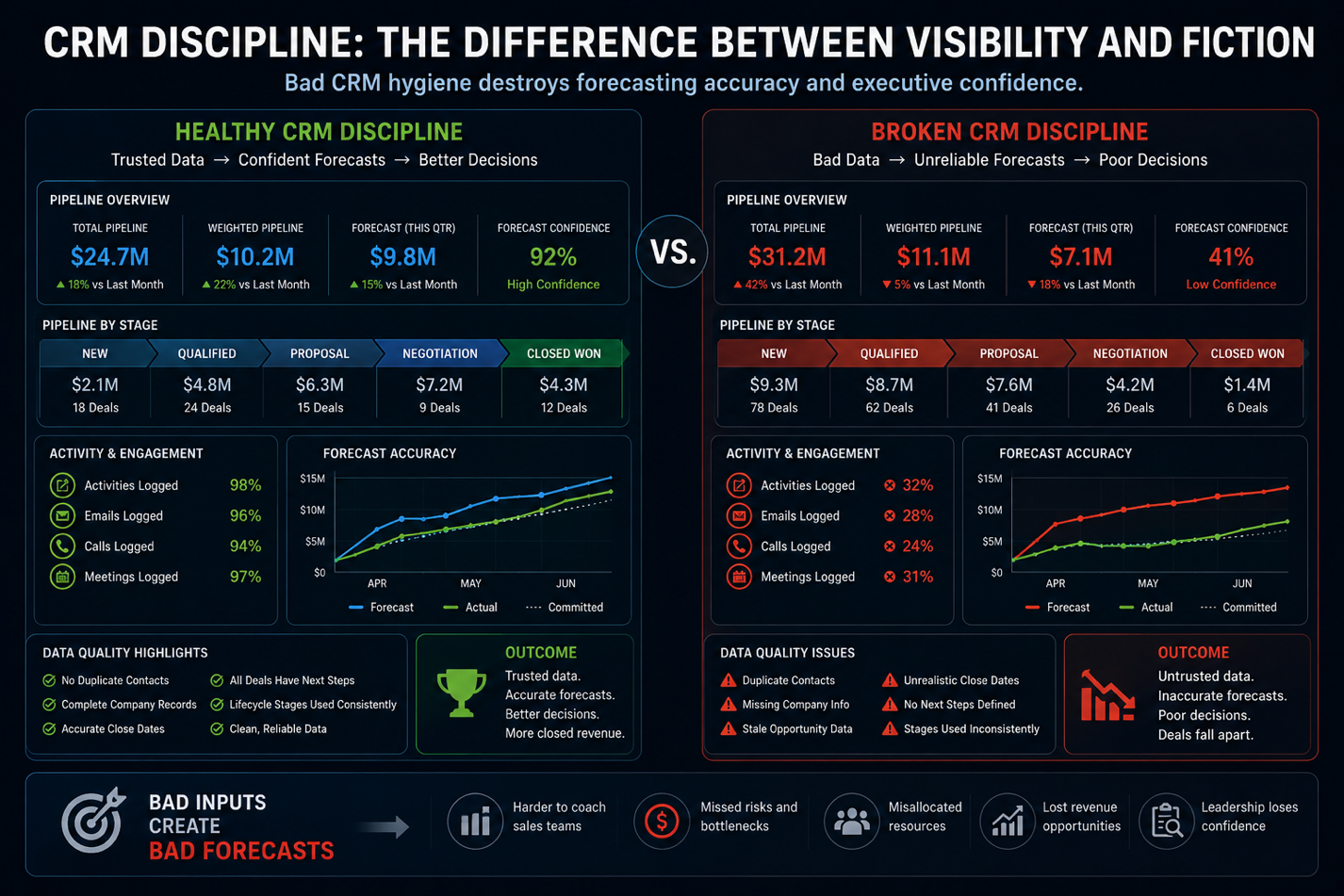
Most CRM failures are not technology failures.
They are operational discipline failures.
Reps enter deals late.
Opportunity values are inaccurate.
Close dates are fantasy.
Lifecycle stages are inconsistent.
Activities are missing.
Contacts are duplicated.
Companies are fragmented across multiple records.
Nobody trusts the reports.
Eventually leadership stops using the system for decision-making.
At that point, the CRM becomes administrative overhead instead of executive intelligence.
I have seen this happen repeatedly in both small companies and global enterprises.
In some organizations, deals only appear in the CRM after they are effectively closed.
That destroys:
- forecasting
- pipeline coaching
- attribution
- resource planning
- sales management visibility
Now leadership cannot identify stalled deals early enough to intervene.
They cannot identify bottlenecks.
They cannot accurately project staffing needs.
And they cannot correctly optimize marketing spend.
A closed-loop revenue system depends on disciplined operational data.
Without disciplined inputs: the outputs become fiction.
Why Attribution Usually Breaks
Most attribution systems are incomplete because they stop at lead generation or opportunity creation.
But revenue optimization requires downstream operational feedback.
A lead source that generates large volumes of opportunities may actually be producing:
- low-margin customers
- difficult implementations
- high churn
- excessive support requirements
- poor collections performance
Another lead source may appear expensive on the surface but generate highly profitable long-term customers.
This is especially true in enterprise sales.
Years ago, while working in enterprise software sales, I participated in pursuits where the pre-sales and consulting investment exceeded $100,000 before the deal even closed.
To many marketers, that sounds insane.
Until the resulting deal value approaches $20 million or more.
At that level, the economics change completely.
High-value revenue systems cannot be optimized using simplistic CPL thinking.
The entire customer lifecycle must be measured.
That is where closed-loop attribution becomes enormously valuable.
The Hidden Role of Delivery
This is the part almost nobody talks about.
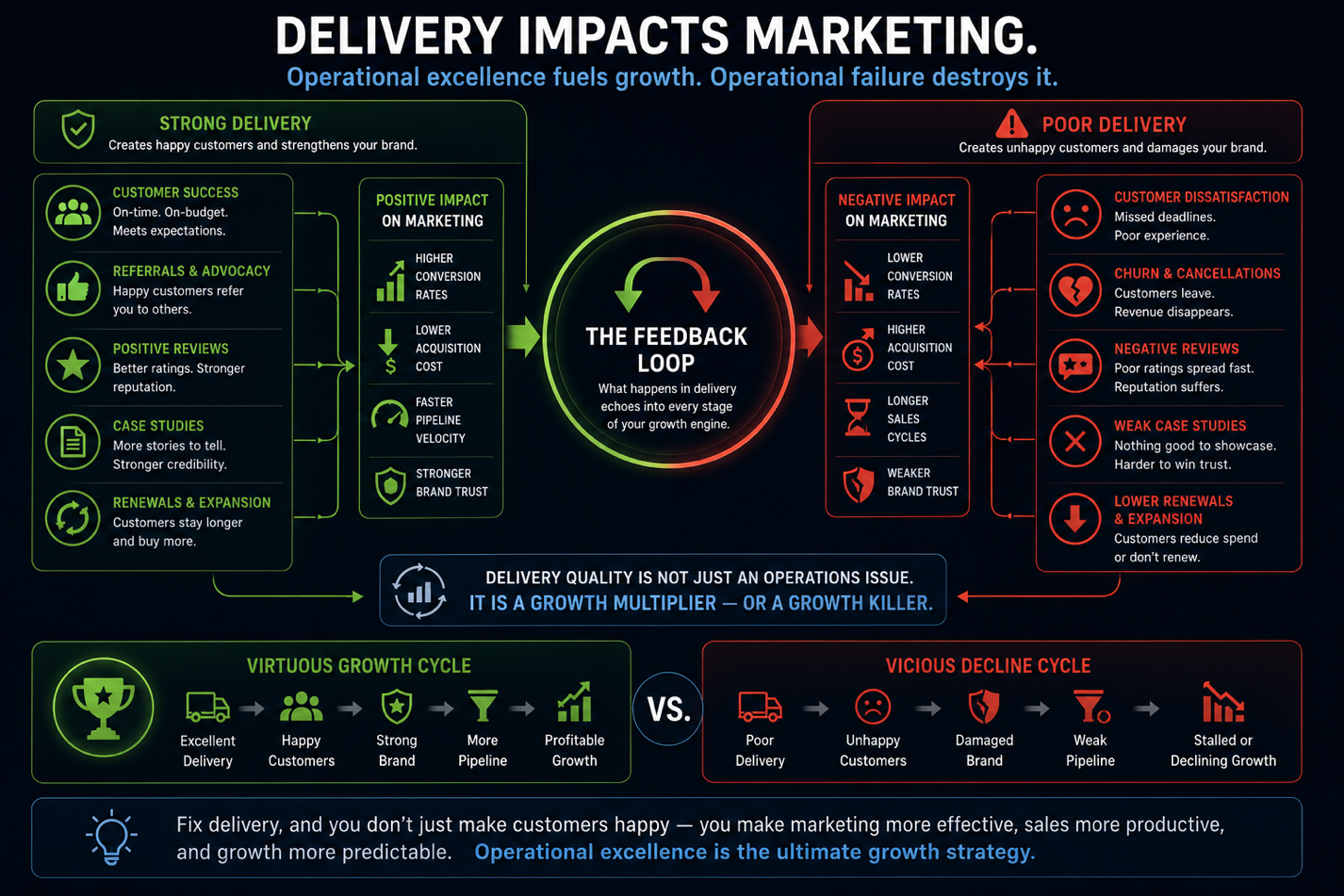
Delivery quality changes marketing efficiency.
If delivery performs poorly:
- referrals decline
- reviews suffer
- renewals weaken
- case studies disappear
- customer trust erodes
- sales cycles get harder
- acquisition costs rise
Marketing eventually pays for operational failures.
The reverse is also true.
Strong delivery systems improve:
- conversion rates
- retention
- upsells
- referrals
- pipeline velocity
- customer lifetime value
This is why the best growth systems are operational systems first.
Not advertising systems.
Years ago, I worked on executive dashboard systems for a large grocery retailer. One recurring KPI involved forecasted product stock outages. The issue persisted month after month.
Eventually, the root cause was traced back to outdated MRP planning settings that had not been maintained correctly for years.
Once corrected:
- fulfillment improved
- inventory performance improved
- profitability improved
The lesson was simple.
The visible problem was downstream.
The actual constraint was operational.
Revenue systems work the same way.
How HubSpot Supports a Closed-Loop Revenue System
Most companies underutilize HubSpot because they position it too narrowly.
They use isolated features instead of building connected operational workflows.
Used strategically, HubSpot can unify:
- Marketing
- Sales
- CRM
- Customer Service
- Reporting
- Automation
- Attribution
- Forecasting
- Revenue Visibility
This allows organizations to build a closed-loop revenue system with stronger operational visibility, cleaner CRM discipline, and more reliable revenue reporting.
HubSpot’s real strength is not email automation.
It is operational continuity.
For example:
- campaign data flows into contact records
- contacts associate to companies
- deals associate to revenue
- activities associate to pipeline stages
- attribution associates back to campaigns
- service interactions associate to customer health
Now leadership can finally begin seeing the full revenue system.
Not just isolated metrics.
The AI Optimization Layer
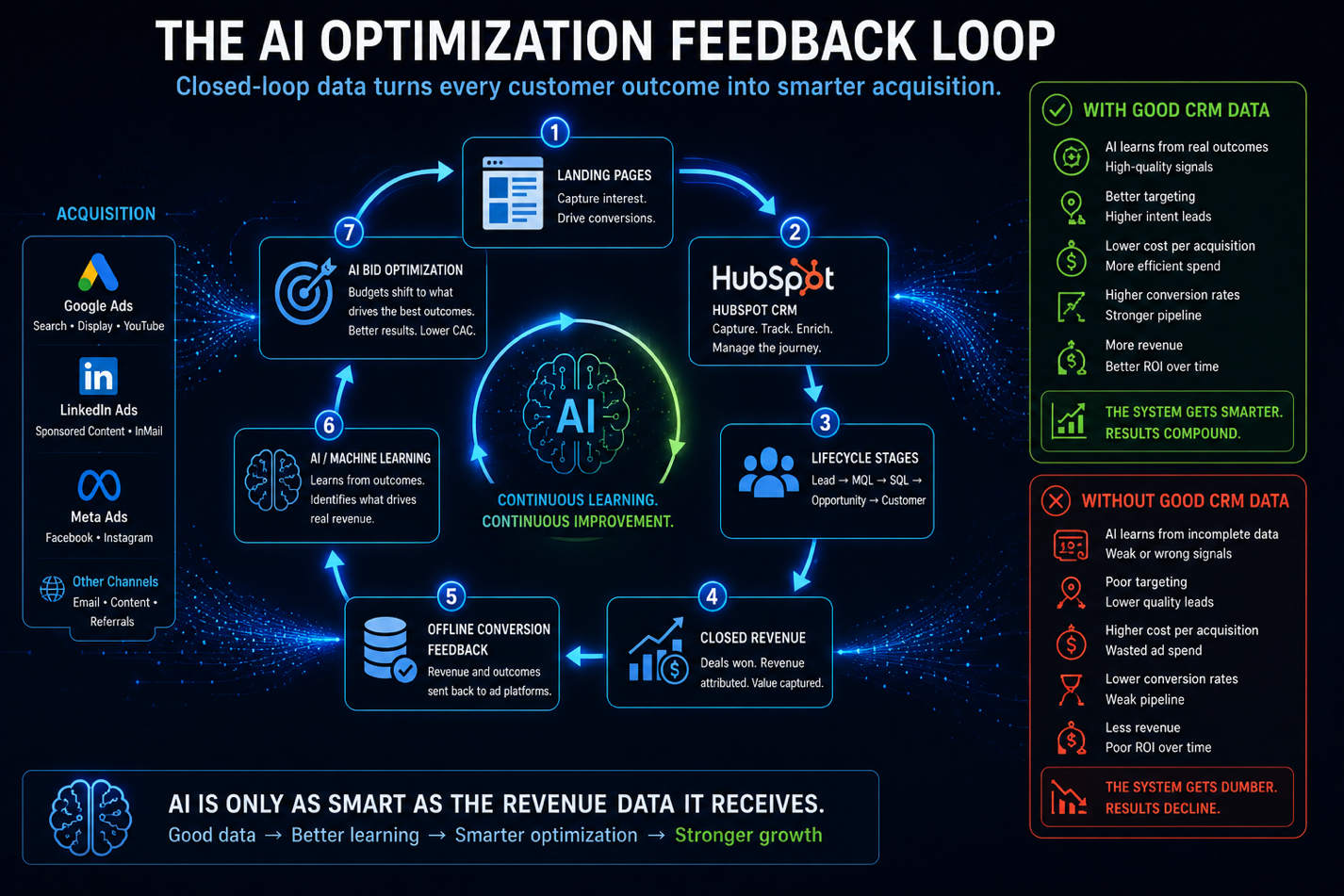
This becomes even more important as AI-driven advertising systems continue advancing.
Google Ads, LinkedIn Ads, Meta, and other platforms increasingly optimize using conversion feedback loops.
But AI systems are only as intelligent as the data they receive.
If the CRM data is inaccurate:
- AI learns the wrong lessons.
- If lifecycle stages are inconsistent:
optimization deteriorates.
If closed revenue is not flowing back into advertising systems:
the platforms optimize for shallow conversions instead of profitable outcomes.
This is why offline conversion tracking and CRM integration matter so much.
Without a closed-loop revenue system, AI optimization often improves conversion volume without improving revenue performance.
A properly configured closed-loop system allows advertising platforms to optimize toward:
- qualified opportunities
- closed revenue
- high-value customers
- profitable accounts
- long-term customer value
Not merely cheap leads.
Cheap leads often create expensive problems.
Why a Closed-Loop Revenue System Improves Forecasting and Decision-Making
Most business problems are not caused by a lack of effort.
They are caused by a lack of visibility.
When information is fragmented across departments, leadership teams are forced to make decisions using incomplete data.
-
Marketing sees campaign performance.
-
Sales sees pipeline activity.
-
Operations sees delivery challenges.
-
Finance sees financial results.
-
Each team has part of the picture.
-
Nobody sees the whole picture.
-
This creates a dangerous situation.
Every department may appear successful while the business itself underperforms:
-
Marketing may celebrate lead growth.
-
Sales may celebrate pipeline growth.
-
Operations may celebrate utilization.
-
Finance may celebrate cost reductions.
Yet revenue growth remains inconsistent.
Why?
Because decisions are being made locally instead of systemically.
A Closed-Loop Revenue System changes this dynamic.
By connecting Demand, Conversion, Delivery, Financial Outcomes, and Feedback into a single operational view, leadership gains visibility into how decisions in one area impact performance in another.
For example:
- Marketing can see which campaigns generate profitable customers instead of simply generating leads.
- Sales can identify which opportunities are most likely to close and deliver long-term value.
- Operations can anticipate capacity requirements before bottlenecks develop.
- Finance can understand which customer segments generate the strongest margins and lifetime value.
- Leadership can see constraints forming before they begin impacting growth.
This visibility improves decision quality across the organization.
Forecasting becomes more accurate.
Resource allocation becomes more strategic.
Marketing investments become more efficient.
Sales coaching becomes more targeted.
Operational planning becomes more proactive.
Perhaps most importantly, conversations become less emotional and more objective.
Instead of debating opinions, teams can evaluate facts.
Instead of reacting to surprises, leadership can address emerging issues early.
This is one of the biggest advantages of a Closed-Loop Revenue System.
It does not simply provide more information.
It provides organizational clarity.
And clarity is often the difference between reactive management and predictable growth.
Executive Visibility Changes Everything
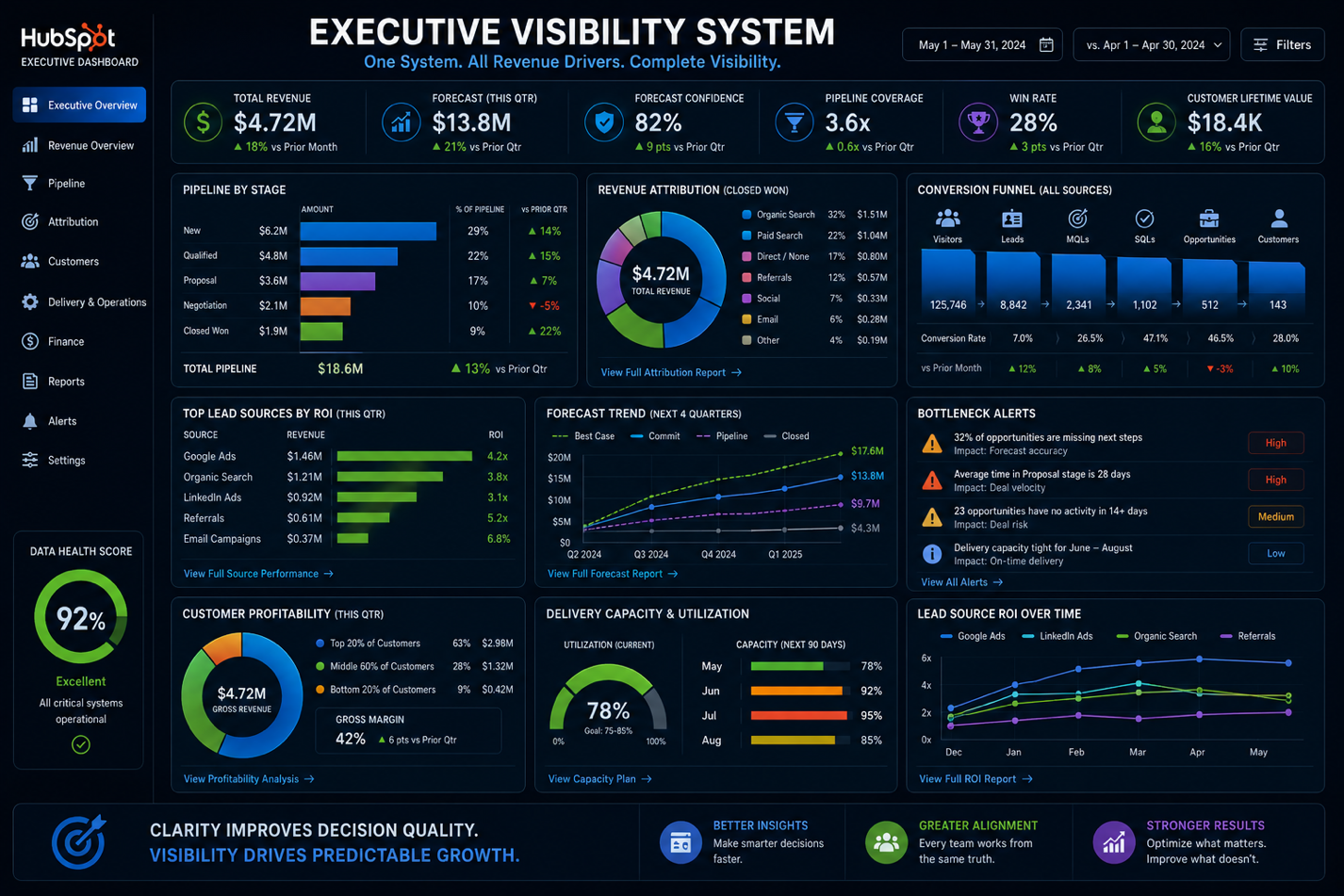
One of the biggest differences between average companies and high-performing companies is visibility.
Leadership teams with strong operational visibility can:
- identify bottlenecks early
- forecast more accurately
- allocate resources intelligently
- coach sales teams proactively
- improve delivery capacity
- optimize marketing investments
- protect margins
Without visibility, leadership operates reactively:
-
Everything becomes emotional.
-
Everything feels urgent.
-
Everything becomes a surprise.
-
That is exhausting for organizations.
A properly designed closed-loop revenue system creates organizational clarity.
And clarity improves decision quality.
How a Closed-Loop Revenue System Creates Executive Visibility
Most organizations already possess the information required to improve performance.
The challenge is that information is scattered across departments, platforms, spreadsheets, reports, and individual teams.
-
Marketing sees one version of reality.
-
Sales sees another.
-
Operations sees a third.
-
Finance sees a fourth.
Leadership is left trying to reconcile all of them.
That fragmentation creates uncertainty.
-
Forecasts become unreliable.
-
Attribution becomes questionable.
-
Growth becomes harder to predict.
A Closed-Loop Revenue System solves this problem by creating operational visibility across the entire customer lifecycle.
Instead of isolated metrics, leadership gains a connected view of how Demand, Conversion, Delivery, Financial Outcomes, and Optimization interact to produce business results.
That visibility changes the quality of decisions.
And better decisions create better outcomes.
For many organizations, the challenge is not a lack of tools. It is the absence of a structured revenue system that connects data, process, accountability, and executive visibility. That is why assessing the full system often creates more value than optimizing one department at a time.
Ready to Assess Your Closed-Loop Revenue System?
If your organization struggles with disconnected reporting, unreliable forecasting, weak attribution, CRM adoption issues, or limited executive visibility, the problem is often not effort. It is revenue system design.
The Revenue System Assessment helps leadership teams evaluate how demand generation, conversion management, delivery execution, data quality, and financial performance work together across the full customer lifecycle.
You will identify bottlenecks, reporting gaps, operational constraints, and alignment issues that limit growth — and gain a practical roadmap for building a more connected, predictable, and profitable revenue system.
Schedule your Revenue System Assessment to see how a Closed-Loop Revenue System can improve visibility, forecasting, and revenue performance.
Why this version is better:
- Repeats the target phrase naturally.
- Better mirrors the article structure.
- Makes the offer feel like the logical next step.