
Shopify Strategy & Marketing Foundation Series
-
What Is Ecommerce Marketing? Here's a Guide to Get You Started
- What is Shopify? A Comprehensive Guide to This eCommerce Platform
- What Is Shopify & How Do You Use It to Boost Your Business?
- Shopify VS WordPress: Which is Better for E-commerce in 2024
- Best Ecommerce Marketing Strategies for Your Business
- 10 Proven Shopify Marketing and Promotion Strategies to Increase Sales
- How to Setup a Shopify Store for Success
- How to Get More Sales in Your Shopify Store
- Boost Your Sales with These Niche E-Commerce Strategies
- Definitive Guide to Building Your Shopify Ecommerce Website
Introduction
Pro-Tip: Before you finalize your architecture, make sure you’ve clarified your niche ecommerce strategy so your website structure reflects how you actually sell.
If you are searching for a Shopify ecommerce website, you are not kicking around an abstract idea. You are likely looking for a revenue machine. This system must plug cleanly into the way your business already runs.

It probably operates with SAP at the core. You are tired of advice that pretends your operation looks like a kid dropshipping sunglasses. Your reality is a real company with serious stakes riding on one Shopify ecommerce website decision.
I understand this situation well. My day is split between HubSpot inbound strategy and Google Shopping optimization. I also manage AI content workflows and ugly data problems.
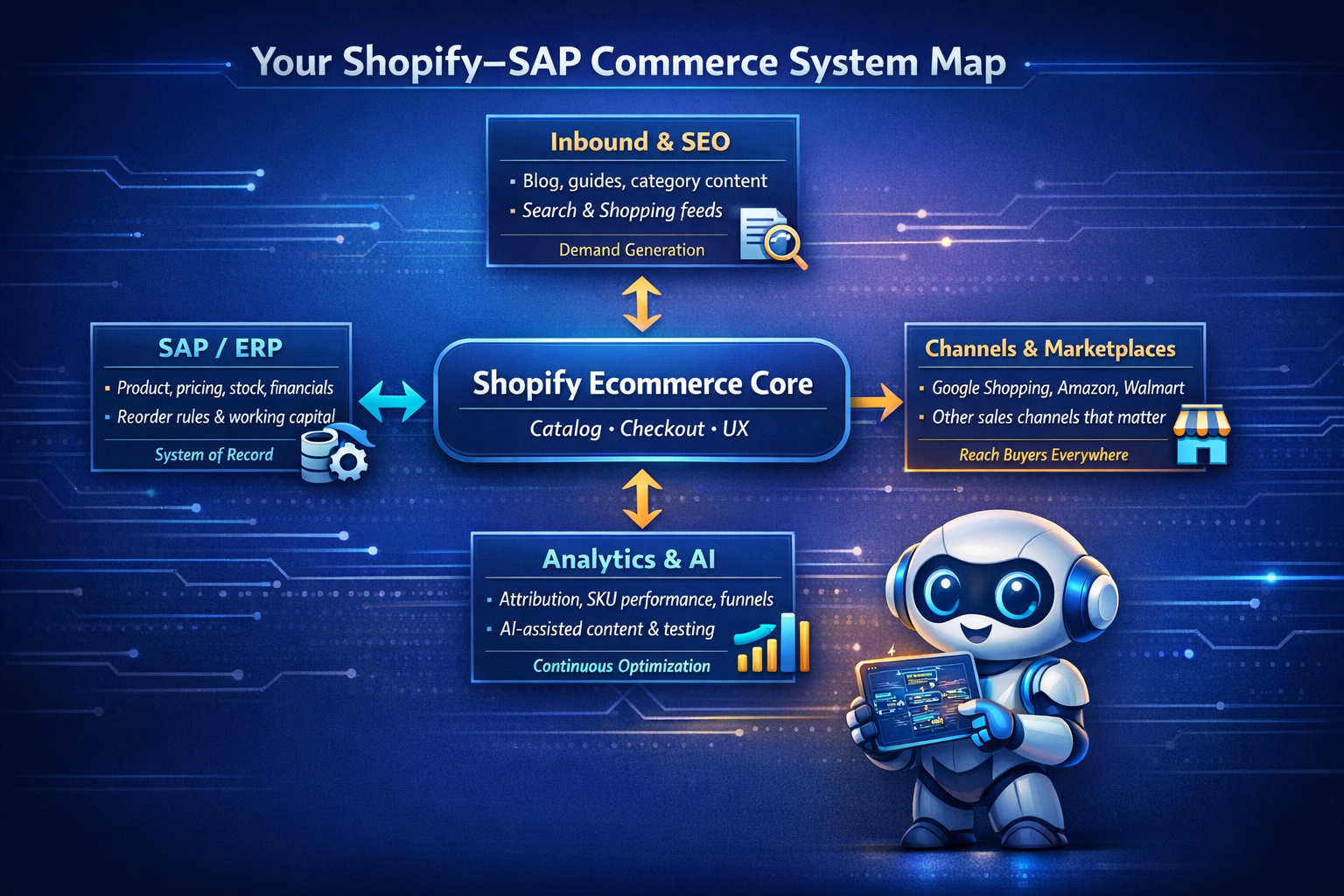
Shopify needs to talk cleanly to SAP and Amazon. It must also connect with every channel that matters. You are not just trying to build an online store.
You are trying to build a growth system that can survive CFO scrutiny. It must scale with demand. It also has to feel smooth for the customer who gives you very little time to make a first impression.
Why Your Shopify Ecommerce Website Is A Strategic System, Not A Pretty Store
- Why Your Shopify Ecommerce Website Is A Strategic System, Not A Pretty Store
- Core Pillars Of A High Performance Shopify Ecommerce System
- 1. Strategy First: Who You Serve, What You Sell, How You Win
- 2. Clean Information Architecture That Matches How People Actually Shop
- 3. Design That Feels Like Your Brand, Not A Theme Demo
- 4. High Impact Product Presentation And Photography
- 5. Mobile First, Because Your Customers Live On Their Phones
- Technology Backbone: Payments, Hosting, And Performance That Can Grow With You
- Content, SEO, And Conversion: Making Your Shopify Store Easy To Find And Hard To Ignore
- Trust, Reviews, And Social Proof
- Operations: SAP Integration, Inventory Logic, And Multichannel Complexity
- Ongoing Improvement: AI, Analytics, And The Shopify Ecosystem
- Conclusion
Why Your Shopify Ecommerce Website Is A Strategic System, Not A Pretty Store
There are millions of Shopify stores live today. Most of them will never become real assets on the balance sheet. The ones that do have one thing in common.
They are built as complete systems rather than side projects. If you are running SAP already, that point is vital. Your Shopify stack has to fit with existing order flows.
It must also align with financial controls and inventory logic. It also has to support serious marketing efforts. Think full inbound funnels and tight Google Shopping feeds.
You need strong content engines and advanced analytics frameworks. A basic traffic and sales chart is not enough for a robust ecommerce business. I wrote a breakdown of how we design that type of ecommerce website for high volume stores.
The pattern is clear. Companies that treat the ecommerce platform like a strategic foundation grow faster. They also spend less on fixes later.
Core Pillars Of A High Performance Shopify Ecommerce System
If you remove the buzzwords, every strong build rests on a few pillars. They are simple to say. However, they are complex to implement well.
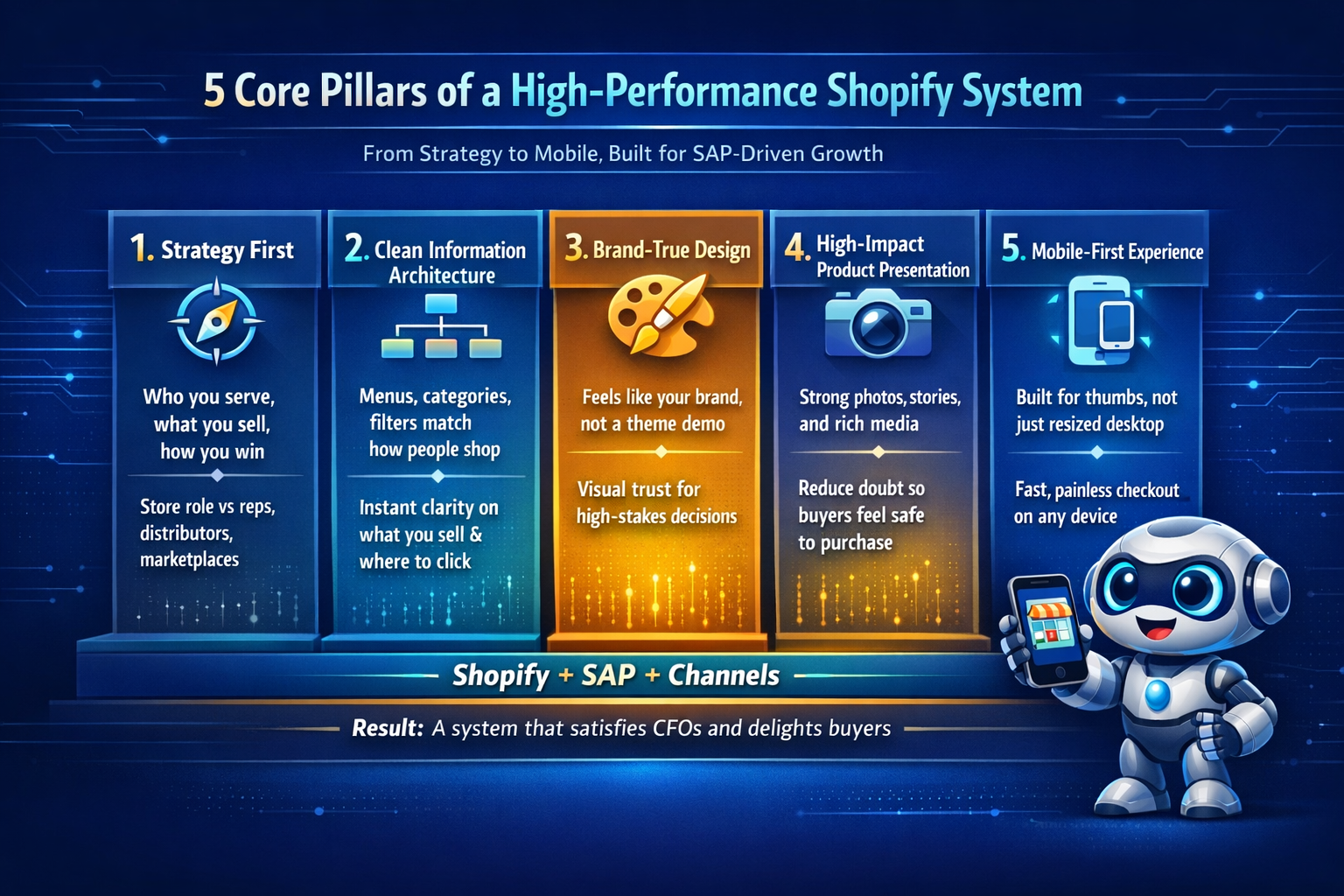
Those pillars line up with what I see across our own projects. You can see the patterns in my review of recent projects. Let us walk through the highlights here.
This will help you map them to your own roadmap. We will look at website examples and structural needs. You can then apply this to your specific ecommerce site.
1. Strategy First: Who You Serve, What You Sell, How You Win
A Shopify ecommerce website does not fail because the shopify theme is bad. It fails because the strategy is missing. You need clear answers to simple questions before you worry about website design.
Who is your target market, and how do they buy today? Which product sets are high margin or repeat purchases? What role should the ecommerce store play compared to sales reps?
You must also consider distributors or marketplaces like Amazon. If you skip that work, you end up with an expensive brochure. You must define your business goals clearly.
That is why I framed an entire guide around strategy first. Technology comes second. This applies whether you are selling internationally or locally.
2. Clean Information Architecture That Matches How People Actually Shop
Research on web first impressions shows visitors form an opinion quickly. It takes about 50 milliseconds. Another study confirms users decide instantly if they will stay.
That snap judgment is not just about colors. It is about clarity. Do people instantly understand what you sell?
They need to know why it matters and where to click next. A site with confusing menus and odd labels kills conversions. Cluttered website templates can hurt your brand.
The best stores keep the choices obvious. Categories are clear. Filters line up with how customers think.
Search actually returns useful results instead of random noise. This creates a superior shopping experience. Your architecture must be intuitive.
3. Design That Feels Like Your Brand, Not A Theme Demo
You can see the power of strong brand expression on many top sites. Every color, font, and photo feels intentional. The site is not shouting.
It speaks clearly to a specific customer. This is not just a nice feature to have. Strong visual branding builds trust.
It gives buyers a feeling that you are steady and credible. This matters a lot for high value subscription models. The good news is you do not need to reinvent everything.
You need a website design that respects your brand. It should give you enough control to make it your own. You can browse shopify themes to find a base.
Many designers stress this in visual branding guidance. You might choose premium themes for more features. Some businesses start with free themes to save costs.
A minimalist style often works best for clarity. You could even look at specific options like horizon themes. The goal is to avoid looking generic.
Make sure to browse themes carefully. You might find themes free themes sections in the store. Just verify they meet your needs.
4. High Impact Product Presentation And Photography
If your product pages are weak, your entire site feels weak. Shoppers cannot pick up your products. The product images and words have to do that work for them.
There is hard data behind this. Research shows that products with several quality photos convert better. Lifestyle photos also help customers visualize use.
360 degree views or 3D content help even more. The more you reduce doubt, the more people feel safe to buy. This applies to all sectors.
It is especially true for clothing beauty jewelry markets. Each store understands what details help a visitor decide. Clear visuals are essential.
5. Mobile First, Because Your Customers Live On Their Phones
The average American spends over 5 hours on a mobile phone per day. That number keeps climbing. For many of your buyers, a phone is the primary device.
Shopify does give you a responsive foundation. But it is still easy to ruin the experience. Messy pop ups and giant images hurt usability.
Dense forms are also a problem. The test is simple. Pull up your site on a phone.
Try to complete a full checkout in under a minute. If it feels painful for you, it is worse for your customers. A poor mobile experience kills your conversion rate.
Good stores handle this well. The layouts reflow cleanly. Images resize properly.
Buttons are easy to tap. You feel like the store was built for your hand. It should not feel like a desktop site squeezed down.
Technology Backbone: Payments, Hosting, And Performance That Can Grow With You
Most executives focus less on colors and more on stability. They want to know how safe and fast the system is. Beauty does not help if the store crashes.
Shopify wraps a lot of heavy lifting for you. You still need to make smart decisions around payments. Infrastructure and security are also critical.
Payment Gateways That Match Your Customers
Your customers care about their favorite payment options. They look for specific cards and wallets at the shopping cart. Buy now pay later options are also popular.
The right mix lowers cart abandonment. People should not feel forced into unfamiliar methods. Shopify payments offers a streamlined solution.
You can also find a specific shopify app for regional methods. Shopify's docs walk through supported options in depth. The strategic decision is yours.
Where do you sell, and how do those buyers like to pay? You also need to protect the payment environment. Many brands skip simple security steps.
You do not want your brand name near a breach story. Make sure to keep your store clear of vulnerabilities. Security is a continuous process.
Hosting And Performance Expectations
With traditional stacks you have to think about hosting fees. Typical hosting costs run from a few dollars to serious money. Ecommerce platforms often charge extra for bandwidth.
Shopify hides much of that from you. It rolls it into the subscription. This makes the platform free of standard hosting headaches.
But that does not mean you can ignore performance. Oversized scripts can slow pages down. Heavy third party apps also hurt speed.
Uncompressed images cost real money in lost conversions. Your visitors judge your site very quickly. Every delay counts.
You want to build fast experiences. Clean builds win here. Speed is a competitive advantage.
How Much Should You Expect To Invest
Industry pricing guides provide a helpful baseline. A simple brochure site runs between $3,000 and $15,000. A real Shopify ecommerce website is rarely simpler than that.
It is often far more involved. Once you add channel feeds and SAP integration, costs rise. Product data work and AI content engines add to the budget.
You are building infrastructure at that level. The question is how fast this investment pays for itself. You might start with a free trial to test the waters.
This lets you start free and scale up. Eventually, you will decide on free paid apps to extend function. You must plan for these costs.
Match your budget with internal requirements. This helps you avoid most missteps. It also keeps your expectations realistic.
Content, SEO, And Conversion: Making Your Shopify Store Easy To Find And Hard To Ignore
You can have the cleanest architecture in the world. You will still lose if no one sees it. Inbound marketing helps here.
AI powered content systems start to pull their weight. My own stack leans on product videos. Structured data is also key.
I control feeds tightly for Google Shopping. Your mix may differ. The core goal remains the same.
Bring in high intent visitors. Help them say yes. Ecommerce websites need traffic to survive.
Building An Inbound Engine On Shopify
I have spent more than a decade running inbound frameworks. The pattern does not change. Consistent content compounds over time.
Your Shopify ecommerce website gives you a perfect base. Product pages can carry buying keywords. Collection pages can explain category value.
The blog can go deeper on use cases. You can capture a customer email address for nurturing. That work stacks up.
Search traffic is an asset you earn. It is not a switch you flip. You must be patient and consistent.
Product Page SEO And Conversion Details
This is where AI becomes useful. I use AI every day to draft outlines. It helps produce structured snippets for product detail pages.
The key is to mix automation with real buyer knowledge. Do not just dump generic content everywhere. There is also very practical advice available.
You can lean on guidance for optimizing shopify ecommerce product pages. Title tags and meta descriptions move the needle. Schema and internal links are also vital.
On the conversion side, study product storytelling. Each brand should speak clearly to its customer's lived experience. This story anchors the products in something deeper than features.
Trust, Reviews, And Social Proof
You sell more when buyers see people like them getting results. This is obvious but often ignored. Real photos matter.
Detailed reviews are essential. Story driven testimonials work better than polished taglines. The tone should be conversational.
Honesty builds a connection. Brands should lean into their personality. Let customers see behind the scenes.
That style also plays well with inbound marketing. Real stories create natural reasons for others to talk about you. This leads to better rankings.
Operations: SAP Integration, Inventory Logic, And Multichannel Complexity
This is where many builds quietly fail. The site might look great on the surface. Backstage, everything is held together with spreadsheets.
If you are serious about growth, you need the opposite. You need stable operations. SAP and Shopify must agree on product data.
Price and stock levels must be accurate. You need this to sell shopify products effectively. Customers place trust in your inventory accuracy.
Why SAP Integration Matters So Much
Your ERP is the system of record. It handles finance and supply chain data. If Shopify drifts out of sync, problems arise.
You get stock outs and double selling. Messy returns create financial noise. This slows every decision.
My team spends time designing clean integrations. Shopify must reflect SAP product availability in real time. It must handle pricing logic cleanly.
Orders must route correctly based on distribution rules. Done right, this improves media performance. Your Google Shopping feeds stay accurate.
The same logic applies across marketplaces. You might sell through Amazon or Walmart. You cannot treat each channel as its own universe.
Reorder Point Logic And Inventory Optimization
This is where data science helps. Many builds think of inventory simply. They just check if items are in stock.
That leaves money on the table. Reorder point logic looks at lead times. It considers demand variability to make decisions.
Maybe some SKUs live in your own distribution center. Others might be in a 3PL. Your site becomes the interface for this logic.
It enables quick order processing. The system should not guess inventory on its own. It connects to your broader logic.
If this sounds advanced, that is because it is. But once you set it up, it saves a fortune. You avoid rushed shipments and wasted stock.
Working Capital And Growth Constraints
Many owners are surprised by growth limits. The limit is often cash tied up in stock. Practical advice on working capital matters.
You must tie inventory models to cash models. This makes your growth more controlled. You can outsell your balance sheet if you are careless.
Tidy dashboards in the shopify admin do not fix a bad cash position. Planning ahead does. This is where tying SAP and Shopify together pays off.
Your finance team gets clean data. Your planners get clear signals. Your leadership team gets realistic growth paths.
Ongoing Improvement: AI, Analytics, And The Shopify Ecosystem
Your launch is the starting line. A serious Shopify ecommerce website gets better each quarter. You must watch the data.
Talk to customers and test ideas. Do not freeze the site after launch. Leading companies manage this cycle carefully.
Use Analytics For Decisions, Not Just Dashboards
Google Analytics and Shopify reports are not just decorations. They answer hard questions. Which SKUs should get more media?
Which locations need new stock? Where does your funnel leak the most? I often bring in more advanced tools.
The end goal is simple. Make small, informed moves every month. These add up over time.
Remember that people care about things beyond price. Sustainability matters to many customers. This preference should shape what you sell.
Lean On The Shopify Ecosystem, But Keep Control
I recommend Shopify for the support network. If you need docs, you have the api documentation. You can check the service status easily.
There is an active shopify community to learn from. Shopify partners can help with development. You can find help in shopify community blogs.
Always review your privacy policy settings. Ensure privacy choices are clear for users. Update your service privacy policy regularly.
You should also verify the partners legal service status when hiring. For technical details, the center api documentation shopify community blogs area is useful. Using the documentation shopify community resources can save time.
Your job is to use these resources wisely. Do not turn your stack into an app jungle. Every tool should earn its spot.
Where AI Fits In A Shopify Stack Like Yours
I use AI every day on live systems. It speeds content research and variant testing. It helps with creative production.
It also aids in some structured coding tasks. The trick is not to chase the newest toy. Fold AI into steady workflows.
That could be generating first drafts of category copy. It could be refining ad angles. AI becomes quiet infrastructure.
It frees your team for higher value work. It should not be something you just talk about. It should be something you use.
Conclusion
A strong Shopify ecommerce website for an SAP driven business is complex. It is not a simple design project. It is a cross functional system.
It ties your brand and data together. It integrates your channels and operations. This creates a single growth engine.
The more clearly you see that from the start, the better. You will have fewer surprises later. Your buyers form opinions quickly.
They live on their phones. They care about more than price. They compare your site to the best experiences anywhere.
That is the standard you must meet. Build on clean strategy and real integration. Focus on solid analytics and steady improvement.
Your store becomes more than a line item. It becomes a place where revenue and insight meet. This is what we aim for on every serious build. For a concrete example, this case study shows how a thoughtfully built Shopify site performed in the real world for a footwear brand. After your core site is live, you can dive deeper into Shopify store customization to refine UX and brand presentation.
Next in the Shopify Strategy & Marketing Foundation Series:
Congratulations! You've finished our in-depth series on Shopify Strategy and Marketing Foundations.
About Us
As a certified Shopify Partner with deep, hands-on ecommerce experience, we help companies turn strategy into predictable, measurable revenue growth. We are also a HubSpot Certified Inbound Marketing Agency and HubSpot Certified Sales Agency, uniting proven demand generation with disciplined, structured sales execution. As an official Google Partner, our Google Ads management ensures your paid acquisition is tightly aligned with ROI and profitability targets.
From large, complex SAP environments to small and mid-sized businesses across industries—including legal practices, public figures and celebrities, consumer packaged goods, apparel and fashion brands, and manufacturing—we bring enterprise-grade rigor, data-driven precision, and accountable execution to every engagement.
