
Shopify Technical Build, UX & Store Infrastructure Series
- Role of Innovative Shopify Website Developers
- Shopify Developer Job Responsibilities: A CEO's Guide
- How Shopify Projects Can Transform Your E-Commerce Strategy
- Integrated End-to-End Ecommerce Systems: The Key to Gaining Competitive Edge
- Streamlining Your Success: Smart Shopify Inventory Management Tips
- Essential Shopify Security Measures: Protect Your Ecommerce Store Today
- Seamless Transactions: Shopify Payment Options and Gateway Best Practices
Introduction
Pro‑Tip: Before reading this page, if you haven’t read the previous one, review what innovative Shopify website developers actually contribute to store performance and UX.
You might be trying to figure out what a Shopify developer actually does all day. Perhaps you are in the middle of a hiring process. Maybe you are thinking about becoming a developer yourself.
You need to know what Shopify developer job responsibilities look like in the real world. A standard job description template often misses the nuance of the role. The reality involves much more than writing lines of code.
These developers build online stores from scratch. They fix problems when things break unexpectedly. They verify that customers can buy products without headaches.
I have worked with ecommerce businesses for years. I have seen a skilled Shopify expert save a business. I have also seen bad ones cost companies thousands of dollars.
The difference always comes down to understanding the developer job properly. It requires a mix of technical skill and business logic. If you need a clearer picture of the difference between strategic development and routine implementation, start with the role innovative Shopify website developers play in building high‑performing ecommerce experiences.

What Does a Shopify Developer Actually Do
- What Does a Shopify Developer Actually Do
- Technical Skills Every Shopify Developer Needs
- Business Responsibilities Beyond Coding
- Maintenance and Troubleshooting Responsibilities
- Collaboration and Communication Skills
- Developer Levels and Expectations
- Staying Current With Shopify Platform Changes
- Specializations Within Shopify Development
- Conclusion
What Does a Shopify Developer Actually Do
A Shopify developer builds and maintains websites using the Shopify platform. They write code in Liquid, HTML, CSS, and JavaScript. This allows them to create a custom theme or specific features.
They also connect third-party apps and payment systems. This integration makes different software pieces work together. It creates a seamless system for the merchant.
But that is just the technical side. Shopify developers also need to understand business goals. They must know what drives sales and what frustrates customers.
The best developers focus on user experience constantly. They ask difficult questions. Can someone find what they want in three clicks?
Does the checkout process feel smooth? Will this work perfectly on a phone? These questions drive the development process.
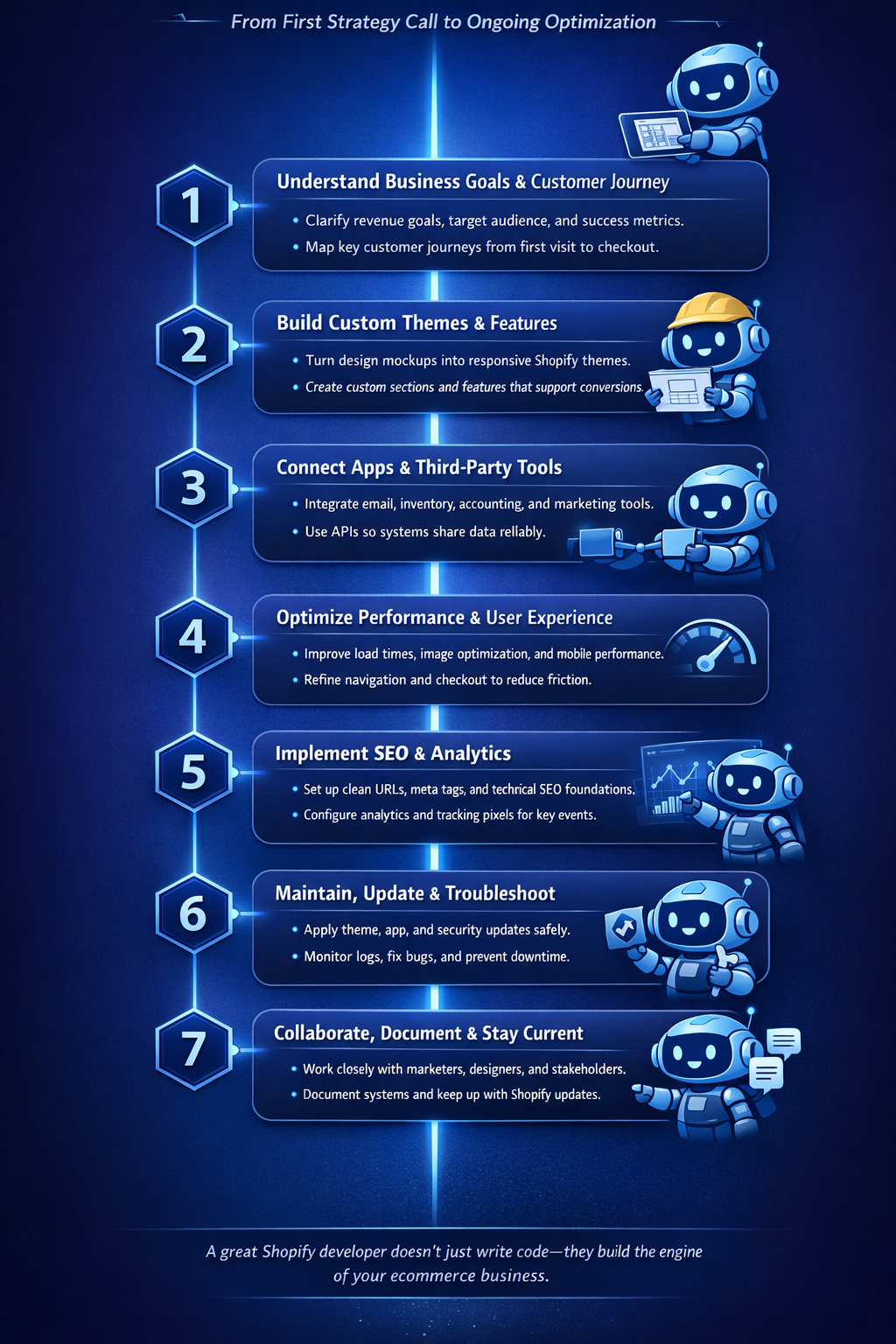
Building Custom Themes and Features
Every business wants their Shopify store to look distinct. That is where custom theme development comes in. A developer takes design mockups and turns them into working websites.
They customize product pages to highlight what matters most. They build checkout experiences that match your brand identity. They create special features that set a store apart from competitors.
This is not about making things pretty. It is about making things work better. A good developer knows that web design decisions affect conversion rates directly.
They focus on creating visually appealing layouts that convert. They use responsive web design principles. This guarantees the site looks good on any device.
Connecting Apps and Third-Party Tools
Most Shopify stores need more than what the core software offers. You might need email marketing tools. You might need inventory management systems.
You might need accounting software that talks to your store. Shopify developers handle these connections. They use APIs to make different systems share data.
They test everything to verify nothing breaks when systems update. This integration work saves you hours of manual data entry. It prevents mistakes that happen when humans copy information between systems.
It makes your business run smoother behind the scenes. Shopify apps are powerful, but they often need configuration. A developer makes them fit your specific needs.
Optimizing Store Performance and Speed
Nobody waits for slow websites anymore. If your store takes more than three seconds to load, you lose sales. Developers optimize images, reduce code bloat, and improve server response times.
They also fix mobile performance issues. More than half of online shopping happens on phones now. If your mobile experience is clunky, you are leaving money on the table.
Performance optimization is ongoing work. As you add products and features, things can slow down. Regular maintenance keeps everything running fast.
Shopify developers focus heavily on these metrics. They know a fast site creates a better shopping experience. This leads to higher revenue.
Technical Skills Every Shopify Developer Needs
You cannot just wake up one day and become a Shopify developer. The role requires specific technical knowledge. Some skills are absolutely required, while others give you an edge.
The core requirement is understanding web development fundamentals. You need to know how websites work at a basic level. You need to understand how code creates what users see on their screens.
From there, platform-specific skills become critical. Shopify has its own quirks and best practices. Knowing these saves time and prevents mistakes.
Whether you are a junior Shopify developer or a veteran, these skills are non-negotiable. They form the foundation of your career. Without them, you cannot build quality stores.
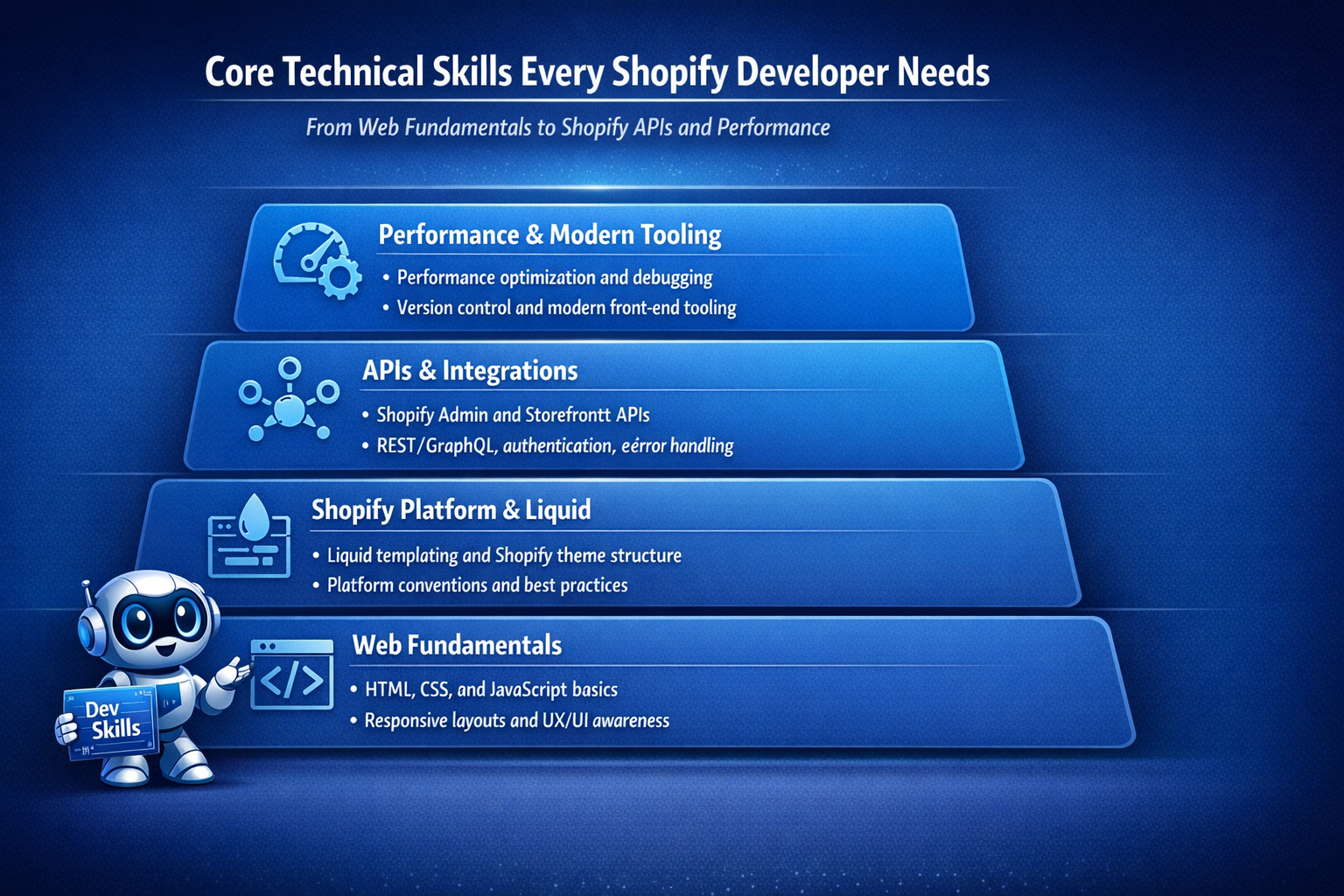
Liquid Templating Language
Liquid is the backbone of the platform. It is how developers add dynamic content to themes. You use it to display product information, customer data, and cart contents.
Learning Liquid is manageable if you know other programming skills. But it has its own syntax and logic. Developers need to understand filters, objects, and tags.
Mastering Liquid means you can customize almost anything in a Shopify theme. You can create complex product displays. You can build custom navigation menus.
You can add conditional content that changes based on user behavior. This skill distinguishes a true developer from a site builder. It allows for deep customization.
Front-End Development Skills
HTML structures your pages. CSS makes them look good. JavaScript adds interactivity.
These three languages form the foundation of front-end development. Shopify developers need strong skills in all three. They build responsive layouts that work on any screen size.
They create animations and transitions that enhance user satisfaction. They handle form validation and dynamic content updates. UX/UI design knowledge is also highly beneficial here.
Modern front-end development also involves frameworks like React or Vue. While not always required, they are becoming more common. Knowing them opens up more complex project opportunities.
Understanding Shopify APIs
APIs let different software systems talk to each other. Shopify has several APIs that developers use constantly. The Admin API lets you manage store data programmatically.
The Storefront API lets you build custom shopping experiences. Working with APIs requires understanding REST or GraphQL. You need to know how to authenticate requests.
You need to handle errors gracefully when things go wrong. API knowledge separates basic developers from senior Shopify developers. It allows for custom app building.
It enables complex integrations. It lets you automate processes that would otherwise require manual work. This is crucial for scaling a business.
Business Responsibilities Beyond Coding
Great developers do more than write clean code. They understand ecommerce strategy. They think about conversion optimization.
They consider the customer journey from first visit to final purchase. This business acumen matters because technical decisions affect sales. Where you place a button can change conversion rates.
How you structure navigation can affect average order value (AOV). Loading speed directly impacts bounce rates. Skilled Shopify developers connect these dots.
They do not just build what you ask for. They suggest improvements you didn't know you needed. They create innovative solutions for business problems.
Conversion Rate Optimization
Every change to your store should increase sales. Developers help with this by implementing conversion best practices. They add trust signals like security badges and customer reviews.
They simplify checkout processes to reduce cart abandonment. They also set up A/B testing to compare different approaches. Maybe one button color works better than another.
Maybe product videos increase conversions. Testing reveals what actually works for your specific audience. This optimization work never really ends.
There is always something to test and improve. The developer who stays focused on results becomes invaluable. They help build a strong e-commerce presence.
SEO and Technical Marketing
Getting traffic to your store matters just as much as converting it. Developers help with search engine optimization by implementing technical best practices. They create clean URL structures.
They add proper meta tags and schema markup. They confirm your site loads fast and works well on mobile. Responsive web principles are vital for SEO rankings.
They also help with tracking and analytics. They set up Google Analytics and Facebook Pixel correctly. They create custom events to track important user actions.
This data helps you understand what is working. Technical SEO is not glamorous work. But it makes a huge difference in organic traffic.
Working With Marketing Teams
Developers do not work in isolation. They collaborate with marketers, designers, and business owners. They need to understand marketing campaigns and support them.
Maybe marketing wants to run a flash sale. The developer builds the landing page and adds countdown timers. Maybe you are launching a new product line.
The developer creates custom product pages that tell the story effectively. Communication skills matter here as much as technical ones. You must explain technical constraints plainly.
A developer who can explain things simply saves everyone time. Effective communication prevents costly misunderstandings. It bridges the gap between tech and business.
Maintenance and Troubleshooting Responsibilities
Building a store is just the beginning. Keeping it running smoothly requires ongoing attention. Things break.
Apps stop working after updates. Customers report bugs that need fixing immediately. Maintenance work is not exciting.
But it is absolutely critical. A store that is down for even an hour loses sales. A broken checkout process can cost you thousands.
Good developers anticipate problems before they happen. They monitor site performance. They keep existing Shopify installations healthy.
Regular Updates and Security Patches
Shopify itself updates regularly. Themes need updates. Apps need updates.
Ignoring these updates creates security vulnerabilities and compatibility issues. Developers handle this update process carefully. They test updates in development environments first.
They make sure nothing breaks before pushing changes to the live store. Version control systems are essential here. They allow developers to track every change.
Security is especially important for e-commerce stores. You are handling customer payment information. You are storing personal data.
One security breach can destroy your reputation. Using version control minimizes risk during updates. It provides a safety net if things go wrong.
Fixing Bugs and Technical Issues
Something will always break eventually. A customer reports that checkout is not working. Products are not displaying correctly on certain devices.
The site crashes under heavy traffic. Developers troubleshoot these issues systematically. They reproduce the problem.
They check error logs. They isolate what is causing the issue and fix it. Speed matters here because every minute of downtime costs money.
The best developers document common issues. This documentation saves time when similar problems come up again. It also helps other team members understand what is happening.
Performance Monitoring and Optimization
Your store's performance changes over time. As you add products, images, and features, things can slow down. Developers monitor key metrics like page load time.
They track time to first byte and largest contentful paint (LCP). When performance degrades, they investigate and fix it. Maybe images need better compression.
Maybe you are loading too many third-party scripts. Maybe your theme code needs refactoring. This ongoing optimization keeps your store competitive.
Fast sites rank better in search results. They convert better. They provide better user experiences.
Collaboration and Communication Skills
Technical skills get you hired. Communication skills determine how successful you will actually be. Developers work with designers, marketers, and owners.
Each group speaks a different language. Translating between technical and non-technical people is a crucial skill. You need to explain why certain things are hard.
You need to push back on bad ideas without damaging relationships. The developers who excel at this become trusted advisors. They are not just order-takers.
They play a pivotal role in the business. They help shape strategic decisions. This makes them more valuable than silent coders.
Understanding Client and Stakeholder Needs
Before writing any code, good developers ask lots of questions. What problem are we actually solving? Who are your customers?
What does success look like? They listen more than they talk. They try to understand the business context behind technical requests.
Sometimes what someone asks for is not actually what they need. This consultative approach leads to better outcomes. It prevents wasted work on features nobody uses.
It helps prioritize what matters most to the business. Developers focus on value, not just code.
Project Management and Timeline Estimation
Developers need realistic estimates for how long work takes. Underestimate and you create stress and missed deadlines. Overestimate and you seem slow.
Good estimation comes from development experience. It also comes from breaking big projects into smaller pieces. You estimate each piece separately.
You then add buffer time for unexpected issues. Project management also means communicating progress regularly. Stakeholders hate surprises.
Regular updates about what is done are vital. Reporting on what is blocked prevents misunderstandings. This keeps the project moving forward.
Documentation and Knowledge Sharing
Code that only one person understands creates business risk. What happens if that person leaves? Good developers document their work.
Others must be able to understand and maintain it. Documentation includes code comments explaining why decisions were made. It includes setup instructions for development environments.
It includes troubleshooting guides for common issues. Knowledge sharing also happens through code reviews. A senior Shopify developer often mentors others.
They guide junior Shopify developers through best practices. Everyone learns from each other's approaches. This lifts the quality of the entire team.
Developer Levels and Expectations
It is helpful to understand the different levels of expertise in this field. Not every developer has the same capability or salary range. Understanding these levels helps with the hiring process.
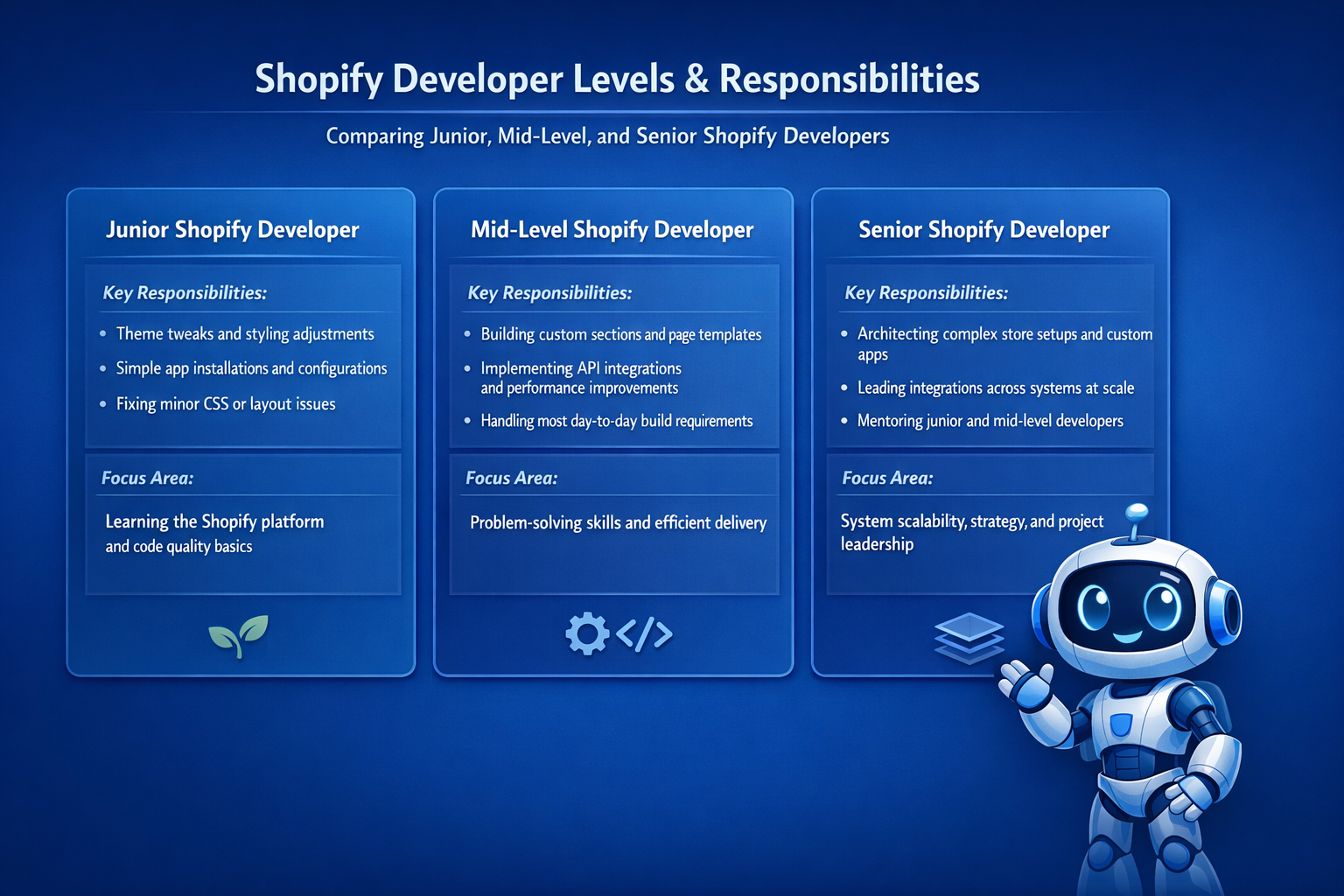
| Level | Key Responsibilities | Focus Area |
| Junior Shopify Developer | Theme tweaks, simple app installations, fixing minor CSS bugs. | Learning the platform and code quality basics. |
| Mid-Level Shopify Developer | Building custom sections, API integrations, performance optimization. | Problem-solving skills and efficient delivery. |
| Senior Shopify Developer | Complex architecture, custom app creation, mentorship, strategy. | System scalability and project management. |
A junior Shopify expert is great for maintenance and small tasks. They are still building their skill development. A mid-level Shopify developer can handle most day-to-day build requirements.
A mid-level Shopify expert bridges the gap between basic coding and architecture. Senior Shopify developers handle the most complex challenges. They design systems that scale.
For a practical template you can use when structuring internal and external ownership, see this breakdown of Shopify roles and responsibilities.
Your budget will often dictate who you hire. A competitive salary is necessary to attract top talent. The Shopify developer salary varies wildly based on location and experience.
Generally, a developer salary correlates with their ability to solve business problems. The more value they bring, the higher the cost.
Staying Current With Shopify Platform Changes
Shopify is not static. The platform releases new features constantly. APIs change.
Best practices evolve. Developers who do not stay updated fall behind quickly. Keeping current requires dedicated time.
You need to read release notes. You need to experiment with new features. You need to participate in developer communities.
This ongoing learning is not optional. It is part of the job. The ecommerce landscape changes fast.
Following Shopify's Developer Updates
Shopify announces major changes through their developer blog and changelog. Reading these regularly keeps you informed. You learn about new APIs and deprecated features.
Understanding these changes early gives you advantages. You can prepare clients for upcoming shifts. You can adopt new features before competitors.
You can avoid building on outdated functionality. Some updates require action on your part. Maybe an API version is being retired.
Maybe security requirements are changing. Staying informed prevents last-minute scrambles. It keeps the Shopify websites you manage secure.
Learning New Tools and Technologies
The web development world moves fast. New frameworks emerge constantly. New tools promise to make development easier.
New best practices replace old ones. Smart developers invest time in continuous learning. They take courses to improve.
They build side projects to experiment with new technologies. They attend conferences and workshops. Not every new thing is worth learning.
But ignoring all of them means falling behind. Highly skilled developers identify which technologies improve their work. They focus their energy there.
Participating in Developer Communities
Other Shopify developers face the same challenges you do. Developer communities provide support and solutions. Forums and Slack groups connect you with peers.
These communities are where you learn tricks. You discover useful apps and tools.
You get help when you are stuck.
Contributing back to these communities builds your reputation. Answering questions helps others while reinforcing your own knowledge. Sharing solutions saves others time.
Specializations Within Shopify Development
Not all developers do exactly the same work. Some specialize in specific areas. These specializations let you go deeper.
Specialists can often command higher rates. Choosing a specialization depends on your interests. It also depends on what the market needs.
Some specializations are more technical. Others are more business-focused. All of them offer opportunities for skilled Shopify developers.
Theme Development Specialists
Some developers focus exclusively on building custom themes. They master CSS and JavaScript. They create pixel-perfect implementations of design files.
They build reusable theme components. Theme specialists understand design systems deeply. They know how to optimize for performance while maintaining style.
They stay current with design trends. They also master accessibility standards. This specialization suits developers who love the visual side.
If you enjoy experience making interfaces come to life, this is for you. It is about creating a beautiful front-end.
App Development Specialists
Other developers focus on building a Shopify app. These apps extend platform functionality. The core product cannot do everything for everyone.
Apps handle complex inventory management. They handle advanced discounting logic. They create custom reporting dashboards.
App development requires deeper backend knowledge. You work with databases and server infrastructure. You think about scalability constantly.
Your app might serve thousands of stores. This suits developers who enjoy complex technical problems. They like building products used by many merchants.
Integration and Automation Specialists
Some developers specialize in connecting Shopify to other systems. They build integrations with ERPs and shipping providers. They connect marketing platforms seamlessly.
They create automation workflows. This eliminates manual work for the merchant. This specialization requires understanding multiple platforms.
You need to think about data synchronization. You must handle error states and edge cases. You deal with situations where systems do not fit together naturally.
Integration specialists are invaluable to larger businesses. These companies have complex tech stacks. The specialist makes control systems talk to each other.
Conclusion
Shopify developer job responsibilities extend far beyond writing code. These professionals build stores and optimize performance. They fix problems and think strategically. Once responsibilities are defined clearly, you can start thinking bigger about how Shopify projects transform ecommerce strategy when the right people own the right work.
Whether you are looking for a developer job description template or looking to get hired, remember the scope. The role requires a proactive approach to technology and business.
From junior Shopify developers to senior Shopify experts, the goal is the same.
They build engines for commerce. They create the success stories of tomorrow.
Understanding the full description template of duties helps everyone. It helps merchants hire the right people. It helps developers build better careers. Ready to speak with an expert Shopify Consultant.
Need a Shopify Developer?
Next in the Shopify Technical Build, UX & Store Infrastructure Series:
About Us
As a certified Shopify Partner with deep, hands-on ecommerce experience, we help companies turn strategy into predictable, measurable revenue growth. When you’re ready to move from planning to execution, this guide walks through proven Shopify marketing and promotion strategies to increase sales.
We are also a HubSpot Certified Inbound Marketing Agency and HubSpot Certified Sales Agency , uniting proven demand generation with disciplined, structured sales execution. As an official Google Partner, our Google Ads management ensures your paid acquisition is tightly aligned with ROI and profitability targets.
From large, complex SAP environments to small and mid-sized businesses across industries—including legal practices, public figures and celebrities, consumer packaged goods, apparel and fashion brands, and manufacturing—we bring enterprise-grade rigor, data-driven precision, and accountable execution to every engagement.
