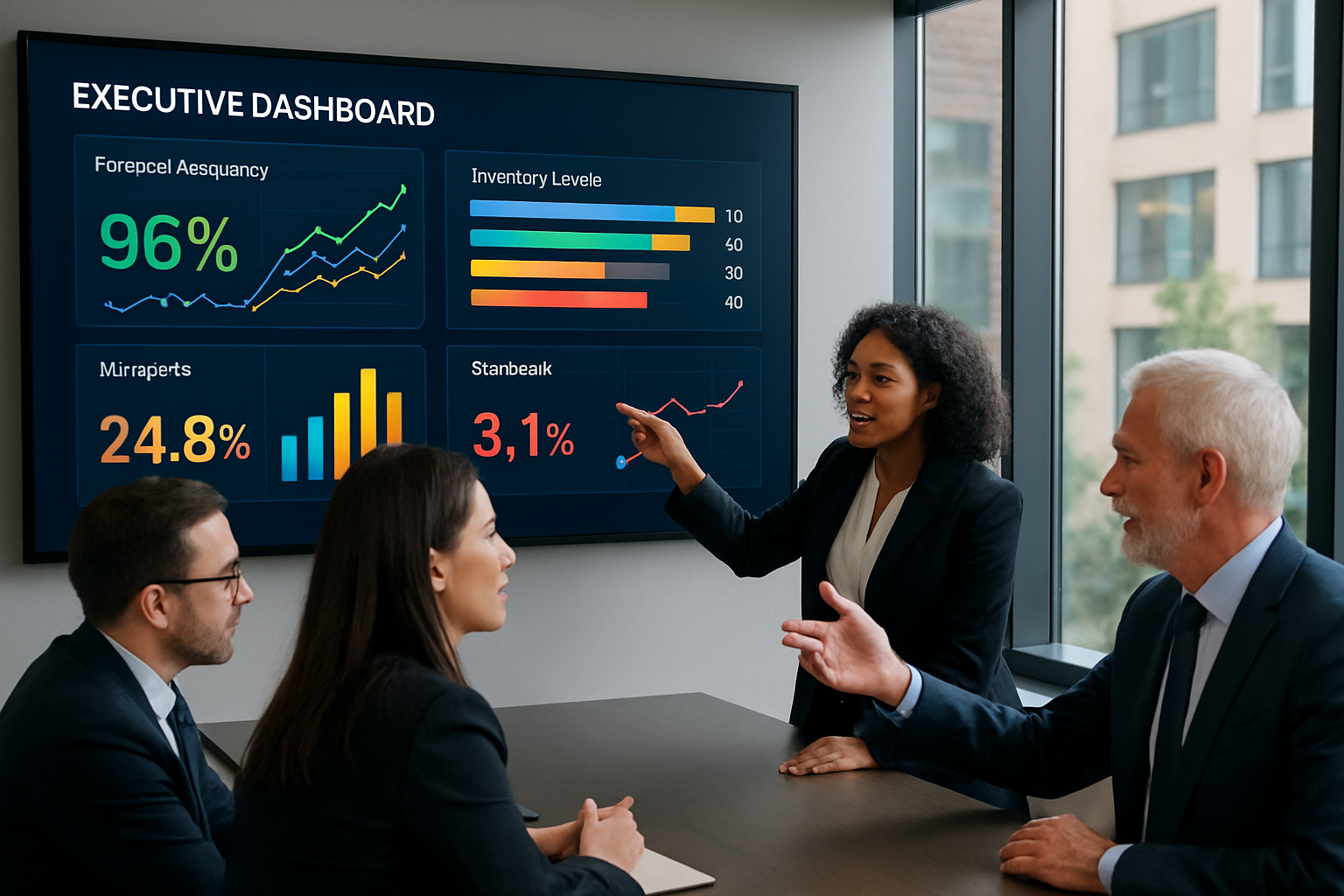
High-maturity organizations look strong from the outside. Tight processes, solid systems, smart people, and stable growth define them. You recognize the picture because you likely live it every day.

Here is the part most leaders do not say out loud. Even high-maturity organizations can start to slip without noticing. Performance drifts a little each quarter while margins thin.
Stockouts creep up and people work harder to get the same result. No clear smoking gun exists. It is just a slow slide.
This is the story of a large, very capable retail company that looked great on paper. They possessed a strong SAP backbone and advanced reporting. They held a culture that valued discipline.
Yet one hidden flaw had been quietly draining margin for almost ten years before a new decision system finally exposed it. If you want to see where your own decision capability stands right now, take a Decision Intelligence Maturity Assessment.
You should run this on your SAP landscape and executive reporting. Most leaders are surprised by the gap between how mature they feel and how their systems actually perform.
If you’d like to see where your organization currently stands, take the Decision Intelligence Maturity Assessment.

The Myth Of "We Are Already Mature"
If your company runs SAP, has BI teams, and reviews KPIs every month, it is easy to feel done. You feel the box is checked. You believe the maturity level is reached.
The problem is that technology and markets do not stay still. Your customers shift behavior while your network changes. Innovations like generative ai enter your planning stack.
Risks like security threats start to shape your ai roadmap, especially once your analytics maturity rises. Research on organizational maturity shows that the highest level is defined by ongoing improvement.
It is about rapid response to change, not by hitting some final score on a chart. That idea shows up clearly in work on organizational maturity models originating from places like carnegie mellon. It is also evident in digital maturity models for technology-heavy firms.
Concepts pioneered at the software engineering institute often highlight that true optimization requires constant adaptation. Yet many senior teams quietly carry three big misconceptions:
- Having SAP means the core process design is finished.
- Having dashboards means everyone sees the truth clearly.
- Having data means your decisions rest on solid ground.
The real story is different. Mature organizations drift because their decisions keep changing. However, the systems underneath them sit frozen in old logic.
You update ai strategy, pricing, promotion, and channel mix. Meanwhile, your planning parameters and core assumptions stay stuck in the past. This is where decision intelligence enters the picture.
Think of it as the operating system that sits across SAP, your data warehouse, your ai solutions, and your executive dashboards. It pulls together how decisions are made. It tracks what data feeds them and how fast feedback loops close.
The Case Study: A Strong Retailer With A Quiet Forecasting Problem
The company at the center of this story was a large regional grocery chain. They operated around a thousand stores with multiple banners. They spanned several countries.
They were mature in almost every way a consulting slide would praise. They had invested heavily in SAP for finance, logistics, inventory, and procurement. The BI stack looked strong and reports landed in inboxes daily.
Performance reviews followed a clear cadence. On paper, they belonged on every list of high-maturity organizations in retail. But trouble had started to bubble up at the edges.
Forecast accuracy was slowly declining, quarter after quarter. Stockouts were growing in key categories that mattered for basket size and customer loyalty. Margins were coming under pressure as well.
The company carried extra safety stock in some regions, but still missed demand in others. Transportation costs rose as emergency replenishment orders grew more common. No one was ignoring the numbers.
Category managers pushed hard while project management teams stayed engaged. SAP teams monitored jobs and interfaces. Yet nobody could point to one clear cause.
Every explanation felt partial. Promotions, weather, or competitive actions were blamed. They were all part of the picture, but not the root.
This is what drift looks like from the inside. There is lots of effort and plenty of intelligence in the room. Yet there is still no stable fix.
The Executive Dashboard Initiative
Our role started with a very specific ask from the CEO and CIO. They wanted a single executive decision system sitting on top of SAP. The leadership team wanted to finally see the full end-to-end story in one place.
We were asked to design and build a suite of integrated dashboards focused on a few core areas. These included same-store sales, gross margin, inventory turns, forecast accuracy, and stockouts. We also looked at logistics cost, supplier performance, and DC throughput.
The idea was simple but powerful. We wanted to give senior leaders a live view across planning, purchasing, replenishment, and sales. This was better than a sea of disjointed reports.
On the surface, this looked like another dashboard program. Underneath, it was a decision intelligence project. We had to connect the right SAP modules.
We needed to understand how the MRP logic drove purchasing. We had to map the forecasting settings. We had to design KPIs that reflected how money was made and lost in their network.
That meant tracing how data flowed from stores to SAP, through the forecasting engine, into MRP, then out to POs. A lot like the thinking behind the CMMI style maturity work described in the CMMI High Maturity Lead Appraiser application, the goal was clear.
Connect real process behavior, real data, and real decisions.
How Dashboards Revealed What Static Reports Missed
Once the first cut of the executive dashboards went live, the CEO finally had something they had never truly seen. Forecast, planned stock, actual stock, and sales sat side by side. We drilled down by store cluster and product group.
That is where the story got interesting. One forecasted stock dashboard showed a pattern that felt off the moment we saw it. Several important product categories showed recurring stockouts in the forecast.
This happened even when sales history was stable and predictable. The demand data itself was clean. Sales lines looked like what you would expect from staple grocery products.
There was noise from promotions and seasonality, but nothing out of the ordinary. Yet the projected coverage dipped again and again without clear business logic behind it. This is the point where decision dashboards shift from being pretty pictures to real diagnostic tools.
We linked forecast signals, MRP outcomes, supplier behavior, and on-shelf availability into a single view. The team could finally stop blaming random factors. The dashboards pushed us to ask sharper questions.

Why is the forecast this low for items that sell steadily? Which MRP type sits under these SKUs? When did we last touch these parameters?
Are lead times and minimum order quantities actually aligned with current reality?
Because the data model sat tightly on SAP, we could jump from anomalies to configuration detail quickly. That closed the loop between executive curiosity and system truth.
The Root Cause: A Decision System Frozen In Time
Once we stepped into the SAP MRP setup for those product groups, the story clicked. A large share of items were running under strategy parameters that had not changed in nearly ten years. The original configuration dated back to an earlier phase of the company.
They had a different network design back then. There were fewer stores and longer lead times. There was less automation with suppliers.
It was a different set of planning constraints entirely. Over the decade that followed, leadership made many smart moves. They expanded and invested in better logistics.
They pushed suppliers to tighten performance and started using richer data. They moved forward. Their MRP settings did not.
The result was almost invisible from the top. Forecasts that looked mathematically fine sat inside old rules. Those rules forced planners and buyers into ordering patterns that did not match current demand.
Over time, a gap grew between how the business actually worked and how the system believed it still worked. That gap showed up as stockouts in some places and excess in others. It created messy fire drills across the network.
The advantage we had came from living in both worlds. We knew how SAP MRP strategy types behaved. We approached the project from a decision intelligence angle.
We treated the dashboards as a way to surface drift in the decision stack. What you see here mirrors what many AI and analytics teams run into at higher maturity. Studies on AI projects with longer life cycles show that drift often happens quietly.
Trust becomes the deciding factor for whether leaders stay committed. Analysts like Birgi Tamersoy have talked about how trust shapes advanced AI efforts inside mature organizations. Even the most dedicated AI leaders face these hurdles.
The Fix: Retuning MRP And Building A Continuous Early Warning System
Once we confirmed the problem, the fix came in a few key waves. First, we reviewed and retuned MRP strategy settings for the most important product groups. That included shifting planning types and changing lot sizing.
We updated lead times. We brought minimum order quantities in line with the new logistics performance. Second, we realigned forecasting logic to current business patterns.
We used fresh horizon choices and smarter grouping of stores. We implemented cleaner handling of promotions and new item introductions. Third, we did the master data cleanup that every SAP veteran expects.
We fixed supplier lead times, rounding values, and purchasing info records. It was not glamorous work. However, it was needed if the decision engine was going to produce solid plans again.
Last, we wired these changes back into the executive dashboard suite as specific early warning views. We made sure leadership could see forecast error and stockout risk. We visualized service level patterns by category and MRP setting.
Within a few planning cycles, results started to show up:
- Forecast accuracy rose sharply in the categories where MRP had been frozen.
- Stockouts dropped, which took pressure off stores and the call center.
- Excess stock shrank because orders now matched actual demand behavior.
- Margins began to recover because the company sold what shoppers wanted.
The dashboards that had first exposed the drift now served a new role. They became the continuous improvement dashboard set for planning and replenishment. Executives could see early if forecast error started to creep back up.
This shift echoed something many experts say about advanced maturity work. Progress at the higher levels is less about single projects and more about habits. Thought leaders and researchers, from communities such as the APQC Global Thought Leadership Institute described on the APQC GTLI Learn more page, often emphasize that continuous learning loops sit at the top of mature performance.
What This Story Shows About High-Maturity Organizations
There are a few blunt truths that fall out of this case. First, high maturity in structure does not protect you from silent decay in practice. The more established your systems are, the easier it is for outdated logic to sit unchallenged.
Second, static reports are a poor way to catch drift. They describe slices of the past.
They do not connect decisions, parameters, and outcomes into one line of sight.
Third, you need a way to combine your maturity work on process, skills, and technology.
Some firms do this through formal models like those supported by ISACA and the CMMI Institute. Others focus more on digital maturity across tools.
This is often discussed by analysts in articles on digitally mature organizations and digital maturity. What we have found is that decision intelligence ties these strands together. It forces you to ask a simple set of questions:
- What decision-making processes drive the outcomes we care most about?
- What data, parameters, and systems actually shape those decisions?
- How fast do we see the impact of a wrong assumption?
- Who has the power and habit to correct drift when it appears?
Companies that build this muscle get something rare. They establish an operating rhythm where KPIs do not just signal pain. They point clearly to where the drift began.
| Feature | Low-Maturity Approach | High-Maturity Approach |
|---|---|---|
| Knowledge Management | Siloed data and tribal knowledge. | Centralized, accessible, and continuously updated. |
| Process Improvement | Reactive fixes after failures. | Proactive tuning based on organization's capabilities. |
| Leveraging AI | Sporadic experiments with no clear strategy. | Strategic integration where solutions fundamentally drives adoption. |
| Assessment | Gut feeling or basic checks. | Rigorous survey based models and structured framework reviews. |
How High-Maturity Organizations Stay Ahead Of Change

How do you stay ahead rather than slipping into ten-year-old blind spots you never planned for? You must evolve beyond just maintaining status quo. High-maturity organizations now focus on fostering AI innovation and designing AI architecture that scales.
There are a handful of practical moves any senior team can push through in the next planning year. These steps will help you move towards high ai maturity.
1. Run Regular Decision System Health Checks
Do not wait for a crisis. Build an annual review of your forecasting and planning parameters into your governance calendar. Treat it like you treat budget and audit cycles.
Include business, IT, and data leaders in that review. Make them walk the chain from strategy to dashboard to SAP configuration together. Treat it as a form of decision maturity review.
This is similar in spirit to what you see in skill maturity models for advanced workforces. You can see these ideas discussed in the Skill Liquidity Maturity Model work referenced by Squirrel North.
2. Use Dashboards As An Early Warning System
If your dashboards exist only to show last month's performance, you are wasting half their power. Tie them tightly to your decision pipelines instead. Set up focused views that highlight drift.
Look for forecast bias by product family. Check service level versus MRP type. Compare lead time changes versus historical norms.
3. Adopt A Structured Framework For AI
Moving from traditional process maturity to ai maturity requires intent. Leading firms have appointed dedicated ai leaders to oversee this transition. You need a structured framework to measure progress.
Consider using a seven-question survey or a standard maturity assessment to benchmark where you stand. When gartner assessed various firms, they found that high-maturity organizations scored significantly better on value generation. Conversely, low-maturity organizations averaged poor results in scaling projects.
A simple seven-question survey based on core capabilities can reveal gaps. It helps in assessing your organization's ai maturity level quickly.
4. Build Security And Trust Into Advanced Analytics
As AI becomes woven into planning, your decision stack carries new risks. Gartner ai research shows security threats are a top adoption barrier. You must focus on building trust within your teams.
If business units trust the data, adoption accelerates. If they doubt the ai infrastructure, they will ignore the insights. Maturity means building governance into AI-based forecasting.
You need clear ways to report and fix data or model problems. This helps increase consistency across the board.
5. Tie Growth Ambitions To Concrete Maturity Moves
Leaders often talk in big ten-year visions. But it is easy for those visions to drift away from the daily system reality. Voices like Giles Johnston from Fraction ERP remind executives to anchor long-term targets in specific moves.
If your revenue target jumps by 30 percent, spell out what that means for SAP forecasting capacity. Define your infrastructure capabilities needed to support that growth. Set explicit maturity goals for each layer.
6. Appoint Dedicated AI Leaders
Success requires ownership. You should have dedicated ai personnel who are responsible for delivering ai infrastructure. These appointed dedicated ai roles bridge the gap between technical teams and business strategy.
A director analyst or similar role can ensure solutions fundamentally drives business value. They are key to building ai organizations that last. They focus on fostering ai talent and retention.
7. Treat Decision Intelligence As An Ongoing Discipline
Finally, see decision intelligence less as a single transformation. View it as an ongoing operating principle. High-performing companies that keep growing their maturity usually do this instinctively.
They are highlighted by groups such as APQC's GTLI Top 100. They build rhythms, rituals, and incentives that reward catching drift early. They accept that parameters grow stale.
They know markets change and assumptions break. Instead of treating that as failure, they treat it as work.
Conclusion
The grocery chain you read about here is not unusual. It sits in the same category as many high-maturity organizations you might admire. They had strong history and deep investment in SAP.
They had smart people and real discipline. What nearly cost them years of margin was not lack of effort. It was a quiet belief that once mature, always mature.
Their systems told a different story. A decade-old MRP setup sat buried under layers of success. It was slowly pulling them off track.
Decision intelligence brought that story into the open. It lined up data, dashboards, and SAP logic into one view. That gave leaders the power to fix the problem.
It allowed them to keep watch for the next drift. You might suspect your own decision stack is carrying old assumptions inside new dashboards. If so, this is the right moment to run a focused maturity assessment.
Get a clear view of your organization's ai and process status. Do this before hidden drag turns into visible damage.
If you’re ready to strengthen your organization’s decision-making capability, start by taking the Decision Intelligence Maturity Assessment. It reveals your current level of decision intelligence and highlights the fastest opportunities to improve clarity, alignment, and performance across the leadership team.
Take the assessment now and discover your path to higher executive performance.
We are team of top-level SAP consultants, focused on helping you get the most value from your SAP investment. Whether you need a single SAP SD consultant or an entire team of SAP experts, we can provide them. Please our book a meeting service to get started.